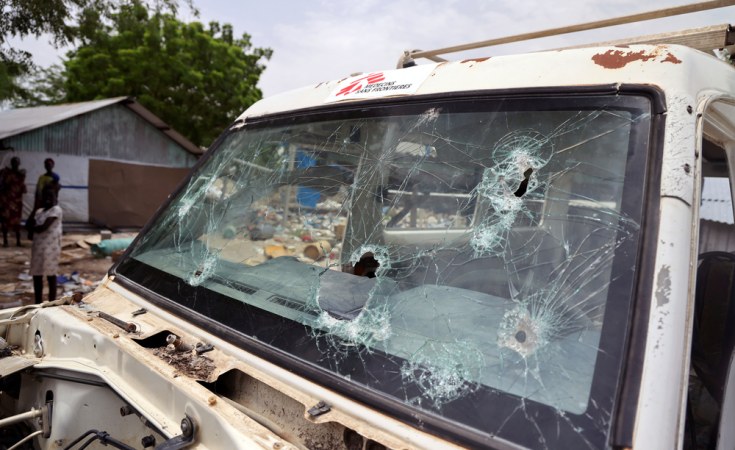
Geneva — RSF targets major Sudanese cities with drone attacks
The Rapid Support Forces (RSF) - the paramilitary group battling the Sudanese army for control of the country - has used drones to target major cities across Sudan including Khartoum (the capital) and El Obeid, where the group has been attempting a full-scale invasion. Several people were killed as Sudanese army bases, a mosque, and electricity infrastructure were all hit. The attacks were some of the largest and most coordinated from the RSF in several months, and were likely designed to send a message after a string of military setbacks. Last month, the UAE-backed group lost control over a highway connecting El Obeid to Khartoum, and they have also suffered defeats in Blue Nile and West Darfur states. In a sign of possible desperation, RSF leader Mohamed Hamdan Dagalo has renewed threats to retake Khartoum, which his forces brutally occupied earlier in the war. But SAF officials claiming they can win the war by the end of the year are surely overconfident too. They have made many similar claims before, only for the pendulum to swing back against them.
MSF sounds alarm over Somalia's drought emergency
Keep up with the latest headlines on WhatsApp | LinkedIn
Exhausted by four failed rainy seasons, more than half a million rural Somalis have left their homes this year looking for help. Over 85% of those displaced are women and children. The sprawling settlements on the outskirts of Baidoa, in the southwest, are one destination. Médecins Sans Frontières (MSF) has found that every second child screened in these camps was malnourished. And yet donors have provided only 30% of the cash needed to support Somalia's $852 million humanitarian response plan. Across the country, 6.5 million people are facing acute hunger, nearly double last year's figure. Two million of those are in an "emergency" category, their assets and livelihoods whittled away by drought. Among the hardest hit is the Burhakaba district in southern Bay region, where earlier this year there was a "credible risk of famine". MSF is ringing the alarm that donors need to find money urgently for preventative action as Somalia's woes multiply. A severe El Niño is expected from October-to-December, triggering floods and yet more destruction and displacement.
As the Board of Peace falters, a dangerous governance gap forms in Gaza
Israeli Prime Minister Benjamin Netanyahu has now publicly rejected a US-backed plan for the future of Gaza that he had previously thrown cold water on. The rejection only intensifies a shroud of uncertainty hanging around a series of moves taken by the Board of Peace since the middle of July aimed at signalling some sort of progress on the implementation of last October's long-stalled ceasefire agreement. With no clarity on a path forward, a dangerous governance gap on the ground is being filled by Israeli-backed militias, criminal groups, and family clans while also leaving Palestinians in Gaza in an administrative limbo. Meanwhile, Israel is carrying out a large-scale operation to crush rubble and clear it from the nearly 70% of the enclave directly under its control. The NGO Euro-Med Human Rights Monitor raised concerns about the rubble containing bodies of Palestinians killed in Israel's military campaign and evidence of war and atrocity crimes. To find out more about how public health data can support accountability for alleged Israeli war crimes, check out our Weekend read below.
As atrocities in Myanmar intensify, investigative capacity shrinks
War crimes and crimes against humanity are escalating in frequency and intensity in Myanmar, according to the eighth and latest annual report from the UN's Independent Investigative Mechanism for Myanmar (IIMM). The mechanism has identified military units and command structures linked to airstrikes on civilians, and is probing killings of detainees, torture, sexual violence, and "double-tap" attacks targeting rescuers. In Rakhine State, investigators are examining alleged crimes by both the military and the Arakan Army, including attacks on schools and hospitals, obstruction of aid, forced displacement, rape, executions, and the destruction of Rohingya mosques and neighbourhoods. The IIMM has collected more than 28 million items of evidence and shared thousands with the International Court of Justice, the International Criminal Court, and several national jurisdictions. However, severe UN funding cuts have shrunk the mechanism's investigative capacity to protect witnesses, process open-source evidence, and investigate sexual violence and crimes against children. For more on the impact of funding cuts on the IIMM's work, read this piece.
Aid access severely constrained in two thirds of crises
Humanitarian access is severely constrained in two thirds of the crises assessed in the latest Global Humanitarian Access Overview by ACAPS. Of 66 countries reviewed, 44 face high, very high, or extreme barriers to aid, with 13 - including Sudan, Myanmar, Afghanistan, Palestine, Ukraine, and South Sudan - rated at the worst level. In addition to insecurity, governments and armed groups are increasingly restricting movement, deregistering NGOs, detaining aid workers, imposing checkpoints and informal taxes, and obstructing people from reaching services. Access deteriorated in 26 countries between December 2025 and May 2026, including Iran, Lebanon, Colombia, Niger, Mozambique, Uganda, and the Philippines. Rather than retreat, humanitarians have responded to constraints by negotiating passage with whoever controls territory, making aid slower, less predictable, and uneven.
New Colombian president criticised for restricting international quake response
As Colombians continued racing to find survivors of the powerful earthquake that struck the country on 10 August, President Abelardo de la Espriella's decision to limit the entry of foreign rescue teams sparked controversy. As of 14 August, at least 281 people had been reported dead, nearly 4,000 injured, and 379 missing. Despite receiving multiple offers of assistance, De la Espriella - a far-right lawyer, businessman, and Trump ally who had taken office just three days before the earthquake - initially said Colombia did not need foreign personnel. Instead, he requested that international humanitarian aid be limited to supplies and funding. Some attributed the decision to the tense political transition and the lack of a formal handover from his predecessor, while others pointed to ideological motives. On 12 August, authorities eventually allowed foreign rescue teams to enter, but only teams from the United States, Israel, El Salvador, and Ecuador, arguing that these were the only countries whose teams met "international search-and-rescue standards". Colombia will also receive an estimated $1.3 billion in humanitarian aid from 12 countries. For more on how escalating conflict is making aid work in Colombia more challenging, read our report here.
Get the Cheat Sheet straight to your inbox
Email Address In case you missed it
AFGHANISTAN: At least 161 Afghan women and children have died preventable deaths linked to US aid cuts, according to Refugees International, directly challenging Secretary of State Marco Rubio's claim that "no one has died because of USAID cuts". The cuts have shuttered health and nutrition facilities, eliminated jobs for female health workers, and reduced access to maternal and emergency care, particularly in rural areas. For more on how the crisis is compounded by restrictions on women and US financial measures, including the freezing of billions of dollars of Central Bank reserves, read our analysis marking five years of Taliban rule.
CAMBODIA: New high-resolution satellite imagery shows Thai forces razed at least 627 homes and other structures in three Cambodian villages along the disputed border after a December 2025 ceasefire, according to Cambodian rights group LICADHO. Destroying civilian property in occupied territory may violate international law, the group has said, while urging Thailand to halt further demolitions and Cambodia to ensure adequate housing for displaced villagers.
CUBA: A group of independent UN human rights experts condemned new US sanctions imposed on the island, calling the measures "an attempt to force change on a sovereign state through threats and coercion". The US began an oil blockade in January, pushing the country into a catastrophic humanitarian crisis, and has since further expanded its sanctions. On 23 July, Washington announced new measures targeting energy companies and further restricting fuel imports, including for humanitarian purposes.
DEMOCRATIC REPUBLIC OF THE CONGO: The Ebola outbreak has reached another grim milestone - it has killed more than 2,000 people - and it is now on track to be the deadliest on record. With the current response not working, health workers are now planning to go door to door to identify cases in an effort to contain it. Meanwhile, new research has found the strain is genetically distinct from previous Bundibugyo Ebola viruses, suggesting a new animal-to-human transmission vector.
EUROPE: Europe is sweltering through its fifth heatwave of the year, facing extreme risk of new wildfires and fears of thousands more excess deaths. Britain's weather service said this summer is "increasingly likely" to be its warmest on record, while France is enduring one of its longest spells of extreme temperatures ever recorded.
HAITI: The UN's political and peacebuilding mission in Haiti (BINUH) warned of a resurgence of armed violence in La Plaine du Cul-de-Sac and Cité Soleil, where 613 people, including 77 children, were killed between 6 March and 31 July. More than a third of those killed were not affiliated with gangs. A further 176 women and girls were raped. Gang violence is also spiking in other parts of the country, raising fears that insecurity could once again disrupt planned elections.
KENYA: The government is planning to import one million tonnes of maize as part of "urgent policy actions" in response to drought-related crop failures. Kenya is also seeking support from the World Bank to help address the effects of the climate crisis. Erratic weather has compounded the pressures facing farmers across Africa, who are already struggling with fuel and fertiliser shortages linked to the war in the Gulf.
LEBANON: Lebanese firefighters, residents, and environmental groups have accused the Israeli military of deliberately lighting wildfires across the areas of southern Lebanon it occupies, with some labelling it "ecocide". Since June, 30-40% of the land in areas close to the front line has been burnt by Israeli drones, flares, and munitions, with firefighters reportedly attacked as they attempted to respond.
PALESTINE: Israeli settlers, backed by the Israeli military, have been laying siege to Palestinian families and taking over homes in the village of Qusra in the illegally occupied West Bank. Amid an intense, state-backed campaign of violence and ethnic cleansing, the siege drew a rare rebuke from US ambassador to Israel Mike Huckabee - a Christian Zionist and ardent supporter of Israel - who referred to the settlers as terrorists.
SOMALIA/ETHIOPIA: Addis Ababa has reportedly asked the African Union to accelerate the withdrawal of its peacekeeping troops serving in Somalia, representing a security challenge for both Mogadishu and the AU's financially troubled mission. Ethiopian forces have already handed control of a base in the Bay region - in an area controlled by al-Shabab insurgents - to the Somali army, and further withdrawals are reportedly planned. But there is concern over the readiness of the Somali military to assume responsibility.
SPAIN/MOROCCO: Morocco has been increasing security at the borders of Melilla and Ceuta amid online calls for another mass movement of people on 15 August towards Spain's North African exclaves. An online rumour campaign led over 70,000 people to cross the border into Ceuta between 30 and 31 July, often by swimming. As many as 141 people are estimated to have died. Several thousand people remain in Ceuta, including over 1,000 unaccompanied children.
SYRIA: A Syrian court on 11 August sentenced former president Bashar al-Assad to death in absentia for killings, torture, arbitrary detention, and crimes against humanity - his first conviction by a local court since he fled to Russia in 2024. His brother Maher and six other former officials also received death sentences, while former Daraa security chief Atef Najib was convicted in person. People across Syria celebrated the decisions, but some have raised concerns that the death sentence would make al-Assad's extradition to Syria unlikely.

Sign up for free AllAfrica Newsletters
Get the latest in African news delivered straight to your inbox
UNITED STATES: Four US rights groups, including Human Rights Watch and the Open Society Institute, have sued the Trump administration over a February 2025 Executive Order sanctioning the International Criminal Court. The order has been used to sanction ICC prosecutors and judges, the UN Special Rapporteur on occupied Palestine, and three Palestinian organisations. The US groups argue it also criminalises their legitimate work. A similar Trump order in 2020 was blocked by a judge and rescinded the following year by President Joe Biden.
YEMEN: Yemen is closer to all-out war than at any other point since 2022, UN Special Envoy Hans Grundberg told the Security Council on 13 August. A Houthi attack on a cargo ship in the Bab el-Mandeb strait on 11 August killed six people, while fresh clashes erupted in Taiz the following day. The Houthis said a drone strike on Saudi Arabia's Jazan oil refinery on 13 August was a response to Saudi violations of Yemeni airspace.
Weekend read
How public health research supports accountability for Israeli war crimes in Gaza
During previous Israeli attacks, 30-41% of those killed were women and children. Between 7 October and 24 November 2023, that figure was 67%.
And finally...
WFP sticks with Palantir despite data security warnings
The World Food Programme has renewed its five-year contract with the controversial US data analytics firm Palantir despite "key privacy concerns" raised in a 2025 internal audit obtained by PassBlue and FRANCE 24. WFP said Palantir supports its "data-informed decision-making" and tackles data-integration challenges. Under a partnership dating back to 2019, Palantir developed DOTS, a system WFP uses to track aid and manage supply-chain data. Scrutiny over the relationship has intensified since a 14 May cyber-attack against a separate WFP system exposed sensitive data belonging to 600,000 Gaza households, alongside existing concerns over Palantir's military and surveillance work. On 30 June, the UN's special rapporteur on the right to food, Sofía Monsalve Suárez, publicly questioned the undisclosed terms of WFP's agreements with Palantir and warned of conflicts of interest involving companies serving both civilian and military clients. The leaked 2025 audit warned that WFP "lacks a unified and trusted system" for managing its data and has "no clearly defined exit strategy for DOTS", while "reputational considerations surrounding the partnership [with Palantir] have led to institutional uncertainty". WFP sources told PassBlue and FRANCE 24 there is an "unspoken rule not to communicate on Palantir".
