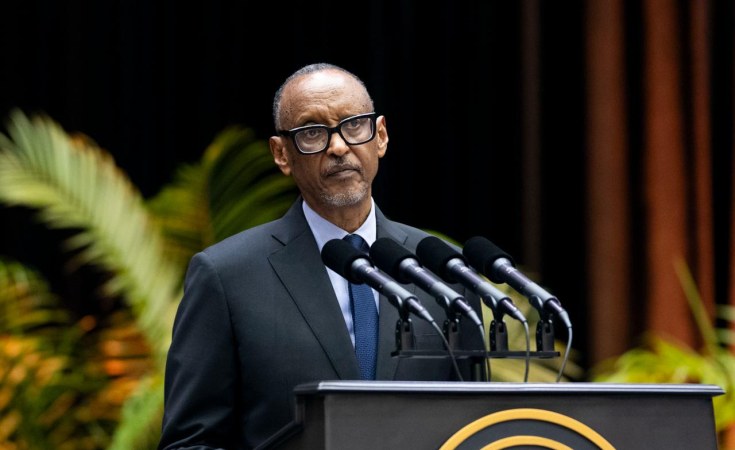
President Paul Kagame has criticised sanctions imposed on Rwanda over the conflict in eastern DR Congo, saying the measures have added to existing problems without addressing the root causes of the crisis.
ALSO READ: Govt backs RDF defensive posture amidst 'one-sided' sanctions by US
At a press conference on Monday, August 24, Kagame said international pressure on Rwanda had done little to resolve the conflict, arguing that sanctions focus on punishment rather than the issues that have sustained instability in eastern DR Congo.
The United States imposed sanctions on the Rwanda Defence Force (RDF) and four senior commanders on March 2, accusing the army of providing operational support to AFC/M23 and violating commitments under the Washington Accords signed by Rwanda and DR Congo in December 2025.
Follow us on WhatsApp | LinkedIn for the latest headlines
Rwanda rejected the measures as one-sided, arguing that they targeted one party to the peace process while failing to hold the Congolese government accountable for its commitments under the accords.
Kagame said the sanctions had only compounded the existing problems.
"Sanctions, yes, they really create problems. They do. But that is all. There are problems added to the problems that were originally there. That's all. It's not anything to do with trying to address the problem."
He questioned the logic of sanctioning Rwanda and AFC/M23 while failing to address the role of the FDLR and the persecution of Congolese Tutsi communities in eastern DR Congo, which Rwanda says are among the factors driving the conflict.
"Especially if you look at the manner in which they are applied. Instead of sanctioning FDLR or those who work with them or support them, they sanction those who fight them. I mean, I don't understand the logic."
ALSO READ: Kagame criticises use of sanctions, urges Africa cooperation
Kagame said attempts to explain the crisis mainly through Rwanda's involvement overlook other actors, including the Congolese government, neighbouring countries and the international community.
"There are many parties to this problem. One is Congo. The other is the international community that has really messed up this whole thing from the beginning as we know it. There is Rwanda. There are other countries in our region."
He said failing to consider how each actor has contributed to the crisis had allowed the conflict to persist.
"Nobody addresses the root cause of this problem. I haven't heard of any effort so far that focuses and tries to address the root cause."
ALSO READ: Nduhungirehe: Rwanda 'disappointed by biased US mediation' in DR Congo crisis
Kagame also rejected what he described as attempts to portray Rwanda as the main cause of the crisis in eastern DR Congo, arguing that the conflict involves Congolese communities as well as political and security actors within DR Congo.
He said the conflict that escalated in 2022 did not originate in Rwanda and questioned why Rwanda continued to be treated as the central issue.
"Even the origin of this conflict, as we know it, which started in, is it 2022? ... How did it start? Actually, this conflict was started by Congo itself."
Kagame said Rwanda had instead continued to focus on the security threat posed by the FDLR and had repeatedly raised the issue as part of efforts to protect its national security.
He said Rwanda would continue taking measures it considers necessary to protect itself while also working with other countries towards peace.
"We will do what is right to protect ourselves, and we will do it without fear, favour, day or night, any time."
"Rwanda, we want peace to the point that we are ready to fight for it."
UN experts' framing of crisis questioned
Kagame also criticised the narratives presented by the UN Group of Experts on DR Congo, saying they often frame the origins of the crisis too narrowly and fail to adequately consider its deeper historical context.
He questioned whether the composition and approach of the group allowed it to properly examine the roots of a conflict with a much longer history.
"The composition has a connection with the history of this problem for probably centuries. So these are the people who are supposed to be understanding the root causes of things we have to deal with. And they frame it like the root causes are just recent."
Kagame said the group appeared to settle on a particular narrative and then discount information that did not fit it.
"They refer to their people who have already framed a narrative that people must believe. Not to address the problem, but to address it the way they want."
He said Rwanda had provided information and access to former FDLR combatants who could offer first-hand accounts of the conflict, but that such evidence was often disregarded.
"It's not one, it's not two, it's like hundreds of testimonies. But they still come back to what they want. Everything will be rubbished, put aside, and they bring you back to what they want you to follow."

Sign up for free AllAfrica Newsletters
Get the latest in African news delivered straight to your inbox
The criticism comes as implementation of the Washington Accords remains central to efforts to find a political settlement.
The accords, signed by Presidents Paul Kagame and Félix Tshisekedi on December 4, 2025, were intended to provide a framework for ending the conflict. They followed the Washington Peace Agreement signed by the two countries' foreign ministers on June 27, 2025.
Rwanda has maintained that implementation must be reciprocal, with Kinshasa addressing its commitments while Kigali undertakes its own obligations.
Kagame said Rwanda would nevertheless remain engaged in efforts to find a solution.
"We remain the course and keep contributing to what can find a solution. Help us find a solution."
For Rwanda, he said, the immediate priority was to remain secure while continuing to push for peace.
"If this problem of FDLR is not resolved, of course Rwanda will always remain involved as part of this problem. There are no two ways about it."
"We have been trying to team up with other countries in bringing peace in different parts of our continent. And that simply underlines how much we want peace. Rwanda, we want peace to the point that we are ready to fight for it."
