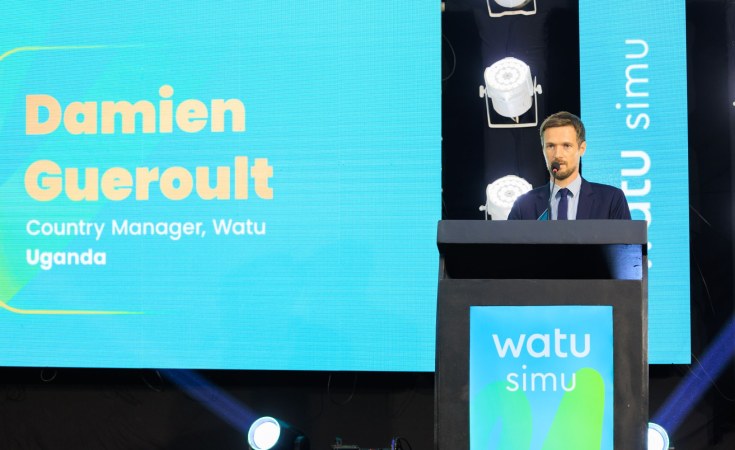
Watu Kenya Country Manager Damien Gueroult says serving customers outside traditional banking starts with understanding how they earn, what they use financing for and what it takes to lend sustainably.
When Damien Gueroult talks about boda boda riders, he describes them first as entrepreneurs.
"Our clients are effectively entrepreneurs. It's not a consumption loan," says Gueroult, Watu Kenya's Country Manager. "When you speak to a boda client, it's very clear: this is their tool of trade, this is how they generate income."
This distinction shapes how he thinks about asset finance more broadly. Many of Watu's customers earn daily rather than receiving a fixed salary at the end of each month. Their income can shift depending on demand, weather and how much they are able to work. Many are also accessing formal credit for the first time.
"You can't expect clients in the informal sector to behave like clients in the traditional banking sector," Gueroult says. "Income is erratic, most don't have medical insurance, and many earn daily. Our practices have to reflect that."
Gueroult took over Watu's Kenya business this year after previously leading its operations in Uganda. Across both markets, he says one of the most important lessons has been to start with how the customer actually earns and uses the asset, rather than expecting them to fit a financing model designed around a salaried borrower.
That affects repayment structures and customer support. It also changes how the asset itself is understood.
Smartphones are one area where Gueroult says his own thinking shifted.
"I may see it that way because I've personally used smartphones for the last 20 years, so I've forgotten what it's like to move from no smartphone to having one," he says. "But about 80 per cent of our clients in East Africa are people moving from a button phone to a smartphone, and for them too, it's a tool of trade. It makes them more productive and opens up career opportunities."
Watu has sought to understand those outcomes through research it commissions from GeoPoll across its East African markets. Close to a third of surveyed customers said access to a financed smartphone helped them secure work, while around half reported improved productivity in work they already had. Close to 80 per cent reported stronger connection to family or improved quality of life, and 44 per cent cited new access to savings products.
The research supports something Gueroult says is easy to overlook from the perspective of someone who has used a smartphone for years. The distinction between a consumer product and a productive asset can look very different for someone moving from a basic phone to their first smartphone.
For many customers, however, the challenge starts even earlier. They may have little or no formal borrowing history.
"Most of our customers have never been banked and have no credit score, so what would we do — tell them we can't lend to them?" Gueroult says. "No. We see our role as being the first ones to lend to these clients."
Watu verifies a customer's identity and personal information rather than relying solely on a conventional credit score that many first-time borrowers lack. From there, the financing relationship begins to create a record of actual repayment behaviour.
That does not mean treating access and risk as separate issues. Gueroult is clear that the ability to continue serving customers depends on getting both right.
Watu's own experience has shaped that view. Several years ago, while the business was still largely focused on motorcycle financing, the company expanded quickly into a market already approaching saturation shortly before the COVID-19 pandemic.
"That taught us that we'd scaled too far relative to the risk we were carrying at the time," Gueroult says.
The lesson, he says, was not that lenders should retreat to serving only customers who already fit traditional measures of creditworthiness. It was that access has to be backed by strong operations and a clear understanding of risk.
"You could build a fantastic, low-risk portfolio by lending only to a small pool of very creditworthy people, but then you won't achieve scale, and you may struggle to attract investors."
That balance becomes more important as asset finance grows. Capital matters, but so do the systems around the financing: how customers are supported, how repayment behaviour is understood and how the lender responds as market conditions change.
It is also relevant as Kenya develops its first framework for asset-backed lending. Gueroult sees clear customer protections as an important part of the sector's development, while noting that the market includes many people who earn informally and may be accessing formal finance for the first time.
His approach to electric motorcycles follows much the same logic.
Watu finances electric motorcycles in Kenya, where Gueroult says the economics have become increasingly competitive with petrol alternatives. But he does not expect environmental arguments alone to determine whether riders make the switch.
"We wouldn't pursue it if the economics didn't work," he says. "For the riders themselves, it's not that they don't care about the environment, but if switching to an EV didn't make economic sense, most wouldn't do it."
For a rider whose motorcycle is a source of daily income, running costs matter. If an electric motorcycle reduces those costs sufficiently, the case for switching becomes much more practical.
The same principle can be seen in customers whose financed assets have continued to create value over time.
Elly "Kidole" Kegode, from Kibera in Nairobi, started with a Watu-financed motorcycle in 2016. Today, he operates a fleet of six and runs a mobile riding school. Two of the motorcycles transport schoolchildren, two serve commuters and two are used to train young riders in road safety and discipline.
"Mobility gave me freedom and stability," Kegode says. "Now I mentor others to achieve the same."
Gueroult is still relatively new to the Kenya role and is careful not to draw sweeping conclusions about a market he is continuing to learn. His career has taken him across Asia and Africa, including work in solar financing and microinsurance before Watu, and he says each market has required a close look at how people actually live, work and make financial decisions.
In Kenya, that has reinforced a relatively straightforward idea: financing works better when it begins with the economic reality of the person using it.
For a customer earning daily, that means understanding daily income. For someone borrowing formally for the first time, it means recognising that a credit history has to begin somewhere. And for a rider considering an electric motorcycle, it means making sure the economics work before expecting adoption to follow.
The products may change. Gueroult's starting point does not: understand how the customer earns, then design from there.

