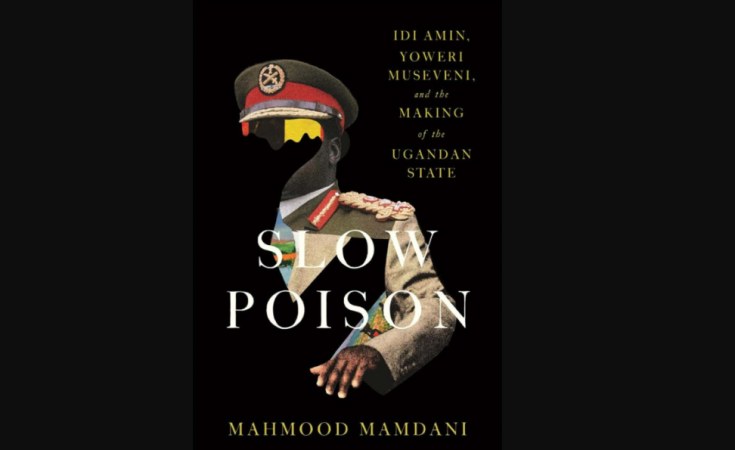
Slow Poison: Idi Amin, Yoweri Museveni, and the Making of the Ugandan State
By Mahmood Mamdani
Review by Uma Dhupelia-Mesthrie
Wits University Press, 2025, 338 pp., R380
The two protagonists of this book are Idi Amin, president of Uganda between 1971 and 1979, and Yoweri Museveni, the president from 1986 until now. Drawing on rich official and unofficial archival sources, including an unpublished biography of Amin by his son Jaffar, Mamdani provides a background to their lives before assuming the presidency, with insights into their personalities. The main focus though is on their terms as presidents and their legacy.
Mamdani’s assessment of Amin unsettles dominant public images of Amin, which became well established through a 1981 film, The Rise and Fall of Idi Amin, and which continued in the western media well into the 21st century. While he concedes that violence was a key part of Amin’s life and strategy to win power, he debunks the image of Amin as a cannibal, a man who kept severed heads of people in his fridge, who sacrificed his son and who was a monster equal to Hitler. All these were untrue and were just part of an anti-Amin propaganda campaign. Mamdani describes Amin as a “master of theatre” (p. 117) who deliberately embraced comedic performance for its shock value. While he may have come into power with Israeli and British support, once in office, he freed himself from their control. The reader is even drawn into admiring Amin for his mocking of the British government and its royal family.
Follow us on WhatsApp | LinkedIn for the latest headlines
Mamdani sees substance in Amin’s rule. For instance, his land tenure reform ensured all land was public land and provided protection for those who worked the soil. He responded to criticisms of excesses under his rule by appointing “one of the first truth commissions in the world” (p. 104). The commission investigated cases of disappeared people under his presidency. The public hearings, like that of the South African truth commission two decades later, gave ordinary Ugandans the opportunity to highlight the extent of abuse of power. Most importantly, Amin turned colonial legacy, which nurtured and fixed divisive tribal identities, on its head. He instead “shaped Uganda as a Black nation” (pp. 117-118). Mamdani reflects on Amin’s hero status in Uganda: “I have lost count of the number of times I have seen a poster on the back of a matatu (public taxi) in Kampala, with photos of Malcolm X, Muhammad Ali, Bob Marley, and Idi Amin, and no caption, because none seemed necessary” (p. 118).
At least three chapters are devoted to the expulsion of Asians in 1972.¹ We are given insight into why indigenous Africans in Uganda supported this. Many of these reasons are common to other countries in Africa with an Asian presence. Amin had personal experience of the “bad Asian” (p. 19) in his youth when he worked on a sugar plantation owned by one of the wealthiest Indian families. The dominant perception of Asians was that they were corrupt, exploited indigenous Africans, gave little back to the country, and did not embrace social integration. Their expulsion was central to Amin’s Africanisation project.
Yet other countries did not take such drastic action. White colonial and apartheid governments in South Africa, for example, offered repatriation or assisted emigration schemes from the late 19th century to the 1970s. These came with free passages to India with bonuses on surrender of domicile rights. In this way, South Africa got rid of at least 73,000 Indians with India’s co-operation between 1902 and 1940, when the scheme was most active (Dhupelia-Mesthrie, 2020). Except for noises made by the Economic Freedom Fighters, the ANC-led government in South Africa, while embracing black empowerment, has never contemplated the removal of its Indian population. Their contribution to the liberation struggle and their long-established South African identity precludes such a thought. Uganda, in contrast, denied Asians the right to Ugandan nationality.
A significant part of Mamdani’s discussion links Asian expulsions to the two expulsions that preceded it, after Amin fell out with the Israelis and the British soon after coming to power. The expulsion of Asians was also meant to embarrass and inconvenience Britain by leaving it the responsibility of resettling British Asians. Mamdani provides fascinating detail on how the Ugandan cabinet worked out procedures for the expulsion, the disposal of property and businesses, and the bureaucratic paperwork. Reading about the workings of the Departed Asians Property Custodian Board brings to mind the Group Areas Development Board in South Africa which, under the Group Areas Act, took control of the sale and acquisition of property of those who were disqualified from living in white group areas.
Mamdani and his family were among the expelled. While he provides very emotional details of his parents’ experience, Mamdani the academic dominates the discussion, and he makes some controversial conclusions. He concedes that the expulsion was “one big, well-organised theft” (p. 97) and that elites benefitted from the sale and expropriation of Asian property. At the same time, he is critical of prevalent narratives of Asian “victimhood” (despite them having to leave with just £50 and unable to take most of their personal possessions). While he argues that “there was no one Asian experience,” and that the greatest consequence of expulsion was a loss of “belonging” and the acquisition of a new status as “strangers” (pp. 94-95), his account, however, favours what he regards as a majority experience. Most Ugandan Asians, he argues, “experienced the expulsion as some kind of purgatory” (p. 94) from Ugandan conditions where access to economic opportunities had shrivelled. As evidence, we are given examples of how some families told him that life in Britain was better.
[Photo caption: Mahmood Mamdani, at a reading of Slow Poison: Idi Amin, Yoweri Museveni, and the Making of the Ugandan State. Photo: Instagram]
We are dependent on one individual’s account that Amin’s photograph was displayed alongside those of gods in the prayer rooms of several Asian homes in Britain. As for the fate of the wealthy Indian, we are provided with an example from a fictional narrative. The evidence we are given is slight and anecdotal. What is wrong with the expelled choosing to see themselves as victims? Most experienced oral historians would engage with why stories are narrated in a particular way rather than trying to prove them to be false or true. In this regard, it would have been appropriate for Mamdani to have engaged with the project led by Dolar Vasani to mark the 50th anniversary of the expulsion. This resulted in 24 podcasts of oral narratives and memoirs, providing accounts of their lives in Uganda, personal experiences of expulsion, life in transit camps, resettlement and racism in the new countries, which are also counterbalanced by stories of success post-expulsion.
Mamdani’s discussion is linked to his overall objective of rehabilitating Amin. He argues Amin was no Hitler and dismisses stories of robbery and rape. He argues that unlike, for example, in Rwanda in 1994 when Tutsis were killed en masse, Asians in Uganda were not killed.
Museveni fares very poorly in this book, deservedly so. The comparison with Amin leaves Amin in an even better light. Museveni the president bore no resemblance to the young man with vision that Mamdani had known. The governing principle of his presidency was how to build and retain power. Vision and desire for change and politics underpinned by morals and ethics were sacrificed. Museveni embraced tribalisation and ethnic divisions and “fragmented the nation” (p. 271). Museveni became a “Washington Poster Boy” (p. 272) with neo-liberalism and the International Monetary Fund determining what kind of changes could be made. Uganda became central to the American “War on Terror” (p. 253) on African soil. The most damning indictment of Museveni is revealed in the extent of corruption which the president sanctioned himself. The financial health of the nation was undermined by the prevalence of “ghost culture,” “ghost institutions,” “ghost soldiers,” and “ghost workers” (p. 248). There are echoes of independent South Africa in the Ugandan state’s purchase of poor quality, deficient arms and helicopters accompanied by significant embezzlement.
While many scholars of African history may focus on the story of the two presidents and the failed post-independence state, what makes this book particularly memorable is how the author’s memoir is woven into an academic study of power. While his grandparents may have come from India, Mamdani’s parents were African born. Although Kampala was home, the family also spent time in Dar es Salaam. Mamdani, however, was born in 1946 in Bombay, during the family’s brief sojourn there. In a strong expression of his African identity, Mamdani laments: “From the time I became politically conscious, I remember feeling resentful about being born in India. Why could I, too, not be born in Uganda, at least in East Africa, like everyone I knew” (p. 24). He lived in an exclusively Asian neighbourhood with a segregated school and social life. It was his years in America as a teenager and young adult that were the most transformative. First enrolling in engineering, he later switched to political science, and subjects such as history, economics, and philosophy opened new horizons for him. He became an activist and participated in several of the African-American civil rights movement campaigns and at Harvard he was drawn into the anti-Vietnam war movement.
He returned to Uganda in 1972, the very month that Idi Amin announced his intention to expel all Asians. Thus began a period of exile where he was employed at the University of Dar es Salaam. It is there that he joined and associated with political groupings that opposed Amin’s presidency. Once Amin was overthrown, Mamdani returned to Uganda and began a long association with Makerere University. In chapter 10 and more particularly chapter 11, Mamdani reflects on his teaching and research vision, which encompassed transformation of curricula and the nurturing of new African researchers free of dependency on external partners. To this end he was founding director of the Centre for Basic Research and, later in 2010, the Makerere Institute of Social Research. In a previous book, Scholars in the Market Place: the Dilemmas of Neo-Liberal Reform at Makerere University, 1989-2005 (Codesria, 2007), and in chapter 11, Mamdani repeats discussions on the deleterious effects of market-driven education and the influence of the World Bank.

Sign up for free AllAfrica Newsletters
Get the latest in African news delivered straight to your inbox
In the very last paragraph of the book, Mamdani asks the questions “What lessons can we draw for intellectuals and academics on the margins of corridors of powers? What does it mean to be in conversation with those who are or will be in power and at the same time, keep a ‘safe distance’? Can one engage with power without being corrupted by it?” (p. 278). These are questions he faced in his relationship with Yoweri Museveni, whom he got to know fairly well in exile and after his return to Uganda. While Museveni was building up his military power in opposition to the presidency of Milton Obote, Mamdani chose “above ground” (p. 146) engagement. He and others strove to improve society through literacy programmes and by providing access to health facilities in rural areas. He declined an offer to join Museveni’s cabinet as a minister with responsibility for monitoring government institutions. This refusal came out of an understanding of power and how it works and the limits of individual influence. Later, he joined a commission on local government and made recommendations that were not to the president’s liking. It was “in the realm of practice” (p. 286) we are told we can find answers to his questions.
This is a book of quality which is expected of a giant scholar of Africa. It represents a sad story of a failed post-independence state, and all these failings cannot be blamed entirely on the colonial legacy. There is local culpability.
References
Dhupelia-Mesthrie, U. (2020). South Africa to India: Narratives of a Century of Repatriation (1871-1975). Matatu, 52(1), pp. 70-100.
Vasani, D. (2022). Uganda Remembers: ‘If We Don’t Tell Our Stories Someone Else Will’. Daily Maverick, 10 January. https://www.dailymaverick.co.za/article/2022-01-10-uganda-remembers-if-we-dont-tell-our-stories-someone-else-will/
Endnote
¹ The exact number of Asians expelled varies from 40,000 to 80,000. Mamdani estimates 25,000 were Asians with British passports and 15,000 of the Asians who were expelled were Ugandan citizens (p. 92).
Uma Dhupelia-Mesthrie is an Emeritus Professor and previously Senior Professor in the Department of Historical Studies at the University of the Western Cape.
This work is licensed under a Creative Commons Attribution 4.0 International license. (New Agenda, Issue 102)
