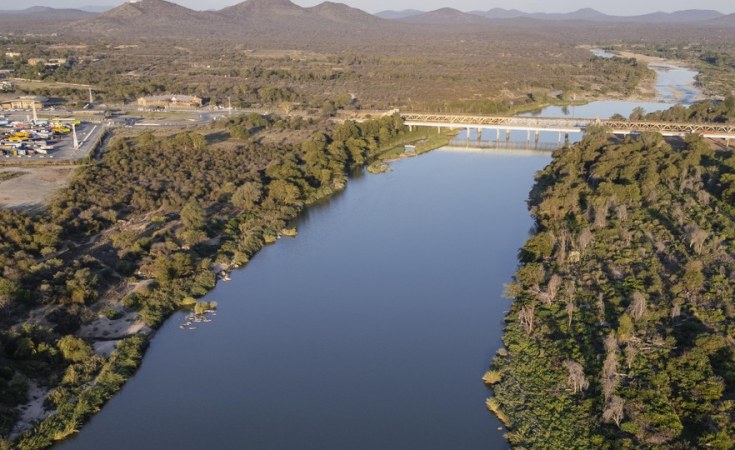
Trucks, elephants, donkeys and humans cross the Limpopo River freely
Whatever you want to buy, there's a good chance you'll find it in Musina, Limpopo. The town centre is abuzz from early in the morning with travellers, traders and smugglers. The myriad shops selling electronics, clothes, furniture, washing machines, fridges, toys, toiletries, cigarettes, and alcohol are doing a roaring trade.
Much of it is going across the Beitbridge border, 10km away on a good road, the last stretch of the N1. The bakkies going north are overloaded with goods, marked with the names of the people in Zimbabwe who've ordered them.
Keep up with the latest headlines on WhatsApp | LinkedIn
At the border some vehicles will cross through the official border checkpoint. But many won't. Instead they'll take a little detour and drive along the dirt road, either west in the direction of Mapungubwe, or east towards where the Sand and Limpopo rivers meet.
We drove west. A few hundred metres along the road, two soldiers, next to their tent, had made a tiny roadblock out of stones. They stopped us. We had a long friendly conversation. The woman was from Potchefstroom and the man from Soweto. Their shift started in April and finishes in November. They told us they frequently turn around Zimbabweans crossing the border. The soldiers used to detain them, but they were just released to cross the border again the same day. So now the soldiers just turn them around and send them back.
We drove on, fully laden trucks passing us in one direction, empty trucks in the other. Not far from the soldiers' roadblock, we found a large hole in the barbed wire fence that runs along the border, with a makeshift road leading down a few hundred metres, to the Limpopo River.
Here goods will be offloaded onto a raft or a boat, or even a human or a donkey if the water level is low enough, and taken across the Limpopo River to Zimbabwe. Our drone showed us a raft and a line going across the river, and activity on the other side.
A man was sitting at another break in the fence. While we were there a few people walked past him across the fence towards the river. He told us he was employed by the game farm he was sitting next to, to prevent poaching. He didn't mind people going past him to cross the border so long as they didn't poach. He told us people pass here carrying all sorts of things, from groceries to blankets, beds and refrigerators, to be sold in Zimbabwe. As we were chatting, one man passed us carrying three 10kg bags of potatoes.
Many of the breaks in the fence are made by humans but some have been made by elephants wandering between the two countries.
One evening as we were driving from Beitbridge to Musina, there was a commotion at a bridge over dense bush just at the entrance to the town. Elephants had been spotted. One person said three. Another six. Several young men energetically tried to find the animals in the thick bush.
We asked one of them what they would do if they found an elephant. Kill it for the meat, was the excited reply.
The next day a traffic official, Ernest Makatu, showed us a video of people chopping up a dead elephant several months ago for its meat. It tastes good, he said.
Makatu wants to end corruption in Musina and South Africa. He is with the Build a Better South Africa political party and in 2029 he intends to stand for president of the country.
Zander Coetzer, who handles security for game farms in the area owned by Hermanus Schoeman, drove us east along the border showing us which breaks in the fence are made by elephants and which by humans, though they are probably used by both species. There are also many donkeys crossing the river, apparently without owners, grazing on both sides. Coetzer told us donkeys are useful for helping to pull stolen cars that sometimes get stuck in the river.
Every day thousands of people cross the border - legally and illegally. Some cross the breaks in the border into South Africa in the morning to work in Musina or on a farm, and return in the evening. This has been going on for decades.
A Zimbabwean man told us he used to often cross the border illegally before getting a work permit.
He said in 2003 he had seen six women drown in the flooded Limpopo at Chivara. "I have crossed that river countless times, got arrested, released, got stripped naked by criminals, but I kept coming to South Africa," he told us. "Crossing a flooded Limpopo River is no joke because the bed shifts when walking on it. Don't worry about crocodiles because they're not found everywhere."
But employment is probably not the main reason people come and go across the border: trade is. There's a huge network of people involved in moving goods from South Africa to Zimbabwe: carriers, people managing the rafts and boats, drivers - all getting a cut of the goods bought in Musina.
Why don't the buyers go through the official border? Because import duties are exorbitant on the Zimbabwean side. Determining what the duties are is hard. This webpage gives an example in which the tax on $610 worth of goods comes to $203. The percentages are laid out in a 1,162-page tariff handbook published by the Zimbabwean government. (Did you know if you import a live whale into Zimbabwe, there's a 10% duty? See page 20.)
In practice the duties appear to be negotiable. "I bought a solar pump for R8,000 in South Africa and was supposed to pay R2,500 at the border officially but negotiated it to R500 which I gave the customs officer. No receipt," one man told us.
So it's often cheaper to pay the various people involved in smuggling goods across the border, including bribing soldiers, than to go through customs.
A woman in Musina connected to cross-border trade explained to us that some shops in the town open as early as 5am. One truck delivering goods to cross the border can make five, or even more, trips a day. "Each load can earn them more than R1,000. There is a good market for chicken, usually braai packs, because it is expensive in Zimbabwe," she said. "All the trucks you see here are headed to the trading point. At the river they use small boats to ferry the loads across. If the water level is low they walk across or use donkeys."
"There are many entrances through the bushes. The one you visited is called Maroyi," she said. "When you leave here you pay a driver's fee for transport, and you also pay the boys you find hiding in the bushes R50 to look out for soldiers."
A smuggler near the border told us: "I carry the goods on my head across the river." He said he generally charges R150 per package. Crossing to the other side takes him 30 minutes. He said he carries all kinds of goods, legal and illegal. He has a Zimbabwean passport. He said he and others do this because they are unemployed and need to make a living.
In Musina we spoke to shopkeepers selling clothes and shoes. Business is not as good as it once was because there are lots of soldier roadblocks on the road to Harare where people have to pay "fees", one told us. So people have switched to other borders, including Zambia. Goods are still cheaper in South Africa, he said, but the cost of paying off soldiers along the way is pushing the cost of importing across Beitbridge too high.
Before meeting him, we were told Hennie Erwee is the lawyer you want if you're ever in trouble. He's a big guy with a big personality. We met him at his office in Musina. He has successfully litigated for Schoeman against the government for infringing his property rights. Now he's running a case, with Schoeman as his client, to get the national government to fix the border.

Sign up for free AllAfrica Newsletters
Get the latest in African news delivered straight to your inbox
Schoeman has had to close his game farm along the border in part because of the uncontrolled animal traffic. "As soon as it's dry, donkeys and cows cross into the farm. If I put out lucerne for my game, the next day there's a hundred donkeys there," he said.
He pointed out that people taking goods to Zimbabwe through the breaks in the border are not breaking South African law; we don't need to worry about that. But the animal traffic is a problem, he explained. "Cattle moving freely across the border, on a daily basis, cross into my farm, mix with local cattle. A big percentage have foot-and-mouth disease."
He is sceptical that South Africa can get the foot-and-mouth disease epidemic under control while this carries on.
The state spends billions of rands protecting the border in a system that is far too bureaucratic. Three years ago the Border Management Authority (BMA) came into existence to co-ordinate the response. But it has already had a troubling audit and serious problems with corruption. And it is clearly failing to control the Beitbridge corridor.
There's a long history of the fence along the Zimbabwean border being built and rebuilt, at large expense and to no avail. Schoeman told us that his security protected the current barbed wire fence while it was put up. But as soon as the fence was built and handed over to the government, his services were no longer used, and holes immediately started appearing.
But if the government did get its act together and managed the Beitbridge border, there would be a different problem. The thriving Musina economy has developed over decades in response to the porous border. Tens of thousands of people probably depend on things being just the way they are to make a living. If every small town in South Africa was as bustling as Musina, our economy would be doing well.
Suddenly fixing the border might just destroy the town's economy.
