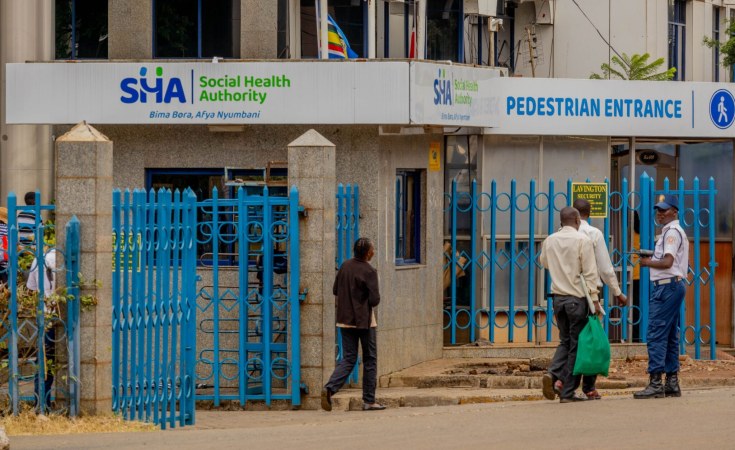
Millions more Kenyans are now protected from the cost of falling ill, Kenyan president William Ruto said in his 2026 state of the nation address.
"Today, 33.7 million Kenyans are registered with the Social Health Authority, compared with approximately eight million registered under NHIF in 2022," Ruto told a joint sitting of parliament on 18 November.
"That is 25.7 million Kenyans, more, brought into the national health financing system," Ruto said.
He presented that growth as evidence that families were increasingly protected from medical bills that could otherwise force them to borrow, sell assets or abandon treatment.
Keep up with the latest headlines on WhatsApp | LinkedIn
He gave the example of a mother of three and small-scale farmer who underwent a kidney transplant and who was paying KSh840 to SHA a month. In turn, the pooled health financing scheme had paid in full a bill of KSh966,000 excluding dialysis. "Is that not a beautiful thing?" he posed.
Is registration the same as active health cover? This guide took a closer look at what the 33.7 million figure says about who can access care, who is paying for it and what the various terms and numbers mean.
The Social Health Authority manages Kenya's new public health financing system. It replaced the National Hospital Insurance Fund, or NHIF, in October 2024 as part of the government's push towards universal health coverage.
Universal health coverage, or UHC, means that people can get the health services they need without being pushed into financial hardship by the cost.
Kenya's new SHA system has three main funds.
The Social Health Insurance Fund (SHIF) is the contributory fund. It receives payments from households and other contributors, as well as government funding for people who cannot afford to pay.
The Primary Healthcare Fund pays for specified basic care mainly at lower-level facilities such as dispensaries and health centres.
The Emergency, Chronic and Critical Illness Fund covers emergency treatment and the management of chronic illnesses once a person's SHIF cover has been exhausted.
Because the three funds cover different types of care, the rules for accessing them also differ.
Ruto's comparison has two early problems. First, official records do not support the figure of eight million NHIF registrations in 2022." The available data put NHIF membership at about 15.5 million principal members and 14.5 million dependants as of June 2022. In addition, the two schemes do not count people in exactly the same way, as we will explain.
Second, being registered with SHA is not the same as making contributions or having active insurance cover.
But government officials have used the terms interchangeably:
- On 10 September 2026, health cabinet secretary Aden Duale told a visiting World Bank delegation that "32.6 million people, equivalent to 68% of the population" had been "onboarded" onto SHA.
- President Ruto only days later said more than 33 million people were "now covered" by SHA. This, he said, had brought the goal of Universal Health Coverage in Kenya by 2030 within reach.
- On 20 September interior principal secretary Raymond Omollo reportedly described "more than 33 million Kenyans" as "registered" with SHA.
At the time of writing, SHA had not published an administrative breakdown. State House spokesperson Hussein Mohamed only told Africa Check the numbers came from a "realtime dashboard with limited access".
"It is fed from the ground as registrations happen countrywide at homes and hospitals. It is real time at the dashboard maintained by DHA (Digital Health Agency) on behalf of SHA," he said.
Every Kenyan is required to register as a member of SHIF. Children are to be registered at birth. Non-residents can also be registered.
Government officials sometimes refer to this collection of a person's details so that they can access services as being "onboarded", although the term is not defined in the Social Health Insurance Act.
Registration therefore shows how many people are entered in the SHA system. But it does not tell whether contributions for that person or household are current.
It also does not say if a registered person is a contributor or a dependant covered through somebody else. SHA's report for the period to 31 March 2026 recorded 30.13 million registered beneficiaries. It also said 16.81 million were principal members, with 12.6 million being from the informal sector and 4.2 million from the formal sector.
It also says active contributors number 4.78 million.
In other words, the registration figure contains several different groups.
For salaried households, their employers deduct their contributions from their pay. The rate is 2.75% of gross pay, with a minimum monthly contribution of KSh300 (about US$2.3 at current rates).
Households without salaried income are assessed differently. SHA uses a means test, which is a questionnaire designed to estimate household income and what premium the household can afford.
The assessment, which is answered at registration, looks at factors such as housing, access to basic services and household composition. The resulting estimate is used to calculate a contribution of 2.75% of household income, again subject to the KSh300 monthly minimum.
Households assessed as unable to afford their contributions can have these paid by the national or county government or by other sponsors.
This is important in Kenya because most employment is informal. In 2025, there were 21.6 million people in recorded employment, excluding small-scale agriculture and pastoralist activities. About 18.1 million of them, or 83.8%, were in the informal sector, according to the 2026 economic survey.
For many households, contributions cannot simply be deducted from a monthly salary and keeping them up to date can become complicated.
No. A registered person may have access to some services but not necessarily the full range paid through SHIF. The Social Health Insurance Act says that access to SHIF services is tied to contributions being "up to date and active".
People who fall behind can face penalties. In a July 2026 notice, SHA said unpaid contributions attract a 2% monthly penalty and that arrears and penalties must be cleared before a member can use SHIF-funded services again.
People paying in instalments under SHA's "Lipa Pole Pole" arrangement must first pay the equivalent of four months of their annual contribution before their cover is activated.
In other words, someone may be registered and still not have access to all SHIF-funded services. But this does not mean an unpaid member has no access to healthcare at all, as the various services are paid for through the three different funds.
Primary healthcare is funded separately from SHIF. The Primary Healthcare Fund pays for basic care at dispensaries and health centres, generally level 2 and 3 facilities. The regulations say that every person resident in Kenya is entitled to primary health care services. In August 2026, SHA said that more than 10 million people had used free services at these levels.
The Emergency, Chronic and Critical Illness Fund pays for emergency treatment. The Act defines this as the immediate care needed to prevent death or stop a medical situation getting worse.
The Social Health Insurance Regulations give every person the right to emergency treatment, and they list stabilising the patient as part of it.
The official tariffs say emergency stabilisation and an ambulance to the nearest emergency centre are available regardless of registration or contribution status.
But this cover is limited. It applies for up to 24 hours, after which SHIF takes over for members whose contributions are active.
Most hospital care, including many admissions, is paid for through SHIF.
But even when emergency care is covered, SHA pays hospitals a fixed amount. The media has reported that if a hospital charges above the KSh95,200 (about $730) set for treating a stroke, for example, then the patient pays the difference.
That means being registered but not paid up does not leave someone completely without care. But it can limit the services available once treatment moves beyond primary or emergency care.
The president's broad figures are the latest from the government.
The most recent detailed administrative figures publicly available put the paying number far below the total registered. SHA's impact report recorded about 4.78 million active contributors at the end of March 2026, and 30.13 million registered beneficiaries.
But this does not mean only about one in seven people had cover. A contributor can also cover dependants. SHA's annual report for the 2024/25 financial year, for example, recorded 24.7 million registrations at the end of June 2025, including more than 8.4 million dependants.
Under the law, a beneficiary can include the contributor, their spouse, children under 21, full-time students under 25 and some dependants with disabilities.
A teacher contributing through her salary, for example, may also cover her spouse and children. The reverse is also possible. Several people in a household may be registered while the household's contribution is not active.
That is why dividing five million contributors by 33.7 million registrations does not tell us the proportion of Kenyans with active cover.
The number needed to establish actual active coverage is therefore how many registered people are currently beneficiaries of an active contribution. SHA has not published that figure. Africa Check has asked the ministry of health and the agency for this data. Neither had responded at the time of publication. We will update this guide if they do.
A separate source gives a useful picture of what coverage looked like earlier in 2026.
The 2025-26 Kenya Mini Demographic and Health Survey, carried out by the Kenya National Bureau of Statistics (KNBS) and several other organisations, visited nearly 30,000 households between November 2025 and February 2026.
The nationally representative survey found that 39.4% of Kenya's household population reported having SHA health insurance. Overall, 40.3% reported having some form of health insurance.
This is not directly comparable with the later administrative registration total. The survey measured reported insurance coverage at an earlier point in time, while SHA's registration number counts everyone entered into its system.
But the survey provides another useful measure.
Among people registered as contributing members, only 43.9% said their SHIF premium had been paid for the current month. Another 52% said it had not been paid, while 4.1% did not know.
These figures support the need to distinguish registration from active participation and also show why a single headline number cannot describe the whole system.
The number of people contributing also matters because SHIF depends partly on those contributions to pay claims.
According to the KNBS Economic Survey 2026, SHIF collected KSh57.7 billion (about $440 million at current rates) from members in the 2024/25 financial year. This was against claims of KSh91.5 billion.
That is equivalent to about KSh1.59 in claims for every KSh1 collected.
Mwangangi said the 32,180,494 registrations in July were "equivalent to 67.7 per cent of the national population". And in September 2026, Duale said the 32.6 million registrations represented 68% of Kenya's population. Duale used the same base again on 18 November, the day of Ruto's address, putting registrations at "more than 33 million" and representing "70% of the population".
While the government is yet to respond to our query on this, those calculations closely match Kenya's 2019 census, which counted 47,564,296 people.
Dividing 32.6 million by the census total gives about 68.5%. But the country's population has grown since 2019. KNBS puts the projected population at 54,227,015 in mid-2026.
Against that estimate, 32.6 million registrations represents about 60% of the population, not 68%. Ruto's later figure of 33.7 million people would represent about 60% of the population.
While the 2019 census is still the most recent, using a current official population projection to describe the share of the current population gives a more meaningful comparison.
Put another way, to really have 68% of Kenyans registered today, SHA would need about 36.9 million people on its books, more than any number cited so far.
Officials often compare SHA registrations with its precursor, the National Hospital Insurance Fund (NHIF).
In his address, Ruto said 33.7 million people were registered with SHA, compared with about eight million under NHIF in 2022. In his June 2026 budget statement, Treasury cabinet minister John Mbadi also gave the eight million NHIF figure.

Sign up for free AllAfrica Newsletters
Get the latest in African news delivered straight to your inbox
But this figure does not match official NHIF membership data. A health sector report published by the treasury recorded 15.517 million NHIF members at 30 June 2022, of whom 6.7 million were active members.
Parliamentary and KNBS figures have also variously put NHIF membership as reaching more than 16 million, as did the defunct agency and its board at separate points.
In August 2026, Mwangangi, said NHIF's highest registration had been 16.9 million.
The eight million figure is therefore neither the official total membership nor the reported number of active members.
Using the 2022 total, the simple difference between 15.5 million NHIF members and 33.7 million SHA registrations is about 18.2 million, rather than 25.7 million.
But the two schemes also counted membership differently.
NHIF's historical figures largely recorded principal members. SHA's registration total includes principal members and dependants. Its own 2024/25 annual report separates the two.
The totals therefore compare different populations and cannot be a direct measure of how many additional Kenyans have gained health insurance.
When SHA launched in October 2024, NHIF members were moved across to the new scheme. At the time, Dr Thuranira Kaugiria, then the technical lead for the transition in the president's office, told Africa Check that the number moved was 12 million.
But being moved across did not mean a person could get care. They still had to complete registration and pay.
The Mini DHS also found a large difference by household wealth. Among people in the poorest fifth of households, 24% reported SHA coverage, compared with 49.2% in the wealthiest fifth.
The difference was even wider among contributing members whose premiums were paid for the current month. Only 17.9% of contributing members in the poorest fifth were paid up, compared with 65.9% in the wealthiest fifth.
The government's means-testing and sponsorship systems are intended to prevent inability to pay from excluding poorer households.
But the means test has itself faced scrutiny. In February 2025, only 3.1 million of about 19 million registered people had completed means testing.
A 2026 investigation by Lighthouse Reports found that the model overestimated spending for 80% of the poorest households in the data it examined, meaning many could be asked to pay more than they can afford.
A separate February 2026 assessment by the Institute of Economic Affairs, a Nairobi think tank, linked weaknesses in means testing to low contribution rates, with only about 18% of registered members reportedly paying.
SHA says it has expanded ways through which the government and other sponsors can pay contributions for vulnerable people. In August 2026, the Standard daily reported fewer than 300,000 government-sponsored members, such as orphans, widows and the very poor.
But in the same month Ruto said the government had "sponsored nearly 560,000" vulnerable households, covering about 2.2 million Kenyans. SHA itself gave a figure of 453,729 sponsored beneficiaries through 249 sponsors, covering 4,235 teenage mothers and 449,494 indigent persons as of March 2026.
