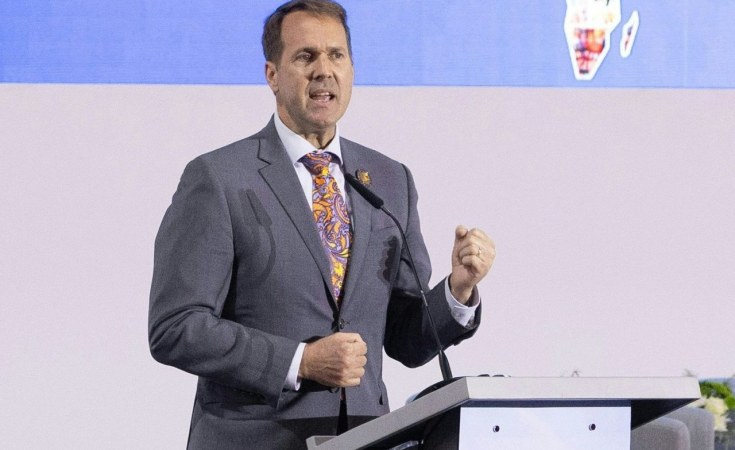
Luanda — Thank you, Chairman Olajide, for your kind introduction. I also want to thank Florie Liser and President Lourenço for their warm hospitality — and for making this Summit possible.
Your Excellencies, Honorable Ministers, members of the diplomatic corps, distinguished guests, and most importantly, the business leaders and innovators gathered here today:
It is a tremendous honor to be in Luanda on behalf of the President of the United States and the Secretary of State at CCA’s 17th U.S.-Africa Business Summit — a platform that reflects our shared commitment to prosperity and partnership. The Trump Administration recognizes — and deeply appreciates — the remarkable transformation Africa has undergone since the first Summit 28 years ago. To illustrate, Africa’s total GDP has grown more than fivefold since 1997. This year, 12 of the world’s 20 fastest-growing economies are in Africa, making it the second-fastest-growing region globally, after Asia.
Technology has reshaped the economic landscape. Africa’s digital economy, valued at $180 billion today, is projected to exceed $700 billion by 2050. This is more than numbers — it signals a shift in how business is done, and a powerful rise in consumer demand. In 2024 alone, Africa imported $435 billion in goods — nearly nine times more than in 2000.
Follow us on WhatsApp | LinkedIn for the latest headlines
Africa’s global influence is also rising. Its growing presence in multilateral institutions — including a permanent seat for the AU in the G20 — reflects its rightful place in global decision-making. By 2050, Africa will be home to 2.5 billion people — a quarter of the world’s population — with projected purchasing power above $16 trillion.
The Africa of 1997 is not the Africa of today, and certainly not the Africa of the future. That’s why our approach must evolve — because delivering on this Summit’s promise of mutual prosperity demands it. We must move beyond outdated, one-way aid relationships to a modern, two-way partnership based on trade and investment. And we must confront hard truths: despite Africa’s growth, U.S. exports to Sub-Saharan Africa still make up less than one percent of our global trade in goods — a figure that hasn’t moved in decades.
We’ve studied the causes, and the conclusion is clear.
For too long, U.S. policy has prioritized development assistance over commercial engagement. We will continue to support development — but through expanded trade and private enterprise. Because business — not aid — drives lasting growth. We’ve also focused too much on macro reforms, while overlooking the daily hurdles U.S. companies face. Our tools have been too slow, fragmented, and reactive to compete with China and others. And many American companies remain hesitant, unsure the rewards outweigh the risks.
That must change — and it is changing.
Last month in Abidjan, I had the honor of launching our new commercial diplomacy strategy — one designed to deliver results. No more repeating that Africa is full of opportunity. It’s time to act on it. It’s time to truly treat each other as equals. This strategy includes six actions, grounded in partnership with you — the companies here — as well as African governments and our interagency partners, especially the Department of Commerce.
- First, we’re making commercial diplomacy a top priority for every U.S. Ambassador in Africa. We now measure success by deals delivered — not cables written. Since the launch, we have been advancing 37 major deals across the continent, building on the 33 deals secured in the first three months of the Trump Administration. At this week’s Summit, we expect to sign additional high-value agreements — highlighted by a landmark $8.8-billion-dollar agreement to construct a full-scale LNG terminal in Freetown.
- Second, we’re working with African governments on top-priority market reforms — from cutting red tape to accelerating permitting and strengthening the rule of law.
- Third, we’re scaling infrastructure efforts, building on the success of the Lobito Corridor and expanding to more high-impact, commercially viable projects that unlock investment.
- Fourth, we’re redesigning diplomatic trips into business-forward engagements — connecting American companies directly with opportunities. For the first time, the private sector is part of our delegations, shaping the agenda from the start.
- Fifth, we’re connecting more of the nearly 300,000 export-ready U.S. companies with demand across Africa — aligning American expertise with the continent’s needs.
- Sixth, we’re pushing for structural reforms to U.S. trade and financing tools — making them faster, more flexible, and more competitive.

Sign up for free AllAfrica Newsletters
Get the latest in African news delivered straight to your inbox
But we can’t do it alone.
We need American businesses to step up — to take smart risks, invest confidently, and seize the opportunity. At the same time, we call on our African partners to create the conditions that attract and sustain investment – especially with U.S. institutional investors here today representing $134 billion in assets under management. We also urge you to look beyond price and recognize the long-term value of choosing American goods and services. With U.S. companies, you get quality, innovation, and a partner committed to mutual benefit.
So, let’s get to work. Let’s use this Summit not just to talk about the future — but to build it, together. Thank you.

