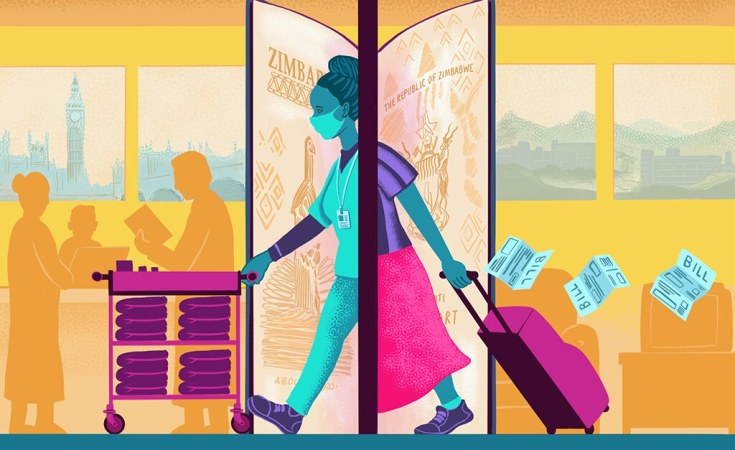
But majorities say the government should reduce the number of foreign job seekers and refugees it allows into the country.
Key findings
- Three-quarters (76%) of Zimbabweans say that Southern Africans should be able to move freely across international borders in order to trade or work. Only one in five (21%) think the government should limit people's cross-border movement.
- Two-thirds (67%) of respondents say that, in practice, crossing international borders is "difficult" or "very difficult."
- Almost half (48%) of Zimbabweans see the economic impact of migrants as positive, while 35% say it is negative.
- Large majorities say they have no qualms about living next door to foreign workers or immigrants (86%) or refugees (77%).
- Even so, more than six in 10 citizens say the government should reduce the number of foreign job seekers it allows to enter the country (47%) or eliminate such immigration altogether (16%).
The International Organization for Migration (IOM, 2024a) writes: "Migration is as old as humanity itself. Throughout history, people have migrated in search of better lives, to flee conflict or seek safety, or simply to find new opportunities." The United Nations (UN) estimates that there are 281 million international migrants in the world, equivalent to 3.6% of the global population (IOM, 2024a). In 2018, the UN adopted the Global Compact for Safe, Orderly and Regular Migration to enhance migration governance among member states, although scholars have argued that the treaty "is marked by major internal contradictions" and "hides the dilemmas raised by migration politics" (Pecoud, 2020).
Keep up with the latest headlines on WhatsApp | LinkedIn
Many scholars argue that migration is a net positive phenomenon (Hirsch, 2023) and that more liberalised migration regimes in Africa it could drive transnational integration, promote economic ties between countries, and open new avenues for innovation, trade, investment, and employment (United Nations Economic Commission for Africa, 2023).
Prior to independence, Zimbabwe held a unique position in Southern Africa as a sender and receiver of labour migrants, while also acting as a corridor for those moving between other countries (Tevera & Zinyama, 2002). Inward migration was mostly from neighbouring Malawi, Mozambique, and Zambia, while Zimbabweans who left mostly worked in South Africa. After the country's independence in 1980, migration patterns show significantly higher population outflows than inflows (Tevera & Zinyama, 2002).
Although reliable data are hard to come by, Zimbabwe is thought to have one of the highest per-capita rates of outmigration worldwide (Mahove, 2021; Migration Data Portal, 2024). The country is home to 429,000 migrants, mostly from neighbouring countries, and hosts more than 20,000 refugees and asylum seekers (Global Migration Portal, 2024; UNHCR, 2025). The United Nations High Commissioner for Refugees (UNHRC) and partners, in collaboration with the government, is actively working to accommodate and integrate refugees, especially at the Tongogara Refugee Camp near the Mozambican border, where most refugees from the Democratic Republic of Congo, Rwanda, and South Sudan are housed (UNHCR, 2025).
In November 2024, Zimbabwe acceded to the International Convention on the Protection of the Rights of All Migrant Workers and Their Families (IOM, 2024d). Other legal frameworks governing immigration include the Immigration Act, the Citizenship Act, the Refugees Act, and the Constitution of Zimbabwe (Muvingi & Mugadza, 2024).
Labour outmigration can have many benefits, including poverty reduction through remittances, the boosting of foreign currency reserves, and knowledge and skills transfer (IOM, 2020). In Zimbabwe, however, labour outmigration has been marked by numerous challenges, including "brain drain," i.e. the outflow of highly skilled citizens, often professionals; irregular migration, characterised by a lack of travel or work permits; a lack of social protection; and the unavailability of up-to-date statistics. In addition, the risk of human trafficking has been growing (IOM, 2020). Most Zimbabweans working abroad take on "three D" jobs, so-called because they are considered dirty, dangerous, and degrading. Many jobs are characterised by the absence of employment contracts and social protection, exploitative wages and long working hours, lack of union representation, and non-existent support from both the Zimbabwean government and the destination country (IOM, 2020).
In 2023, Zimbabwe's net migration rate was -6 people per 1,000 population, indicating that more people continue to permanently leave than enter the country (Migration Data Portal, 2024). According to Fernandes & Sharma (2023), outmigration is driven by both economic and political factors in Zimbabwe. The most prominent reasons for moving abroad include looking for livelihood opportunities, leaving for education or training, joining family, and traveling to conduct commercial activities.
Since the government-mandated land seizures of commercial farms in 2000 and the resulting economic freefall, the numbers of both skilled and unskilled workers leaving Zimbabwe has accelerated (Ndlovu, 2023). Emigration has also intensified during times of political violence and human-rights violations. In 2008, a year of highly contested elections, the number of Zimbabweans applying for asylum jumped fivefold to more than 100,000 (World Data, 2025). The countries with the biggest Zimbabwean diaspora populations are South Africa, the United Kingdom, Australia, Canada, New Zealand, and the United States (FactCheckZW Media Lab, 2024).

Sign up for free AllAfrica Newsletters
Get the latest in African news delivered straight to your inbox
Afrobarometer's Round 10 survey sought the attitudes of ordinary Zimbabweans on the subject of migration.
Findings reveal contradictory tendencies: While most citizens favour the free movement of Southern Africans to work and trade across the region, a majority also want fewer immigrants, or even none, to come into Zimbabwe. This resistance prevails even though nearly half of respondents perceive migrant workers as contributing positive economic value and an overwhelming majority profess to have no reservations about living next to foreign workers or refugees.
Two-thirds say that moving across international borders is hard.
One of the most significant findings is that about three-fifths of Zimbabweans have considered emigrating themselves, mostly in search of better economic opportunities. Nearly four in 10 prospective emigrants would target neighbouring South Africa. Young and highly educated citizens are especially likely to contemplate moving abroad.
Eldred Masunungure Eldred V. Masunungure is the national investigator for Zimbabwe.
Simangele Moyo-Nyede Simangele is a research officer Mass Public Opinion Institute

