

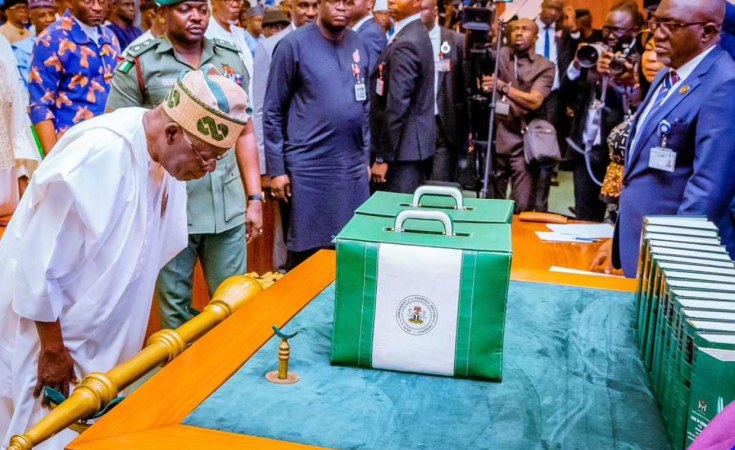
The minister praised the Tinubu administration for confronting long-standing economic distortions head-on, particularly the removal of fuel subsidies and the unification of multiple exchange rates.
The Minister of Finance and Coordinating Minister of Economy, Wale Edun, has warned West African countries against depending on external assistance to finance their development.
Speaking at the 11th Annual Conference and General Assembly of the West Africa Association of Public Accounts Committees (WAAPAC) in Abuja on Monday, Mr Edun said dwindling global support, rising debt costs, and shrinking fiscal space leave Africa with only one option: to rely on internal reforms, domestic revenue growth, and private sector-led investment.
Follow us on WhatsApp | LinkedIn for the latest headlines
The minister described the moment as "defining," noting that Africa faces the convergence of elevated debt servicing obligations, constrained revenues, and growing social demands.
Placing Nigeria's fiscal reforms within a global context, the minister warned that Africa's vulnerabilities are being worsened by trends in world trade and development finance.
He pointed out that trade wars and protective tariffs have eroded $2 trillion worth of world trade, while developed countries increasingly channel resources into domestic subsidies rather than global cooperation.
He said, "This conference comes at a defining moment. Currently, the world is beset by global uncertainty. There is a reduction in world trade. World trade is what helps countries participate in the growth of the world economy.
"About $2 trillion worth of world trade has disappeared and gone into subsidies. And this reduces the ability of countries to participate in growth and development as a result of being included in world trade.
"In fact, developing countries are even putting back more than they are getting in terms of concessional financing, and what that means is that we have to look as a country, as a region, and as a continent, we have to be more self-reliant.
"We have to reform our economies. We have to increase our tax-to-GDP ratio. We have to apply technology, automation, digitisation, and even AI to our revenue and efforts, and finally, we need to crowd in the private sector."
Mr Edun, however, praised President Bola Tinubu's administration for confronting long-standing economic distortions head-on, particularly the removal of fuel subsidies and the unification of multiple exchange rates.
According to him, those difficult decisions laid the foundation for Nigeria's fiscal recovery strategy, which rests on two pillars: restoring macroeconomic stability and investing strategically in infrastructure, healthcare, education, agriculture, and technology.
"If we look at the vision behind the president's actions, it is to build a strong, resilient, and inclusive economy, inclusive in the sense that it provides good quality jobs for men, for women, for young people in particular," he said.
Mr Edun outlined Nigeria's four fiscal priorities as debt transparency, growth-enhancing borrowing, domestic revenue mobilisation, and coordinated debt treatment.
He reported that reforms are already producing results and investor confidence is improving, fuel import costs are falling, and by next year, Nigeria expects to achieve 1.2 million barrels per day in domestic refining capacity, ending its reliance on exporting crude and importing refined products.
"That is how jobs are created and the economy grows," he said.
Despite mounting concerns over Nigeria's debt levels, Mr Edun insisted that the country's debt-to-GDP ratio remains at a "comfortable" 38.8 per cent. However, he stressed that discipline is critical, explaining that borrowing must be project-based and yield measurable returns.
One key reform, he noted, is the newly passed comprehensive tax law, which lowers burdens on the most vulnerable while simplifying compliance and expanding the tax base.
Mr Edun insisted that Nigeria is not at a crossroads but at a "turning point" towards recovery.
He said rising revenues, stronger foreign exchange inflows, and a more stable naira are laying the foundation for inclusive growth.
In particular, he pointed to opportunities in manufacturing, which he said has become more competitive due to exchange rate adjustments. "Products made in Nigeria, whether by small, medium, or large manufacturers, are now competitive. That is an opportunity to grow industries, create jobs, and build resilience," he said.

Sign up for free AllAfrica Newsletters
Get the latest in African news delivered straight to your inbox
Mr Edun urged lawmakers across Africa to ensure rigorous debt oversight, fiscal discipline, and long-term planning. "If we maintain discipline and strengthen oversight, we can build resilient economies across our region and secure prosperity for future generations," he said.
The WAAPAC conference
The five-day WAAPAC conference, hosted by Nigeria's House of Representatives from 8 to 12 September, is themed "Strengthening Parliamentary Oversight of Public Debt: The Role of Finance and Public Accounts Committees."
It brings together lawmakers, auditors, civil society leaders, and technocrats from across West Africa to deliberate on strategies for tackling debt accumulation, ensuring fiscal transparency, and safeguarding democratic accountability.
Since its founding in 2009, WAAPAC has provided a platform for regional cooperation, peer learning, and oversight.
This is the first time Nigeria is hosting the conference since its creation, a development Mr Edun described as "a significant privilege and an opportunity to reinforce shared commitment to the region."

