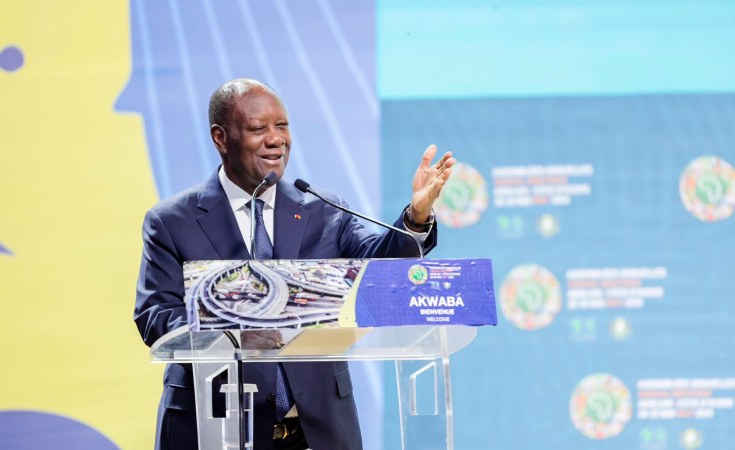
Having emerged as the leader of Côte d'Ivoire in April 2011, following bloody post-electoral violence that cost 3,000 lives, President Alassane Ouattara is preparing to seek a fourth mandate ahead of presidential elections in October 2025. His third term, which began in 2020, was already a source of controversy, judged as anti-constitutional by the opposition and marred by deadly intercommunal violence in multiple cities across the country.
Five years later, and despite these unfortunate precedents, Ouattara responded favourably to the calls of his supporters who had pushed him to seek a new term in the presidential palace.
The announcement of his candidacy on 29 July 2025 provoked scenes of joy in many localities. Several days later, in Bouaké, the president was received triumphantly during celebrations marking the 65th anniversary of Independence, which included a military procession in which the Ivoirian army deployed an impressive arsenal of terrestrial and aerial might. For many observers, and supporters of the executive, this demonstration contained an important message: the state is ready to counter all attempts at destabilisation. This was a barely-veiled warning to opposition parties who had announced their strong hostility to the announced bid for a fourth presidential mandate.
The opposition responds
Keep up with the latest headlines on WhatsApp | LinkedIn
This show of strength was not enough to discourage the opposition, who succeeded in organising two displays of their own to influence public opinion.
The first was on Saturday 9 August 2025. On that day, the two largest parties of the opposition - the Democratic Party of Côte d'Ivoire (Parti démocratique de la Côte d'Ivoire, PDCI) of Tidjane Thiam and the Party of African Peoples in Côte d'Ivoire (Parti des peuples africains de la Côte d'Ivoire, PPA-CI) of the former president Laurent Gbagbo - unveiled their new coalition called the Common Front (Front commun). Together, they came out in impressive numbers on the streets of Yopougon, the largest commune in Abidjan, to denounce Alassane Ouattara's bid for a fourth term and to call for their own leaders to be restored to the electoral roll. Major individuals such as Laurent Gbagbo, Tidjane Thiam, Charles Blé Goudé, and Guillume Soro are currently struck off of the electoral roll, which renders them ineligible for election.
In front of large crowds gathered in the famous Ficgayo de Yopougon Square, the President of the Executive of PPA-CI, Sébastien Dano Djédjé, welcomed an 'exceptional' mobilisation:
'This is a show of force which shows those in power that we are more numerous than they are. We want our leaders who have been struck off to be reinstated to the electoral rolls. We do not want an anti-constitutional fourth mandate.'
One week later, the same Ficgayo Square hosted a meeting of Laurent Gbagbo. Once more, party supporters came out in large numbers to hear their leader. Upholding his reputation for a direct communication style, the former president spoke plainly and proclaimed that 'there will be no fourth mandate' four Alassane Ouattara.
These repeated challenges did not deter the outgoing head of state. On Friday 26 August 2025, he officially registered his candidacy with the Independent Electoral Commission (Commission électorale indépendante, CEI) accompanied by a throng of partisans.
The presidential mantle is increasingly contested
Candidate to his own succession after fifteen years in power, Alassane Ouattara and his supporters are demonstrating high levels of confidence. They are holding up their economic and institutional successes, convinced that they have established Côte d'Ivoire as one of the powerhouses of francophone Africa. For them, this record should be enough to secure easy re-election.
But competition appears to be fierce. The CEI has announced a record number of candidates, sixty in total. Among them are Laurent Gbagbo and Tidjan Thiam, despite their exclusion from the electoral roll. This factor could lead to their disqualification by the Constitutional Court, which will give its verdict on the question by 10 September 2025, at the latest.
Alongside these emblematic figures are multiple other personalities capable of shaping the electoral landscape: Simone Ehivet Gbagbo, the former First Lady and President of the Movement of Capable Generations (Mouvement des générations capables, MGC); Ahoua Don Melo, BRICS representative in Central and West Africa; and Assalé Tiémolo, Deputy Mayor of Tiassalé and President of the Movement for Today and Tomorrow - Côte d'Ivoire (Mouvement aujourd'hui et demain - la Côte d'Ivoire, ADCI) whose position of issues such as school fees and internet charges by mobile providers is attracting a growing share of the electorate.
What will Gbagbo and Thiam do if disqualified?
Although they are perceived to be the two principal challengers to the incumbent, Tidjane Thiam and Laurent Gbagbo are still excluded from the electoral roll. Despite their legal challenges, the authorities have not responded to their appeals, which in effect renders them ineligible for election under the law. Nevertheless, it is up to the Constitutional Court to make a definitive ruling, and all eyes are now on this institution.
What will the reaction of the two leaders be in the case of disqualification? Will they boycott the election, and thus risk provoking new protests? Or will they choose to fall behind another candidate in the hope of presenting a united front against the regime in power?
For the political analyst Abou Said, this situation gives the opposition and immense opportunity:
'The Ivorian opposition is today faced with an historic opportunity. Either it can choose to boycott, and its runs the risk of plunging the country into a new logic of confrontation and violence which has already cost Côte d'Ivoire so much; or, it can take a strategic view: move beyond egos, unite around a common project and seek a consensus candidate. Only a disciplined and credible coalition can hope to take on the political and institutional machine of the party in power.'
Said adds nevertheless that the option of a boycott would be a 'political trap' that would strengthen Ouattara:
'If the opposition refuses to participate, President Ouattara will be re-elected without difficulty and he would be able to claim institutional legitimacy, even if this would be challenged politically and morally. That is why Thiam, Gbagbo, and their allies should understand that their true force lies not merely in the streets, but also in their capacity to turn popular anger into a democratic alternative.'
From popular neighbourhoods up to diplomatic circles, the same question is consequently being asked: will the Constitutional Court validate or not the candidacies of Laurent Gbagbo and Tidjane Thiam? The answer to this question will determine the outlines of next October's election. More than ever, the date for the publication of the definitive list of candidates is awaited with a combination of impatience and anxiety.
The population hopes for 'maturity' from politicians
In the run-up to the election, many Ivoirians are expressing their desire to experience peaceful elections without the violence of the past. Citizen and cultural initiatives are multiplying to call for a climate of peace and tolerance.
At Cocody, a sports tournament organised in favour of peace, multiple artists and opposition leaders launched a call for responsibility on the part of the political class. Among them, the singer Zigui Dona Salim, better known by his pseudonym Samo Samo, exhorted political actors to prioritise the wider public interest:
'We hope from the bottom of our hearts that our politicians will agree to have elections without violence. We call upon them to truly think about the future of our youths, since all that we want is peace for our beautiful country.'
This message, widely shared by the population as a would, communicates a strong desire: that the political class proves its maturity and prevents dragging the country back towards renewed tensions.

Sign up for free AllAfrica Newsletters
Get the latest in African news delivered straight to your inbox
'The people are ready to live together in peace, but this requires that our leaders set the example,' said an inhabitant of Yopougon. For her, the maturity of political actors will be judged by whether the 2025 elections occur serenely.
Two months ahead of the presidential election, Côte d'Ivoire finds itself at an historic turning point in its political history. Between an incumbent president determined to secure a fourth mandate in the face of significant contestation, a weakened opposition that is nevertheless able to mobilise, and a population that aspires to peace and stability, much remains uncertain.
The verdict of the Constitutional Council on the candidacies of Laurent Gbagbo and Tidjane Thiam appears to be a moment of decision: this will decide not merely the final casting of the election, but also the political climate that will accompany it. A validation could open the way to an unprecedented electoral competition, whereas disqualification could reignite the tinderbox of historic tensions.
In this context, the responsibility of political actors is immense. Côte d'Ivoire, which has paid a heavy cost for repeated electoral crises since 2010, cannot allow itself to be plunged back into a cycle of electoral violence. More than ever, the maturity of political actors and the will of the people will have to be the guarantors of a calmer election.
The question remains: will Alassane Ouattara succeed in being elected for a fourth time, or will Côte d'Ivoire decide to turn a page in its political history?
Gael Zozoro is an Ivorian journalist passionate about meaningful stories, inspiring journeys, and major topics such as politics, the environment, economy, sports, and society. For over seven years, he has practised his profession with dedication in Côte d'Ivoire and beyond, driven by the belief that information can enlighten, raise awareness, and transform society.

