

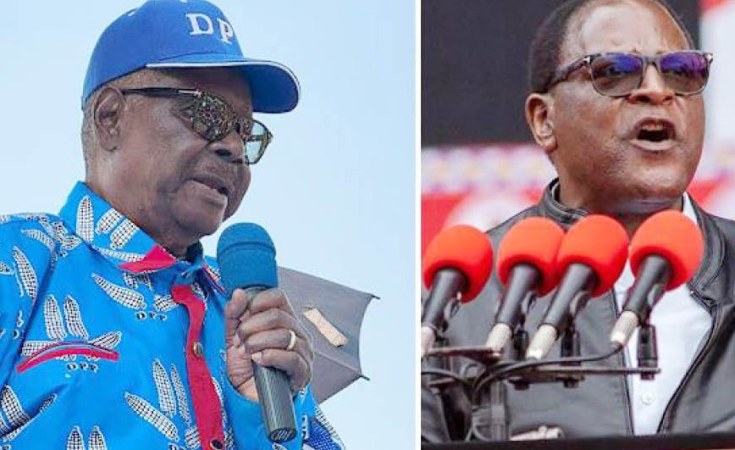
Malawians vote for a new president today in an election clouded by economic hardship as incumbent Lazarus Chakwera squares off against his predecessor in a race where few voters see a real alternative.
Three of the 17 candidates for the September 16 polls have already served as president of the southern African nation, and another is the current vice president.
While the list of contenders is unusually crowded, voters have lost faith in the political class to deliver meaningful change to one of the poorest countries in the world, analysts say.
"Whether it is Chakwera or (his predecessor Peter) Mutharika, nothing changes for us. It's like choosing between two sides of the same coin," said Victor Shawa, a 23-year-old unemployed man in the capital, Lilongwe.
Follow us on WhatsApp | LinkedIn for the latest headlines
Optimism that accompanied Chakwera's coming to power has long since been eroded by runaway inflation of around 30 per cent, chronic fuel and foreign exchange shortages and corruption scandals touching senior government figures.
"People feel trapped," said Michael Jana, a Malawian national and political scientist at South Africa's Wits University.
"The economy is in crisis, the politicians are the same, and many Malawians don't believe this election will change their lives," he told AFP.
Chakwera, a 70-year-old evangelical preacher, wants a second term after a mixed performance during his first run, which was handed to him only after the 2019 election result was cancelled over rigging claims.
Battle of two presidents
Malawi's election is the third bout of a battle for power between two presidents, incumbent Chakwera and his predecessor, Mutharika.
Here are short profiles of the two:
Chakwera, second chance?
A charismatic former evangelical preacher who says he was called by God to govern his country, Chakwera's first term has been overshadowed by climate-linked disasters and economic crisis.
The leader of the country's oldest party, the Malawi Congress Party (MCP), he strode past Mutharika to first take office in 2020 with nearly 59 per cent of ballots.
The vote was a rerun after the nullification of the 2019 "Tippex Election" in which courts upheld opposition claims that correction fluid was used to alter vote tallies. Mutharika had been narrowly ahead in the first round.
Chakwera lost his first duel against Mutharika in 2014, afterwards taking a seat in parliament as leader of the opposition.
With a Southern American twang, the 70-year-old has degrees in philosophy and theology, and studied in Malawi, South Africa and the United States.
Described as a warm consensus builder, Chakwera is a strong orator with an inclusive leadership style. He was born in a village with no electricity or running water to a subsistence farmer, whose two elder sons died in infancy.
His campaign has called for continuity to "finish what we started", urging voters not to "Stop the Progress" of his first term, during which several road, school and hospital construction projects were undertaken.
Mutharika, a comeback?
The reserved 85-year-old leader of the Democratic Progressive Party (DPP) is a former Washington law professor who was first voted in as president in 2014.
With law degrees from the University of London and Yale, Mutharika worked as a constitutional law expert at Washington University, returning to Malawi in the early 1990s to help draft its first democratic constitution.
Following another stint in the United States, he came back in 2004 when his brother, Bingu wa Mutharika, was elected president, and became his right-hand man. He was elected to parliament in 2009 and went on to head several ministries.
After Bingu died in office from a heart attack in 2012, Peter was accused of attempting to conceal his death for two days in an alleged bid to secure the job for himself and prevent the vice president from taking over.
He narrowly won his first stint in power in 2014 with just over 36 per cent of votes, and the term was dominated by food shortages, corruption scandals and ballooning national debt.
Running on a platform of a "return to proven leadership", Mutharika - known among supporters affectionately as "Adadi" (father) - has promised to revive the struggling economy, including by challenging mismanagement.
'Eroded public trust'
According to a survey of 2,400 voters by the Institute of Public Opinion and Research (IPOR) released recently, Mutharika leads with 41 per cent ahead of Chakwera at 31 per cent.
As outright victory requires 50 per cent plus one vote, analysts say a second round is all but inevitable.
Results are due a week after voting.

Sign up for free AllAfrica Newsletters
Get the latest in African news delivered straight to your inbox
Joyce Banda, Malawi's only woman president (2012-2014), and Vice President Michael Usi are also running, but their chances are seen as slim, and any role of kingmaker may go to former central bank governor, Dalitso Kabambe, who polls a distant third.
For most Malawians, the choice on election day - when hundreds of local and parliamentary seats are also up for grabs - boils down to a single issue.
"The economy, the economy, and the economy - in that order - is what is driving this election," said Boniface Dulani, politics lecturer at the University of Malawi.
"Inflation, fuel shortages and corruption have eroded public trust in Chakwera, whose support has nearly halved since 2020," he said.
While Chakwera has been in power, the country has been hit hard by the COVID pandemic, 2023's Cyclone Freddy which killed more than 1,200 people and successive droughts.
But critics argue that these exposed, rather than excused, the administration's lack of strategy.
"When people cannot afford food, when jobs are scarce, when inflation is out of control - those factors influence the vote more than anything else," said Bertha Chikadza, president of the Economics Association of Malawi.

