After witnessing the deaths of his wife and daughter in the middle of bombings in El Fasher, Sudan, AM* set out on a gruelling journey towards Tawila, 60 kilometres away, on Monday, 27 October. They spent four agonising days walking on foot, in which he and his remaining family endured torture, beatings, and robbery. Along the way, in the village of Garni, he had to bury his niece, a young girl who had died of exhaustion and hunger.
"She couldn't bear walking such long distances," says AM. "The journey has been very tough, and we are in great distress."
He kept moving forward to Tawila--taking his surviving children, his brother, and even orphans he met along the way. When they finally reached the town, they found nothing but despair; there was not enough water, food, shelter, or latrines.
Keep up with the latest headlines on WhatsApp | LinkedIn
The journey has been very tough, and we are in great distress. AM, a displaced man in Tawila
Almost one month after the Rapid Support Forces (RSF) took control of El Fasher on 26 October 2025, the last Darfur city held by the Sudanese Armed Forces (SAF) and the Joint Forces, the situation in North Darfur remains critical. Based on Norwegian Refugee Council registration, around 10,000 people, such as AM, who survived mass atrocities have fled to Tawila, where they are facing dire conditions in overcrowded camps.1 This figure remains relatively low compared to the estimated 260,000 people who, according to the UN, were still in El Fasher as of late August.
"We started receiving an influx of people from El Fasher a week before the city was taken over," says Dr Mouna Hanebali, medical team leader at Tawila hospital. "At first, there were mostly women and children who were exhausted, malnourished, dehydrated, and brought by trucks. After the fall of El Fasher, we also received men, most of whom had traumatic injuries, gunshot wounds, and infected wounds, who came by foot."
"Now, fewer and fewer people are coming via this road," says Hanebali. "Some are coming from Korma instead, but the numbers remain small."
We started receiving an influx of people from El Fasher a week before the city was taken over. At first, there were mostly women and children who were exhausted, malnourished, dehydrated, and brought by trucks. Dr Mouna Hanebali, medical team leader at Tawila hospital
While neither MSF, nor any other international humanitarian organisation, has been able to reach El Fasher, our teams continue to try to identify survivors in need of medical assistance in various locations.
In North Darfur, we visited Um Jalbak, Shangil Tobay, Dar el Salam and Korma: we did not observe any mass arrivals, with only a few hundred people having left El Fasher in the last three weeks, and we referred several people in critical condition to the hospital in Tawila. We are also conducting medical activities in Umbaru, Mazbet, Karnoy, and Tina, localities on the route to Chad: no major influx there either. The situation is similar in Belliseraf, in South Darfur, and Golo and Fanga, in Central Darfur, where our teams are assessing the needs and getting ready to distribute kits to the recent arrivals.
Although the International Organization for Migration estimated that more than 100,000 individuals had been displaced from El Fasher by 17 November,2 its reports also indicated that the vast majority remained within the El Fasher locality,3 primarily in rural villages to the west and north of the city.
Our observations, survivor testimonies, and external information such as satellite analysis conducted by the Yale School of Public Health's Humanitarian Research Lab, point to a catastrophic scenario in which a large part of the civilians who were still alive in El Fasher before 26 October were killed, died, or are detained, trapped, and unable to receive vital assistance and move to a safer place.
Inadequate conditions in the camps across Tawila
Survivors who reach Tawila arrive at camps where existing services were already overwhelmed by the arrival of over 650,000 internally displaced people from El Fasher in the last two years,4 including almost 380,000 new arrivals since April 2025 when the RSF attacked Zamzam camp.
"The living conditions in the camps across Tawila are extremely precarious," says Myriam Laaroussi, MSF emergency coordinator in Darfur. "Devastated people are arriving at a place where there are not enough resources to meet their basic needs: they sleep under makeshift tents made of wood and sheets, and food assistance provides only one meal per day for prioritised people."
Devastated people are arriving at a place where there are not enough resources to meet their basic needs: they sleep under makeshift tents made of wood and sheets, and food assistance provides only one meal per day for prioritised people. Myriam Laaroussi, MSF emergency coordinator in Darfur
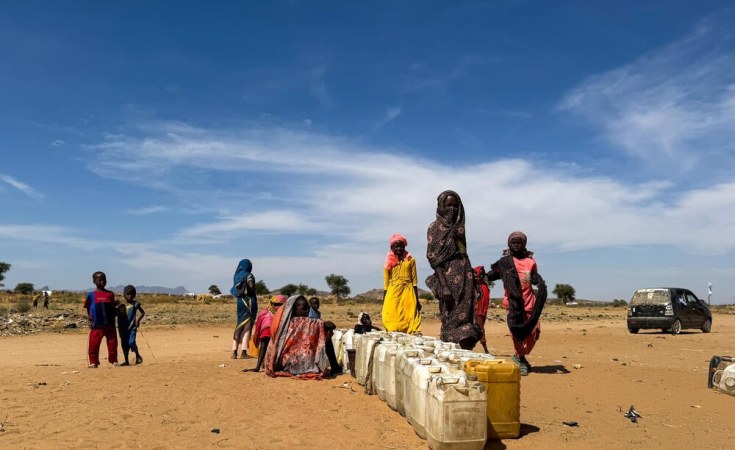
During an MSF assessment in Daba Naira and Tawila Umda camps, we found that there is an average of only 1.5 litres of water per person per day, which is far below the humanitarian standard of 15 litres minimum.
IO*, around 30 years old, sits with her two children under one of the makeshift tarpaulin tents. They walked for three days until they reached Daba Naira, currently the biggest camp for displaced people in Tawila, with around 210,000 people. Her husband was struck by shelling in El Fasher when he went out to search for food. When she finally decided to flee with her two children on 25 October, they found his lifeless body on the street.
"Everything we owned was stolen," says IO. "The only thing I have left is this garment, which my children and I spread out on the ground to sleep on. I need clothes for my children, as they only have one pair of shoes, which is passed around for whoever needs to go to the bathroom. We are still missing many basic items".
According to the Sudanese American Physicians Association (SAPA), around 74% of Tawila's displaced people live in informal gathering sites without adequate infrastructure, and less than 10% of households have reliable access to water or latrines.5 Throughout the Daba Naira camp, it is common to see open air defecation, which can increase the risk of diseases, such as cholera, spreading. With the cold season approaching, displaced families are also worried about not having warm clothes and blankets.
People remain trapped in El Fasher
IA* used to work as a watchman in a university in El Fasher. A day before the fall of the city, he was shot in the leg, and his tibia shattered in several places.
"The wound was bleeding, and my brother made a tourniquet," says IA. "Then he lifted me onto a donkey cart and brought me here. Can you imagine the pain? It was very hard."
The wound was bleeding, and my brother made a tourniquet. Then he lifted me onto a donkey cart and brought me here. Can you imagine the pain? It was very hard. IA, fled from El Fasher after being shot
He spent three days on the trails. Despite their efforts, part of his leg had to be amputated when they finally reached Tawila hospital.
As IA's, the testimonies of our patients who managed to flee are devastating. All the survivors report fleeing during shelling and shootings, and walking on foot for between three and five days, often hiding during the day and moving at night to avoid detentions and attacks. They describe extreme violence, including mass killings and ethnically motivated atrocities.
On their journeys, they saw many dead bodies, and suffered torture, kidnappings for ransom, sexual violence, humiliation, and had everything they owned stolen. Patients also mention mass arrests where men, mainly the young, were detained and separated from women and children in places like Garni, northwest of El Fasher.
FI*, a 50-year-old man, was detained for ten days, beaten, and forced to endure unspeakable violence, including a rope tied around his neck. His captors demanded 10 million Sudanese pounds (US$4,000) for his release.
"They got drunk and took us to the desert," says FI. "They made us lie down in bushes, beat us, and humiliated us terribly. They said they would kill us, and they shot at us with a lot of live ammunition."
They got drunk and took us to the desert. They made us lie down in bushes, beat us, and humiliated us terribly. FI, was released from detention after a ransom was paid In the end, his captors let him go after he paid 500,000 Sudanese pounds (US$200) because his wounds were badly infected.
According to patients we treat, many civilians are still detained in Garni, and other towns around El Fasher, for ransoms or prevented by the RSF and its allies from reaching safer areas like Tawila. "The people who are missing are still behind us, and they won't let them go," says FI.
"The people who survived the extreme violence remain in grave danger in and around El Fasher," says Laaroussi. "Humanitarian access is blocked, people still alive are trapped, while direct information on the current situation inside and around the city is very limited."

Sign up for free AllAfrica Newsletters
Get the latest in African news delivered straight to your inbox
MSF's response in Tawila
MSF has increased our capacity in Tawila to respond to people's growing needs. Our teams have built a health post at the entrance to Tawila Umda, one of the main arrival points for displaced people from El Fasher. There, we provide injury dressings and outpatient services, stabilise critical cases, and arrange referrals with ambulances to the hospital for patients with the most severe conditions. MSF has also identified an urgent need for mental health care, which will be a priority for our teams in the coming weeks.
At Tawila hospital, where we have set up an emergency area for arrivals from El Fasher since mid-August, we have expanded capacity for wounded and trauma patients, from 24 beds to over 100.
"We are performing an increasing number of surgeries: around 20 cases per day compared to seven cases per day last month," says Hanebali. Our teams also continue to treat people arriving with alarming malnutrition, evidence of the siege they endured in El Fasher. Recently, our teams began distributing water and installing latrines in Daba Naira camp.
MSF teams are also beginning an intervention to restore and increase healthcare access in Kornoi, North Darfur, near the border with Chad, as well as in Tine, Chad.
MSF calls on the RSF and its allies to urgently provide safe and free passage to the sick, injured, and all civilians seeking to reach safer places, and to facilitate humanitarian access to Garni, El Fasher, and other places where there are survivors. We also call on donors and humanitarian organisations to increase their responses to the growing health, protection, food, and water and sanitation needs in Tawila.
*Names have been changed to protect people's identities.
NRC: Sudan: Media update on the latest situation in Tawila
IOM: DTM Sudan Flash Alert: Al Fasher (Al Fasher town), North Darfur (Update 111)
IOM: DTM Sudan Focused Flash Alert: Al Fasher, North Darfur (Update 011) | Displacement Tracking Matrix
