

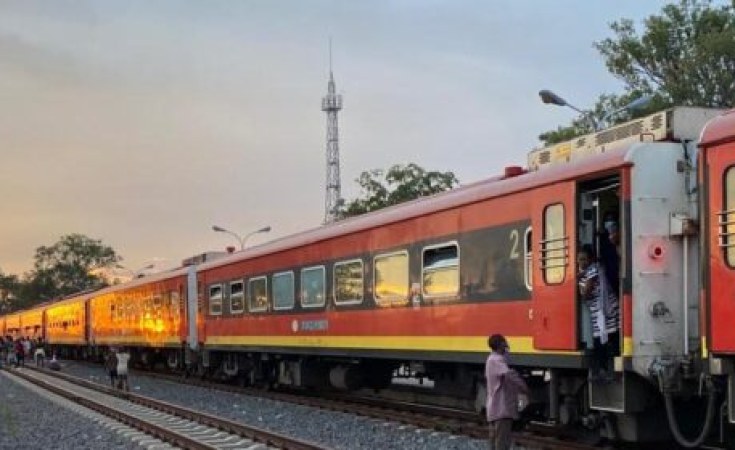
Luanda — If hypocrisy needed a railway, it would look exactly like the Lobito Corridor. It is being hailed as a symbol of African progress. In truth, it is a mirror of everything negative the continent endures: Chinese debt, Western opportunism, Congolese blood, Angolan misrule—and a railway that connects foreign interests more efficiently than it connects the people who live along its tracks. It promises prosperity while delivering the same old extraction dressed in new flags.
As Angola hosts the 7th African Union–European Union Summit, one of the flagship projects presented as proof of renewed partnership is the Lobito Corridor. Over the past year, Washington, Brussels and several media outlets have portrayed the corridor as a strategic Western response to China's expanding influence in Africa—a seductive narrative suggesting a geopolitical comeback. President João Lourenço echoes this view, selling it as his diplomatic triumph and economic breakthrough. Yet the narrative collapses under basic scrutiny.
A Chinese Project Rebranded as Western Cooperation
The heart of the Lobito Corridor is the Caminho de Ferro de Benguela (CFB), a 1,344-kilometre railway built a century ago by the Portuguese. Destroyed during Angola's civil war, it was rebuilt entirely by China between 2006 and 2014 under a US$2 billion "rail-for-oil" program. Chinese engineers restored stations, bridges and rolling stock, delivering Beijing's largest African railway project since the 1970s.
Follow us on WhatsApp | LinkedIn for the latest headlines
In 2015, the presidents of Angola, the DRC and Zambia inaugurated the rebuilt line at Luau, reopening a logistics artery shut for three decades. Since then, trains have intermittently carried copper and cobalt to Lobito. These achievements belong to China—not to the United States or Europe.
Every kilometer of this railway was financed through oil-backed loans that Angola continues to repay. The narrative of Western "revival" conveniently ignores that Angolans are still servicing billions in Chinese debt for infrastructure the West now claims as its own success story.
The United States and Europe only rediscovered the corridor in 2023. President Biden's 2024 visit produced pledges totalling US$4 billion under the PGII—plans for rail extensions in Zambia, loans to the Lobito Atlantic Railway (LAR) consortium, and technical support. But these are promises, not infrastructure.
Even LAR is not fully "Western": Mota-Engil, one of its leading companies, is 32.4% owned by China Communications Construction Company, which belongs to the Chinese State. Thus, even in the West's "new phase," Chinese capital remains embedded.
In practice, the West is not building the Lobito Corridor. It is offering management models, logistics optimisation, and governance frameworks—areas where it still has leverage because it lost the construction race long ago.
Here's a slightly edited version:
"For the US, branding the corridor as Western-led offers an illusion of strategic coherence, but US funding takes time to materialize. For China, silence suffices; its infrastructure speaks for itself. Meanwhile, Angola risks being reduced to a pawn on its own turf."
Prosperity for Whom?
The U.S. and EU present the corridor as a generator of prosperity for Angola, Zambia and the DRC. But such optimism erases the brutal reality in the Democratic Republic of Congo—one of the supposed beneficiaries.
How can anyone speak of shared prosperity while the DRC remains locked in one of the world's longest and deadliest conflicts, fueled by the very minerals transported along this railway? Neither the West nor China has shown genuine interest in ending the war. They want minerals, not peace.
And what does this reveal about the AU-EU partnership?
If such a partnership cannot stabilize the region that supplies minerals essential to its own industries, what influence does it really possess?
This leads to an even more uncomfortable question:
Which African country has truly advanced in human development in the last 20 years thanks primarily to Western investment?
The list is empty.
Western oil majors—Chevron, Exxon, TotalEnergies, BP, ENI—have extracted immense wealth from Angola. Yet the country remains mired in poverty, inequality and institutional fragility. The same absence of development applies to Zambia and the DRC.
While China presents its infrastructure projects as "win-win", the long-term reality is far more sobering: no African country owes more to Beijing than Angola, which has accumulated more than US $46 billion in Chinese loans since 2000.
The West extracts or advises.
Neither model has transformed African societies.
Angola's Internal Failure: Infrastructure Without Capacity
The Lobito Corridor's potential is further undermined by Angola's own governance crisis. President Lourenço promised reform but further centralized power and preserved the extractive economic order. Social services remain starved of resources—but the deeper problem is structural: Angola does not produce human capital because its education system suppresses critical thinking.
It is not merely underfunded; it is intellectually hollow.
A population unable to question or innovate becomes hostage to foreign narratives and incapable of economic transformation.
The paralysis of the Caminhos de Ferro de Luanda proves the point.
Another vital domestic corridor, rebuilt at high cost, has been paralyzed by mismanagement. If Angola cannot operate its own internal railways, how can it expect the Lobito Corridor to deliver genuine development?
And Angola still lacks a national railway system: the Benguela Railway (serving the central-eastern axis); the Luanda Railway (confined to the north-western corridor); and the Moçamedes Railway (restricted to the south-western region) are not interconnected.
Three separate rail islands in a country of continental scale—none linking North to South or East to North—make national mobility nearly impossible and render any promise of shared prosperity hollow. Angolans cannot move freely within their own territory.

Sign up for free AllAfrica Newsletters
Get the latest in African news delivered straight to your inbox
This fragmentation destroys any claim of national integration or meaningful development. Being praised in Washington or Brussels does not build a functioning state.
Beyond Geopolitics: What the Corridor Could Become
The Lobito Corridor could be more than a geopolitical trophy. If grounded in real reform, Western support could modernize operations, extend networks, diversify exports and support local processing. But that requires transparency, local investment, conflict-sensitive strategies and policies that empower Angolan entrepreneurs rather than foreign or domestic elites.
Conclusion: The Real Question
The Lobito Corridor is not a contest between the U.S. and China. It is a mirror exposing a harsher truth: the West claims what it did not build; China maintains long-term leverage through the debt and infrastructure it controls; and Angola, constrained by its own machinery of state capture, watches development fall out of reach.
The question is not who laid the tracks or who runs the trains.
It is who benefits—and at what cost to the people along the railway, from Lobito to Kolwezi to the war-scarred heart of the DR Congo.Until these questions are answered with integrity, the corridor remains just another extractive route—another line on the map where global powers profit while African communities stay on the margins.

