

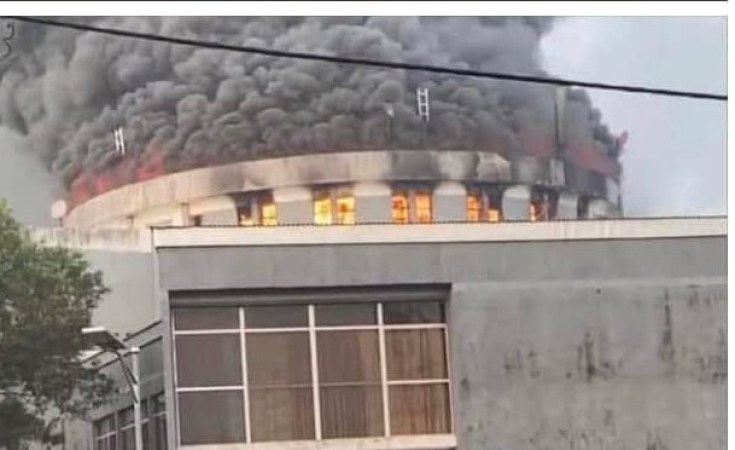
A major evidentiary dispute emerged in the ongoing Capitol arson trial after the prosecution's key audio recordings--presented as proof that former Speaker Cllr. J. Fonati Koffa and six co-defendants, including three current lawmakers, conspired to burn the Legislature--were played in Criminal Court "A" on Tuesday.
Instead of strengthening the government's case, the recordings triggered immediate skepticism from the defense, the jury, legal observers, and even raised doubts within parts of the prosecution's own circle.
The defendants have consistently denied any involvement in the July attack on the Capitol Building.
When prosecutors attempted to introduce the audio files--allegedly retrieved from a defendant's mobile phone--the courtroom fell silent as the recordings were played. What followed, however, was far from the compelling evidence the state had promised.
Keep up with the latest headlines on WhatsApp | LinkedIn
The audio consisted of broken, muffled sounds with monotone voices that were largely indecipherable.
The prosecution's key witness, Rafael Wilson, Chief Investigator of the Liberia National Police Crime Services Department, was on the stand during playback. But Wilson--who admitted he is not a certified voice analyst--could not identify any of the voices or definitively link the conversations to any of the defendants.
"I cannot confirm whose voices are on the recordings," Wilson told the court, a statement that senior defense lawyers argue dealt a significant blow to the prosecution's credibility.
Defense: "This Is AI-Generated, Inadmissible, and Dangerous"
Following the playback, the defense immediately objected, raising concerns about reliability, authenticity, and chain of custody. They argued that advances in artificial intelligence make it possible for audio to be fabricated or manipulated, and the prosecution had failed to provide any forensic verification.
Lead defense attorneys insisted, "This recording cannot be admitted. It is inaudible, unauthenticated, possibly AI-generated, and lacks a verified chain of custody. Allowing it risks convicting innocent people based on manufactured sound."
The defense further questioned whether the audio was extracted legally, as there was no documentation showing how the file moved from the defendant's phone to the investigators, nor any metadata showing time stamps or transfer logs.
Despite objections, Judge Roosevelt Z. Willie ruled that the audio would be admitted provisionally.
He emphasized that admissibility does not equal credibility, and the jury will ultimately determine the recording's evidentiary weight.
Legal observers say the judge's decision reflects Liberia's evidentiary standards, which allow questionable material into court if it is "potentially relevant," but require the jury to decide its value.
However, there are key "red flags" that the jury must examine if it is to come to a conclusive and independent verdict at the end of the case. The jury's evaluation will hinge on several unresolved issues, inaudibility, authenticity concerns, and chain of custody.
Many in the courtroom believe that the audio is significantly distorted, preventing listeners from extracting coherent statements or identifying speakers. Other think forensic expert has to examine the file for tampering.
The file was reportedly extracted from a defendant's phone by a security agent, but there is no documentation of who accessed the device, no log of transfers, and no independent verification of originality
Defendants allege they were tortured and coerced into implicating high-ranking officials, raising questions about whether the audio was recorded under duress or fabricated afterward.
Portions of the audio--though unclear--appear inconsistent with the prosecution's narrative and suggest alternative explanations for the arson.
The prosecution has also introduced physical exhibits, including an empty Clorox bottle, and a matchbox, which they claim were used during the arson.
However, the defense says these items do not match descriptions in earlier police reports, raising questions about whether evidence was added later.
A senior defense lawyer remarked, "If the state cannot get its audio right, cannot get its chain of custody right, and cannot reconcile physical evidence with its own reports, then this prosecution is in serious trouble."
The Capitol Building arson case is one of Liberia's most politically explosive criminal prosecutions in years.
The attack, which resulted in significant fire damage to the Legislature's central wing, sparked public outrage and heightened political tensions. The government quickly launched an investigation, during which several defendants claimed they were detained unlawfully, threatened, and subjected to physical abuse.
Human rights advocates have raised concerns about alleged political motivations behind the arrests, the speed of the investigation, conflicting witness statements, and the questionable handling of digital evidence.

Sign up for free AllAfrica Newsletters
Get the latest in African news delivered straight to your inbox
Legal Context: Liberia's Requirements for Audio Evidence
Under Liberian law, for audio recordings to be admissible authenticity must be established, voices must be identified, recordings must be unaltered, chain of custody must be documented, and recording must be relevant and obtained lawfully.
So far, defense lawyers argue, none of these requirements has been met.
A respected legal mind who observed Tuesday's hearing noted, "Audio evidence is powerful, but dangerous if mishandled. Without certification, transcription, and demonstrable authenticity, the court risks miscarriage of justice."
The trial continues this week with additional prosecution witnesses expected to testify.
The jury will ultimately decide whether the audio is credible, whether other evidence corroborates the prosecution's claims, and whether the state has met the high burden of proof required in a criminal case.
For now, the case has taken an unexpected turn--one that could reshape its trajectory entirely.
As one courtroom observer put it, "If the audio falls apart, the entire case could unravel with it."

