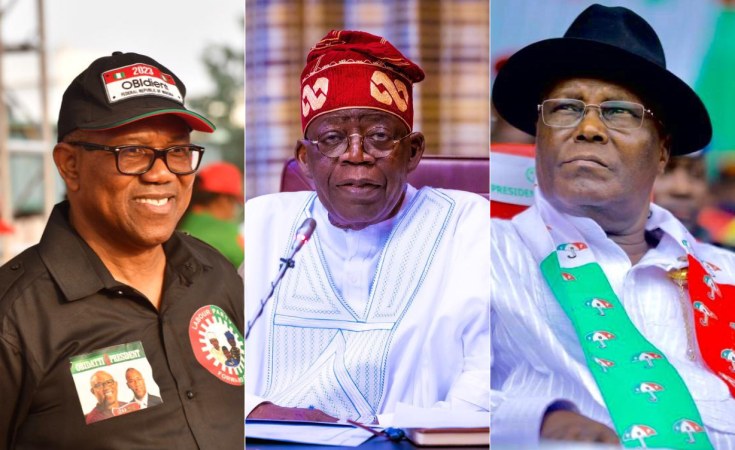
Ahead of the 2027 election, leaders from the opposition platform have warned that the use of state institutions to target elected leaders and also key opposition figures ahead of the 2027 general election poses "a grave danger to Nigeria's democratic future."
The opposition leaders, in a jointly signed statement, decried what they described as the growing politicisation of state institutions for persecution of the opposition.
They also called for sweeping legislative reforms in the operations of anti-graft agencies.
The statement was signed by ADC national chairman, Sen. David Mark; former Vice President, Alh. Atiku Abubakar; former presidential candidate of Labour Party, Mr. Peter Obi.
Keep up with the latest headlines on WhatsApp | LinkedIn
Other signatories to the statement are Mallam Lawal Batagawara, Chief Bode George; and Chief John Odigie-Oyegun.
The statement comes against the backdrop of the Economic and Financial Crimes Commission (EFCC) has held former Justice minister and Attorney general of federation, Abubakar Malami, and former minister of Labour, Senator Chris Ngige, over alleged financial crimes.
Malami and Ngige served as ministers under the immediate-past APC administration of late President Muhammadu Buhari.
The former Justice minister has openly associated with the ADC, while his former labour counterpart has distanced himself from APC since he left office.
However, the opposition leaders, in their statement yesterday, said they were compelled by duty to nation and conscience to alert compatriots and the international community to what they called Nigeria's gradual slide into a state "where key national institutions - particularly the Economic and Financial Crimes Commission (EFCC); The Nigeria Police; The Independent Corrupt Practices and Other Related Offences Commission (ICPC) are increasingly perceived as tools of political intimidation, selective justice and systematic persecution of opposition leaders."
They added that there are mounting concerns that state power is being deployed for persecution of perceived political adversaries with the aim of weakening opposition voices and dismantling Nigeria's multiparty democracy.
They further said there is a covert undemocratic agenda to ensure that all state governments fall under the control of the president's party by secretly intimidating opposition governors via the anti-corruption apparatus until they succumb and defect.
The party leaders claimed that recent defections of opposition governors into the ruling party have reinforced public suspicion that political pressure, not ideological or personal persuasion, is driving this realignment.
"This pattern forms part of a broader project that targets not only elected leaders but also key opposition figures perceived as architects of emerging coalitions ahead of the 2027 general election. We must warn that this project, if allowed to continue unchecked, poses a grave danger to Nigeria's democratic future," they said.
The party leaders said the persecution of the opposition leaders by the EFCC was aimed to weaken the opposition for the benefit of the ruling APC.
They claimed that the pattern reflects a long-standing sentiment openly expressed some years ago by a former national chairman of the ruling APC, Adams Oshiomhole, who declared when receiving defectors from the PDP: "'Once you have joined APC, all your sins are forgiven."'
The opposition leaders claimed that that statement symbolises a "troubling reality where allegations against members of the ruling party are routinely perceived to be overlooked", while unsubstantiated accusations against opposition figures are pursued and subjected to media trial.
They cited a recent example of a female minister, who was forced to resign over allegedly being implicated in a financial scandal but was neither charged nor arraigned by the EFCC.
The opposition leaders claimed the minister is now actively involved in the president's re-election campaign.
They also cited the case of another minister, who, after resigning from office over a university certificate scandal, has yet to face charges months after he left office.
"Such selective enforcement undermines the legitimacy of anti-corruption efforts and erodes public trust."
They added that "Nigerians are not blind to the sudden empowerment of certain political actors, including individuals appointed to federal executive positions after crossing from the opposition but still claim to be members of opposition party - whose unstated mandate, appears to include the systematic destabilisation of opposition parties through the creation of factions, inducement and the exploitation of judicial processes, allegedly funded by state resources."
They however described the EFCC as a critical national institution to safeguard Nigeria's economic integrity but noted that many Nigerians fear that its independence is steadily being eroded.
They told President Bola Tinubu to recognise that evident social and political injustice could snowball into mayhem as the nation approaches another election cycle.
"This trend must be halted immediately if the nation must be spared a major catastrophe," they warned.
Calling for reforms, the opposition leaders said EFCC's operations must be urgently shielded from political interference and must not serve the whims and caprices of any president, party or political faction.
They said the anti-graft agency must return to its statutory mandate of focusing on genuine detection and prevention of economic crimes across board, not selective prosecution, media trials or intimidation of opposition figures.
The opposition leaders also called for the defending of multiparty democracy, stressing that Nigerians must remain eternally vigilant to ensure that the "President does not transform the country into a de facto one-party state - as witnessed in Lagos over the last 25 years, where opposition leaders were silenced, coerced or induced into irrelevance."
They also advocated what they called embed preventive anti-corruption mechanisms whereby anti-graft operatives would be embedded in all levels of government payment processes to ensure compliance with rules of transparency, accountability and probity in public financial transactions.
"Put differently, the EFCC must recognise and exercise their function as covering both pre and post expenditure.
"operatives must also be held accountable for any unreported but later detected economic and financial infractions in their respective areas of oversight.
"To further strengthen the EFCC, we propose that the EFCC Act should be amended for this purpose," the statement said.
The opposition leaders also called on the Attorney General, in consultation with the National Assembly, to set up an independent body with full access to the public accounts of the federal, all states and all local governments from 2015 to 2025.
They said the body would be mandated to conduct a transparent, comprehensive review of financial transactions and publish its findings.

Sign up for free AllAfrica Newsletters
Get the latest in African news delivered straight to your inbox
They added that such a review will expose the EFCC's pattern of selective prosecution of opposition figures and reveal that many current officials of the federal government--and those of ruling-party-controlled states--should have long been prosecuted for economic and financial crimes, but were shielded due to their political affiliation.
Based on its findings, the independent body should also propose amendments to EFCC's enabling law to strengthen the agency for more effective and efficient prevention of financial crimes.
They added that the proposed body will be chaired by an eminent judge, and composed of the following: Representatives from civil society organisations; Representatives of the Nigerian Bar Association; Representatives of Institute of Chartered Accountants of Nigeria;
Others are representatives of the Institute of Chartered Bankers; The Nigerian Financial Intelligence Unit; Representatives of anti-graft agencies; Representatives of the Police; Representatives of the DSS; Representatives of the Armed Forces; Representatives of all political parties with a seat in the National Assembly.
They however called on all patriotic Nigerians across party lines, professions, regions and faiths to stand firm, adding that Nigeria's democracy is under threat through the deliberate and systematic weakening of opposition forces, with the EFCC as the central instrument in this troubling strategy.
The opposition leaders said they will engage foreign partners of Nigeria's anti-graft agencies and diplomatic missions, including United States, UK, Canada, EU, World Bank Office, United Nations, "to express our deep concern about the EFCC increasingly becoming a willing tool in a broader scheme to weaken opposition in Nigeria, and also demand a reform of the anti graft agency."
