

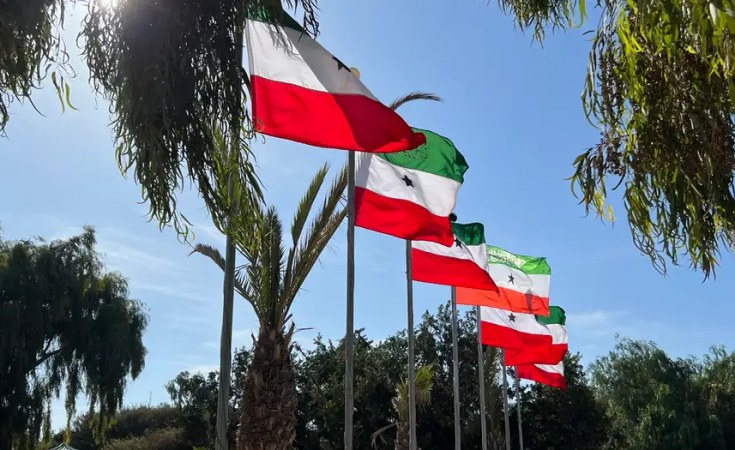
Israel's recent recognition of the entity claiming independence in northwestern Somalia, commonly called Somaliland, has drawn sharp criticism from Somali legal and political circles. The move is widely seen as a violation of Somalia's territorial integrity and a breach of international legal principles.
Legal scholars and Somali officials argue that the recognition does not reflect conditions on the ground and fails to meet established criteria in international law. While no central international body or regional bloc has endorsed Somaliland's claim to statehood, Israel's unilateral move is viewed as politically driven rather than legally grounded.
Not a Legal State
Keep up with the latest headlines on WhatsApp | LinkedIn
Somaliland declared independence from Somalia in 1991 following the collapse of the central government. Since then, it has maintained internal administrative structures but remained unrecognised internationally until now. Israel's move was made without consultation with the African Union or the United Nations.
International frameworks such as the United Nations Charter and the African Union Constitutive Act emphasise the preservation of existing territorial boundaries of member states. The Montevideo Convention of 1933, which outlines the legal standards for statehood, requires a defined territory, a permanent population, a functioning government, and the capacity to enter into relations with other states.
Somaliland's claim falls short on several of these points. Much of the territory it claims is not under its control, and large parts of the population do not recognise its authority.
Northeast Regions Reject Secession
Several regions reject Somaliland's claim to represent all of northern Somalia. Sool, Sanaag, Ayn, and Haylan, collectively known as the Northeast State of Somalia, have formally aligned themselves with the Federal Republic of Somalia.
On August 30, 2025, the Northeast State held regional elections and elected President Abdikadir Ahmed Ali "Firshiye", further reinforcing its commitment to federal governance. The state operates under the Somali Provisional Constitution and participates in the National Consultative Council, Somalia's main intergovernmental coordination body.
This political development affirms the Northeast State's legal and administrative separation from the Hargeisa-based authorities of Somaliland. It also highlights that Somaliland lacks jurisdiction over the entire north.
In the west, the Awdal region has similarly distanced itself from Hargeisa's claims. Local elders and political actors continue to advocate for full inclusion within the federal system and oppose any attempt to secede from Somalia.
One-Group Dominance
The Reer Sheikh Isaq clan dominates the political leadership in Hargeisa. This has raised concerns over the exclusion of other communities in the areas Somaliland seeks to control.
According to international legal standards, the right to self-determination must reflect the collective will of all groups in the territory. The International Court of Justice, in its Western Sahara advisory opinion, stated that self-determination must be genuine and representative. It cannot be claimed by one group while others are sidelined or opposed.
The movements in both the Northeast State and Awdal show that a significant portion of the population rejects Somaliland's project. Without consent from these regions, the case for statehood lacks both legitimacy and legality.
Strategic Intent, Not Legal Ground
Observers note that Israel's recognition appears linked to regional strategy, particularly access to the Bab al-Mandeb Strait, a central international shipping lane in the Red Sea and Gulf of Aden. This area is of interest to many countries due to its proximity to Yemen and the regional security threats it faces.
Legal scholars warn that recognition based on strategic interest, rather than compliance with legal standards, undermines international norms. As Professor Christine Gray notes in International Law and the Use of Force, state recognition should not be reduced to a tool for foreign policy. It carries legal weight and must meet objective criteria.
Israel's decision is therefore seen more as a political gesture than a legitimate recognition of statehood.
A Diplomatic Weakness in Mogadishu
The recognition has also highlighted gaps in Somalia's foreign policy infrastructure. Analysts have pointed to the appointment of diplomats on the basis of political loyalty rather than professional merit.
"Diplomacy must be built on law and strategy, not on patronage," said the author of this article. "We cannot protect our sovereignty without legal expertise at the international level."
Calls have grown for President Hassan Sheikh Mohamud to reform Somalia's diplomatic institutions and strengthen legal advocacy at international forums. Somalia's territorial integrity will not be preserved through political speeches alone but through sustained, qualified diplomatic engagement.
No Legal Effect
Despite public attention, Israel's recognition of Somaliland changes nothing in international law. The region remains recognised as part of the Federal Republic of Somalia.
The presence of functioning regional governance in Sool, Sanaag, Ayn, and Haylan within the Northeast State, combined with Awdal's rejection of secession, weakens the case for a unified Somaliland. These areas continue to participate in Somalia's national legal and political processes.

Sign up for free AllAfrica Newsletters
Get the latest in African news delivered straight to your inbox
The legal test of statehood includes effective control and internal consent. Somaliland lacks in large parts of its claimed territory.
A Federal Path Forward
Somalia's federal model offers the most viable and lawful path to resolving internal disputes. It allows for local governance while preserving the country's unity and international recognition. Communities across the country, including those in the north, already engage in this system.
International actors should respect Somalia's sovereignty and avoid actions that deepen divisions. Recognition of a breakaway region against the will of the broader population sets a dangerous precedent, both in the Horn of Africa and beyond.
Legal References
United Nations Charter, Article 2(4)
African Union Constitutive Act, Article 4(b)
Montevideo Convention on the Rights and Duties of States (1933)
UN General Assembly Resolution 2625 (1970)
Western Sahara, ICJ Advisory Opinion
James Crawford, The Creation of States in International Law
Thomas D. Grant, Recognition of States
Christine Gray, International Law and the Use of Force
By : Abdullahi Mohodin Hassan (Abdullahi Yabarow)
LLM

