

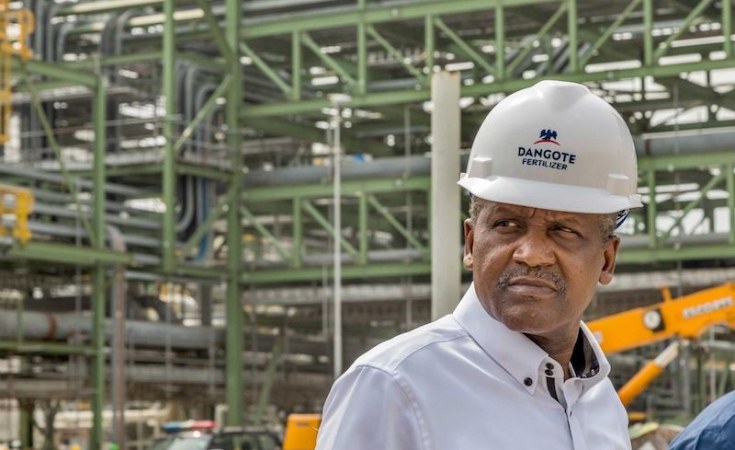
"There is no doubt that the coming into the market by Dangote Refinery will upend rules, traditions, and conventions as the industry has known it, as what Dangote has done in setting up such a massive refinery is to disrupt the industry within and without, at home and abroad. 7
It would thus be naive on the part of the promoters of the Refinery to expect that other players whose livelihood and existence are now under threat will receive them with a bear hug." - Simbo Olorunfemi, 16 September, 2024
Whereas the Petroleum Industry Act, to my understanding, does not vest in the President the powers of a summary dismissal of the CEO or members of the board of the regulatory agencies listed under the PIA, except for circumstances provided for in the Act, vested interests, including a regular analyst, repeatedly accused of speaking for one of the operators, had been making the rounds of TV Stations calling for the sacking of the CEOs of the NNPC, NUPRC, and NMDPRA for over a year, before Mele Kyari was removed earlier in the year, and Farouk Ahmed and Gbenga Komolafe eventually threw in the towel.
So, while the recent allegations against Farouk Ahmed by Alhaji Aliko Dangote might have been the immediate trigger of the departure from office, there is no doubt that efforts to ease him out have been afoot for a while, and Gbenga Komolafe might not just have been collateral damage in the battle between Dangote and Ahmed, as some have framed it, but a target, as well, with the NUPRC having been accused of standing in the way of the Dangote Refinery's stated objectives.
Keep up with the latest headlines on WhatsApp | LinkedIn
There is no doubt that Dangote has not been happy with the NNPC, NUPRC, and NMDPRA for different reasons. The questions are - Why is that so? What does he want? At the heart of Dangote's grievances are the following issues:
The Crude Conundrum
Crude oil is the lifeblood of any refinery. As the NNPC's former CEO, Mele Kyari, once put it, "You must secure your feedstock and find a market. This is basic and determines what happens in any refinery worldwide." Alhaji Dangote would know that, and must have put some thought, one would think, into how he can have regular and reliable access to crude to service the refinery. Perhaps there might have been conversations with the trio around the 445,000 bpd allocation for domestic refining, which, since the NNPC-owned refineries had been out of operation, had largely been deployed into servicing the Direct Sale Direct Purchase (DSDP) swaps for refined products.
The lifeline must have been the 2021 decision by the NNPC to stake $2.76 billion for 20 per cent equity in the Dangote Refinery. Apart from the immediate injection of a much-needed $1 billion (secured through a forward sale arrangement) for 7.2 per cent stake in the project, the balance was supposed to come through crude swaps at $2.5/bbl discount on 300,000 bpd over time. That would have guaranteed almost a steady supply of almost 50 per cent of the refinery's needs. But before that could kick off, the NNPC backed out of the arrangement, capping its equity participation at the paid sum, citing investment portfolio realignment, as the reason.
That must have wrong-footed Dangote, which then made him fall back on Section 109(2) of the PIA, whichmandates a Domestic Crude Supply Obligation (DCSO), requiring lessees like NNPC and IOCs to prioritise local refineries over exports. While Dangote saw it as a mandatory requirement, a prerequisite to the issuance of export permits, my interpretation, relying on Section 3(1), was that the DCSO was more persuasive than punitive, as it spoke to supply "ON A VOLUNTARY BASIS at the prevailing international market price," akin to the arrangement/argument by the NUPRC that it could only be on a "willing buyer, willing supplier" basis, especially when encumbrances such as pre-existing contracts and oil theft have affected production level and crude availability.
But that argument didn't cut it with Dangote, who accused the NUPRC, under Gbenga Komolafe, of failing to enforce the rules and urged it to wield its Section 4(8) hammer: deny export permits to non-compliant lessees and impose 50 per cent fiscal penalties. Devakumar Edwin, Dangote VP Oil and Gas, decried what he saw as NUPRC's reluctance, which had left them "high and dry," forcing them to buy Nigerian crude from international traders at a premium. Even when NUPRC claimed it had facilitated delivery to the Dangote Refinery, for a long time, the company was still not satisfied. While the naira-for-crude arrangement, which allows for local refineries like Dangote to purchase Nigerian crude oil from NNPC Ltd in naira instead of dollars, even with the initial hiccups, might have steadied the waters, the undercurrents remain troubled, if not turbulent.
The PIA
It might not be out of place to track back to the 13-year process that led to the enactment of the Petroleum Industry Act (PIA) 2021 and the conversations There was an agreement among stakeholders to not incorporate into the PIA the Backward Integration Policy (BIP)-style waivers launched in 2002 primarily for cement, and later extended to commodities like sugar, rice, and dairy, which offered targeted fiscal and regulatory incentives, such as high tariffs or outright import ban on finished goods once local capacity met certain thresholds. The objective of the BIP was to encourage importers to invest in local production and reduce Nigeria's import dependence. However, for reasons to do with governance and equity concerns, fiscal and corruption risks, and the need to avoid distorting Nigeria's liberalised oil markets, the drafters of the Petroleum Industry Act (PIA) 2021 decided to prioritise investor neutrality over sector-specific protections.
Distribution Challenges
In all of the issues, one area that has been the stickiest is the modalities for the distribution of products from the refinery to the Nigerian market. Faced with enquiries from the media following the official announcement of the commencement of production, Alhaji Dangote said: "On pricing, it is an arrangement which is designed and approved by the Federal Executive Council (FEC) led by His Excellency, President Bola Ahmed Tinubu...As soon as it is finalised, which he (Tinubu) is pushing, once we finish with NNPC, it can be today, it can be tomorrow, we are ready to roll into the market." That took not a few by surprise, as one could not understand how/why a private operator in a deregulated industry would be waiting on FEC or NNPC to fix or announce the price of its products. That there was a lack of clarity on the pricing/distribution model was evident. If there was a prior understanding on that, it unravelled immediately, as the NNPC declined the 'offer' to be a sole offtaker for Dangote's products. "The DRL and any other domestic refinery are free to sell directly to any marketer on a willing buyer, willing seller basis, which is the current practice for all fully deregulated products. NNPC Ltd has no desire or intention to become the distributor for any entity in a free market environment, and therefore, the notion of becoming a sole offtaker does not arise," NNPC stated.
My thought, at the time, was that the Dangote Refinery had worked with an expectation or understanding of a B2B model with NNPC, rather than a B2C model, and was caught flat-footed by that development. But it quickly responded, triggering a chain of events and reactions that triggered a war between Dangote and marketers on one hand, and Dangote with other players - the regulators, the SOE (NNPC), and even workers, turning the industry on its head.
Issue with Marketers
The battle between Dangote and the marketers has been the fiercest. It started in September 2024, with Devakumar Edwin, Vice President, Dangote Industries Limited, calling out local marketers for not buying their products, saying that only about 3 per cent of local oil marketers are purchasing refined products from the refinery. "The conglomerate of all oil marketers is refusing to buy from us. It is very strange that after putting up the refinery to supply the products locally, we have to export every diesel and jet fuel because they do not want to buy from us," he said.
But marketers cited some encumbrances on the way of their patronising Dangote:
"We are disadvantaged by the Dangote Refinery policy of selling Big Parcels of products to international traders who then take such products offshore Lome and resell to Nigerian oil traders in small parcels and in market terms that they are used to, such as credit terms, in Naira (eliminating exchange risks) and in quantities needed, and of course higher than what they paid Dangote Refinery."
The relationship between the two parties degenerated with allegations hurled from Dangote's end at marketers for bringing in dirty and off-spec products, the purchase of crude from Russia, and running a blending plant in Malta. The NMDPRA was also accused of compromise, by allowing importers bring in dirty fuel and indiscriminate issuance of licence for the importation of products. "...licences are being issued, in large quantities, to traders who are buying the extremely high sulphur diesel from Russia and dumping it in the Nigerian Market," Dangote's Vice President said. Farouk Ahmed, the NMDPRA CEO, shot back, "Dangote refinery is still in the pre-commissioning stage. It has not been licenced yet. We have not licensed them yet. I think they are at about 45 per cent completion. So, we cannot rely heavily on one refinery to feed the nation because Dangote is requesting that we should suspend or stop all importation of petroleum products, especially automotive gas oil (AGO) or jet Kero, and direct all marketers to the refinery... Dangote refinery, as well as some major refineries like Waltersmith refinery, produce between 650 ppm to 1,200 ppm (of sulphur in their diesel). So, in terms of quality, their quality is much more inferior to the imported quality."
The Court
Out of frustration with the NMDPRA. Dangote Refinery approached the court in September 2024, suing NMDPRA (1st defendant), NNPC Ltd (2nd), and importers like AYM Shafa, A.A. Rano, T. Time Petroleum, 2015 Petroleum, and Matrix Petroleum (third-seventh), seeking a declaration that NMDPRA had violated PIA Sections 317(8-9) by "issuing import licenses without proven domestic shortfalls." Dangote filed to discontinue/withdraw the suit in July, as momentum picked up on the naira-for-crude deal, and the suit was formally dismissed by the Court in November.
15 Per cent Tariffs
What Dangote could not secure from the PIA and the Court, it appeared to have secured through a government policy in October, as the government approved a 15 per cent ad-valorem tariff on imported petrol and diesel in late October 2025 as a "market-responsive framework" to protect local refineries, such as Dangote. While that drew backlash from marketers, it brought some form of added respite for Dangote, until an announcement came from NMDPRA in November, "that the implementation of the 15 per cent ad-valorem import duty on imported Premium Motor Spirit and Diesel is no longer in view." The argument that this was done in response to "public concerns" didn't make sense to Dangote, describing the suspension as "disappointing."
That decision by the NMDPRA must have been the trigger that made Aliko Dangote ramp up the push to oust Farouk Ahmed from the leadership of the NMDPRA and put an end to what, to him, has been an unfriendly regulatory regime.
But does that automatically guarantee a regime in which Dangote is now able to have its way, and have all the underlying issues swept away? Well, there are a few things undefined or unclear about the industry at the moment - current local production level, local cost of production, availability of feedstock, and terms under which such will be made available for local refining. There are also issues around the distribution of products, especially where the dominant players of the pre-Dangote distribution structure (MOMAN, DAPPMAN, PETROAN) come in.

Sign up for free AllAfrica Newsletters
Get the latest in African news delivered straight to your inbox
Single Train Refinery
There are also issues of capacity and utilisation constraints with the Dangote Refinery, some have said. A single-train Residue Fluid Catalytic Cracking (RFCC) unit, as in Nigeria's Dangote Refinery, faces inherent technical limits due to its monolithic design, leading to high vulnerability to outages, suboptimal capacity utilization and frequent maintenance needs, experts say. Single-train RFCC requires phased turnarounds, and the Dangote Refinery has reportedly faced intermittent outages with a shutdown at the moment for catalyst replacement and reactor repairs scheduled to last until January 2026, pausing crude distillation for a while. That might be what has led to expansion plans for a second single-train unit that will increase the plant capacity to 1.4 million bpd.
That inherent vulnerability and claims that the current production capacity, said by NMDPRA to be between 50 per cent and 60 per cent (18-23.5M litres daily), with national consumption level put at 35-40 million litres daily has been cited as cause for concern in terms of energy security, and grounds for continued imports to avert shortages.
The Many Battles
One would have thought that with all that Alhaji Aliko Dangote has been through, he would be battle-weary by now. But it does look like, rather than being battle-weary, he is, in fact, battle-hardened. He has firmly laid it out - "$20 billion of investment is too big to fail... At the end of the day, someone will give up; either we give up, or they will give up, and I don't think I will give up."
There is a suggestion that this might be a fight to finish. One estimate I saw puts the monthly loss, on account of the price cut on Petrol, at almost N200 billion between Dangote and the marketers. It is difficult to tell what the actual endgame is. Not sure if this war is the sustainable path to take for all the parties. Not sure if the change in the leadership of the three sisters can guarantee a smoothing of relations, without a correction or agreement on some of the underlying fundamentals, as evident in the continued, even if understated, friction between NNPC and Dangote. There are underlying, largely unspoken issues around the PIA that require a careful reading to ensure that the interests of all parties are subsumed under the interest of Nigerians and the nation.
As counselled in an August 2024 intervention, "it is not too late to get everyone back in the boardroom to fashion out a win-win solution, with Nigeria's energy security and national interest guaranteed...I think that should start from a recognition and acceptance that mistakes have been made. I will argue that what is required, at this time, is what we usually refer to as the 'political solution'. There has to be a way for a win-win solution.
Simbo Olorunfemi is a specialist on Nigeria's foreign policy, a communications consultant, and managing editor of Africa Enterprise. Email: Editor@enterpriseafrica.ng

