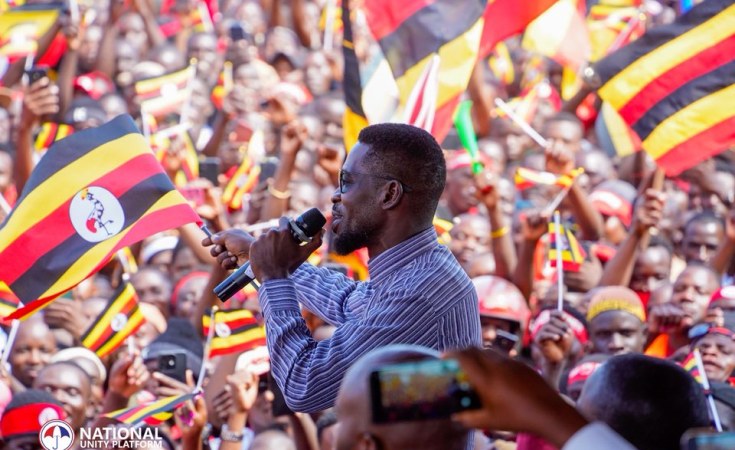
Forty years since Yoweri Museveni took power in Uganda, he plans to seek a seventh term as president in elections on 15 January. His strongest challenger is former entertainer Bobi Wine, but his party's rallies have been marred by what watchdogs call a "brutal campaign of repression".
The campaign for this month's general elections began calmly enough, according to Kristof Titeca, an expert on governance in Uganda at the Institute of Development Policy at the University of Antwerp.
"But as soon as Bobi Wine and his political party, the NUP, really started campaigning, the repression escalated," he told RFI.
Follow us on WhatsApp | LinkedIn for the latest headlines
The NUP has complained of arbitrary arrests at its rallies, saying that some 400 of its supporters have been detained. While analysts put the figure lower, closer to 200, it is evident that there has been "a real attempt to prevent Bobi Wine and the NUP from campaigning, from organising rallies", Titeca said.
"The repression remains very clear."
Tear gas, torture
The United Nations and other organisations have sounded the alarm over a crackdown that seems to be intensifying as Uganda's elections near.
According to Amnesty International, Ugandan security forces have unlawfully targeted opposition rallies with excessive force as well as arrests, and subjected some attendees to torture.
The rights watchdog said this week it had documented incidents in which security officers fired tear gas and beat people at two separate NUP rallies in November where at least one person died. The organisation spoke to others who said they were hit with batons, pepper-sprayed in the mouth and tasered.
While police claimed attendees had provoked the violence, eyewitnesses told Amnesty the crowds were peaceful.
The organisation says it has also received reports and verified digital evidence of similar incidents in other parts of the country.
"The authorities have launched a brutal campaign of repression against the opposition and its supporters, making it extremely difficult for them to exercise their rights to freedom of association and peaceful assembly," said Tigere Chagutah, Amnesty's regional director for East and Southern Africa.
Ugandan opposition MP abducted and tortured ahead of elections
Human rights lawyer arrested
Having reviewed court charge sheets, Amnesty says that in at least some cases, people have been arrested "solely for their perceived support for the NUP".
Those detained including Sarah Bireete, a prominent lawyer and human rights activist, who was arrested at home in Kampala on 30 December. She is accused of unlawfully obtaining or disclosing voters' data, charges she denies.
Her arrest marks a new level of repression, according to Titeca.
"This didn't happen in previous elections," he said. "This is the first time a figure like Sarah Bireete has been arrested on charges that were somewhat vague."
Ugandan opposition denounces brutal crackdown ahead of 2026 elections
'Hybrid regime'
Since Museveni came to power in January 1986, he has walked a fine line at the head of a "hybrid regime", Titeca explained.
"It has authoritarian tendencies, but also democratic ones. That means the government and President Museveni still need the support of the international community, namely the European Union and the United States, the financial and political backing of these international actors."
These conflicting demands explain why Wine has been allowed to stand, Titeca said, even as longtime opposition leader Kizza Besigye is in jail on charges of treason.

Sign up for free AllAfrica Newsletters
Get the latest in African news delivered straight to your inbox
Ugandan court denies bail to veteran opposition leader in treason case
At 81, one way or another Museveni's time in power is limited. For Ugandans, the most important question now is what comes after, Titeca said - whether the president is replaced by one or his opponents or by his son, Muhoozi Kainerugaba, the head of the army who is being positioned as his successor.
The Museveni clan will do everything it can to stop power changing sides, Titeca said, "and that is the greatest difficulty or danger for the country".
"How will this transition unfold? Will the army and the people accept that someone from Museveni's clan stays in power once more?" That remains to be seen, the analyst concludes.
This article is based on an interview in French by RFI's Christophe Boisbouvier.

