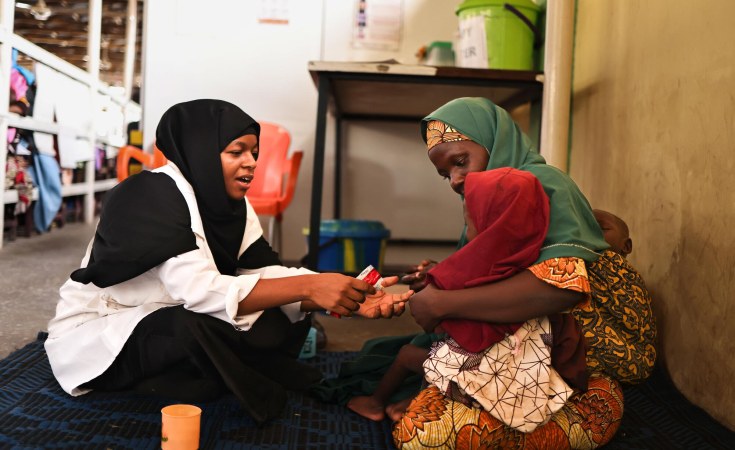
According to the Kebbi State Nutrition Office, 608 severely malnourished children died between January and September 2025 across 21 treatment centres in five local government areas.
Misconceptions about child malnutrition continue to delay medical care in Kebbi State, contributing to hundreds of preventable deaths despite the presence of treatment centres and humanitarian support.
For families like Halima Abdullahi's in Birnin Kebbi, such delays have proved fatal.
Mrs Abdullahi, a resident of Aleiru quarter, took her one-year-old daughter, Hauwa, to Sir Yahaya Memorial Hospital in Birnin Kebbi metropolis in August 2025. There, doctors diagnosed the child with severe acute malnutrition.
Follow us on WhatsApp | LinkedIn for the latest headlines
Mrs Abdullah said her family initially believed the child's illness was the result of witchcraft and relied on traditional remedies.
"We were reluctant and relied on traditional medicine because we believed it was witchcraft. When we eventually took her to the hospital, she was admitted to the intensive care unit," she said.
Seven days later, the child died.
"I was sitting beside her bed when I noticed her head shaking rapidly. I realised she was dying and called the doctors. They asked me to step outside, and a minute later they told me my daughter had died."
Her story reflects a broader pattern across Kebbi State, where health officials say misconceptions around malnutrition continue to delay medical care and contribute to preventable child deaths.
A cycle of losses
Rabiatu Usmanu lived through a similar tragedy, having lost one of her daughters to malnutrition years ago.
At the time of the visit in October, she was receiving treatment for her one-year-old twins, Hassan and Hussaina, at the Takalau Malnutrition Treatment Centre in Birnin Kebbi.
"My first daughter survived malnutrition, but I lost the second," Mrs Usmanu said. "Now my twins are being treated for the same illness. Thankfully, they are responding to treatment, and we will soon be discharged."
Mrs Usmanu, who is from Gwandu Local Government Area, said she now understands the importance of early medical intervention.
Delays fueled by misconceptions
Health officials say deeply rooted misconceptions that portray malnutrition as a spiritual attack have worsened child deaths in Kebbi State.
According to a document obtained by PREMIUM TIMES from the Kebbi State Nutrition Office, the state recorded 608 deaths among severely malnourished children between January and September 2025.
The deaths occurred across 21 treatment centres in five local government areas. Three of the centres are supported by Médecins Sans Frontières (MSF), also known as Doctors Without Borders.
Data from the 2018 Nigeria Demographic and Health Survey (NDHS) highlights the severity of malnutrition in the state.
Among children under five, 66.1 per cent are stunted, 16.6 per cent wasted, and 80.8 per cent anaemic. Only 38.1 per cent meet minimum dietary diversity, while just 25.1 per cent of newborns are breastfed within one hour of birth.
The World Health Organisation (WHO) warns that malnutrition not only increases the risk of death but also leads to stunting, impaired cognitive development, and reduced intelligence quotient (IQ).
Why caregivers arrive late
Comfort Joel, nursing team supervisor at the Maiyama Hospital in Kebbi, said many caregivers arrive at health facilities only when a child's condition has become critical.
"Most of the children come in with severe acute malnutrition, often complicated by diarrhoea or other illnesses," she said.
Ms Joel explained that cultural beliefs, household decision-making and mistrust of medical information often delay care.
"Some mothers need permission from their husbands before seeking treatment. Others are discouraged by in-laws who insist the illness can be treated at home," she said.
She added that some caregivers expect immediate recovery and request early discharge when improvement is not visible within days.
Economic pressures, culture, access driving malnutrition
Mairo Idris, a paediatric nutritionist, said Nigeria's volatile inflation and rising poverty levels are significantly worsening malnutrition across the North-west, including Kebbi State.
She explained that, beyond economic hardship, entrenched cultural practices and poor dietary habits continue to fuel the crisis.
According to Ms Idris, a major but often overlooked driver is the disconnect between crop production and household consumption.
"In Kebbi and many other North-west states, men are largely responsible for cultivating nutritious crops needed for child development. However, many sell their entire harvest for income without reserving a portion for household consumption," she said.
This, she noted, leaves women struggling to address child malnutrition without access to the very foods grown within their communities.
Knowledge gaps and misconceptions
Even when food is available, poor dietary knowledge remains a major challenge, Ms Idris said.
"Many mothers have the right ingredients but lack the knowledge to prepare balanced meals. This leads to over-reliance on Ready-to-Use Therapeutic Food (RUTF) only after a child's condition has deteriorated to a critical stage," she said.
She stressed that RUTF should complement, not replace, adequate household nutrition.
Myth of "spiritual attacks"
Ms Idris said misinformation continues to fuel beliefs that malnutrition symptoms are caused by spiritual attacks.
As a result, families often prioritise traditional or spiritual treatments over medical care, delaying hospital visits until the child's condition becomes severe.
"By the time many families arrive at health facilities, the child's condition is already critical. These are deaths that could largely be prevented through early detection and timely care," she said.
She added that geographic isolation in rural communities further compounds the crisis.
While global health standards recommend that primary healthcare facilities be located within two kilometres of communities, many families in the North-west live far beyond this range.
Transportation costs, she said, discourage clinic visits, while household dynamics often prevent women from seeking care.
Rapid population growth, Ms Idris warned, is also overstretching already fragile healthcare systems.
"As cases continue to rise, existing facilities lack the capacity to provide quality care to every child in need. Without addressing both economic pressures and cultural misconceptions, malnutrition in the North-West will continue to worsen," she said.
State government response
The Kebbi State Nutrition Officer, Bello Aliyu, said the state government released N500 million as counterpart funding to UNICEF's Child Nutrition Fund (CNF) for the procurement of Ready-to-Use Therapeutic Food (RUTF) and other nutritional supplements.
He added that Governor Nasir Idris has approved the distribution of Small Quantity Lipid-Based Nutrient Supplements (SQ-LNS) and Ready-to-Use Supplementary Food (RUSF) across the state.
Mr Aliyu said the government has also reactivated 140 outpatient treatment centres, bringing the total number of nutrition facilities to 161, including the 21 existing centres.
According to him, sustained awareness campaigns have helped address long-standing misconceptions, with more caregivers now seeking treatment for malnourished children at health facilities.
Mr Aliyu said the state's food and nutrition policy aims to reduce hunger and malnutrition by 20 per cent by 2027.
He added that the policy targets increasing exclusive breastfeeding rates to 30 per cent, expanding zinc supplementation coverage to 50 per cent, and boosting the cultivation of nutrient-dense and fortified crops by 70 per cent.
Northern Nigeria in crisis
In November, Médecins Sans Frontières (MSF) warned of a worsening child malnutrition crisis across northern Nigeria, noting that thousands of children continue to die each year despite expanded humanitarian and government interventions.
Speaking during a high-level conference titled "Mobilising Against Malnutrition in North-West Nigeria" in Abuja, the organisation said admissions and deaths among children under five rose sharply in 2025, describing the situation as a recurring emergency that demands urgent and coordinated action.
The MSF Country Representative, Ahmed Aldikhari, said Nigeria remains the epicentre of the organisation's global malnutrition response, with more children treated in the country than anywhere else in the world.
According to him, MSF admitted nearly 300,000 children with severe acute malnutrition (SAM) across northern Nigeria in 2024, more than half of the organisation's global admissions for the year.

Sign up for free AllAfrica Newsletters
Get the latest in African news delivered straight to your inbox
He attributed the scale of the crisis to Nigeria's large population and the high burden of malnutrition in the northern Sahelian belt, where hunger, seasonal food shortages, and recurrent disease outbreaks intersect.
While acknowledging the federal government's March 2025 declaration of malnutrition as a national emergency, Mr Aldikhari called for stronger collaboration among government authorities, humanitarian partners, and donors.
Rise in cases
Evgenia Zelikova, MSF medical manager, speaking with PREMIUM TIMES, said admissions rose at least 20 per cent in 2025, with over 120,000 children treated by September, surpassing 2024's total of 90,000.
Most affected children are under two years old, though nearly 40 per cent are older. Repeated malaria and cerebrospinal meningitis outbreaks have worsened the crisis, overwhelming health facilities.
Despite expanding inpatient capacity from 100 to 800 beds, over 1,000 children died from malnutrition and related illnesses in 2025.
Federal government response
At the same conference in Abuja, Uju Rochas, senior special assistant on Public Health, who represented Vice President Kashim Shettima, described malnutrition as both a public health and economic crisis, estimating that it costs Nigeria about $56 billion annually.
She said federal initiatives such as the Nutrition 774 programme and Accelerated Nutrition Results in Nigeria (AMRIN) 2.0 are designed to integrate nutrition interventions across all local government areas through improved financing, coordination, and accountability.
Also speaking at the event, the Coordinating Minister of Health and Social Welfare, Muhammad Pate, represented by Ladidi Bako, said malnutrition remains one of Nigeria's most pressing challenges, particularly in the North-west, where stunting and wasting rates have exceeded emergency thresholds.
He noted that behind every statistic is a family struggling to cope, and while humanitarian interventions have helped to mitigate the crisis, underlying drivers such as poverty, food insecurity, and weak health systems remain unresolved.
Mr Pate said that under President Bola Tinubu's Renewed Hope Agenda, nutrition has been elevated to a national priority, with the federal government scaling up both preventive and treatment interventions.
