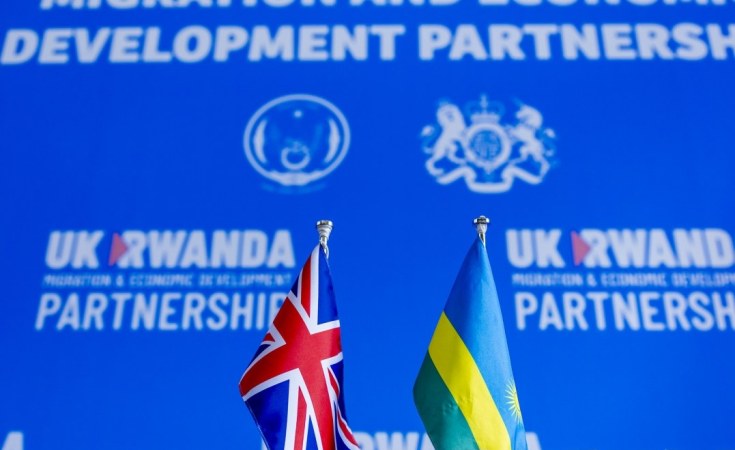
Rwanda has initiated arbitration proceedings against the United Kingdom before the Permanent Court of Arbitration. The proceedings arise from a dispute concerning the implementation of commitments under the Migration and Economic Development Partnership (MEDP), a bilateral treaty concluded between the two States.
Contacted by The New Times, Michael Butera, Chief Technical Advisor to the Minister of Justice said Rwanda engaged in diplomatic exchanges before initiating arbitration: "Rwanda attempted at first to clarify positions and explore possible paths forward, indicating openness to discussion, including on the orderly conclusion of the partnership, provided that any arrangements were mutually agreed and legally consistent. As these discussions did not result in a shared understanding, we exercised the dispute-resolution option expressly provided in the treaty."
ALSO READ: VIDEO: Rwanda, UK sign new migration deal
Butera added that the use of arbitration reflects Rwanda's preference for resolving inter-State disputes through established legal mechanisms: "Arbitration offers a structured and neutral process through which both parties may present their positions and obtain a determination in accordance with international law."
Keep up with the latest headlines on WhatsApp | LinkedIn
ALSO READ: Rwanda, UK hail 'bold' migration deal
The issues in dispute
The arbitration concerns the performance of specific commitments under the treaty.
Rwanda and the United Kingdom had agreed--through a binding exchange of diplomatic notes in June 2024--on financial arrangements intended to support refugee hosting and economic integration. Under those arrangements, two payments of £50 million each became due in April 2025 and April 2026. These payments have not been made.
ALSO READ: UK-Rwanda migration deal expanded
The treaty also envisaged the establishment of arrangements under which the United Kingdom would resettle a portion of the most vulnerable refugees hosted in Rwanda. While the treaty provided a framework for such arrangements, they were never finalised.
Finally, when the new U.K. government took over last year, announcements were made indicating that the partnership would no longer continue.
According to Butera: "These announcements were made prior to the formal invocation of the treaty's termination provisions. Under international law, termination operates prospectively and does not affect obligations that had already accrued while the treaty remained in force."
Beyond the specific treaty, the dispute underscores a broader principle of international cooperation: agreements between States are intended to be performed in good faith and in accordance with their terms.
Rwanda has consistently approached its international engagements on that basis, including where doing so has required significant institutional preparation and financial commitment. The expectation that agreed obligations will be respected is central to maintaining trust and predictability in international relations.

Sign up for free AllAfrica Newsletters
Get the latest in African news delivered straight to your inbox
Asked about the next steps in the case, Butera explained that the arbitration will proceed in accordance with the applicable rules and procedures: "Rwanda will participate constructively and professionally in that process. Through arbitration, Rwanda seeks a legal determination of the parties' respective rights and obligations under the treaty, in accordance with international law. Rwanda remains committed to international cooperation on migration, refugee protection, and development--guided by respect for the rule of law, reciprocity between partners, and the orderly resolution of disputes through agreed legal frameworks."
The origin and purpose of the partnership
The MEDP was established following a request by the United Kingdom to explore new approaches to addressing irregular migration. Rwanda engaged in the partnership in line with its long-standing national and international commitments on refugee protection, including close cooperation with UNHCR and a policy approach centred on dignity, self-reliance, and socio-economic inclusion.
Rwanda has hosted significant refugee populations for decades while pursuing inclusive development under Vision 2050. The partnership aligned with this experience and with Rwanda's broader approach of linking humanitarian protection with long-term economic opportunity.
At the United Kingdom's initiative, the partnership was subsequently formalised into a legally binding treaty, which entered into force in April 2024. The treaty established reciprocal obligations and included a dispute-resolution mechanism providing for arbitration.
