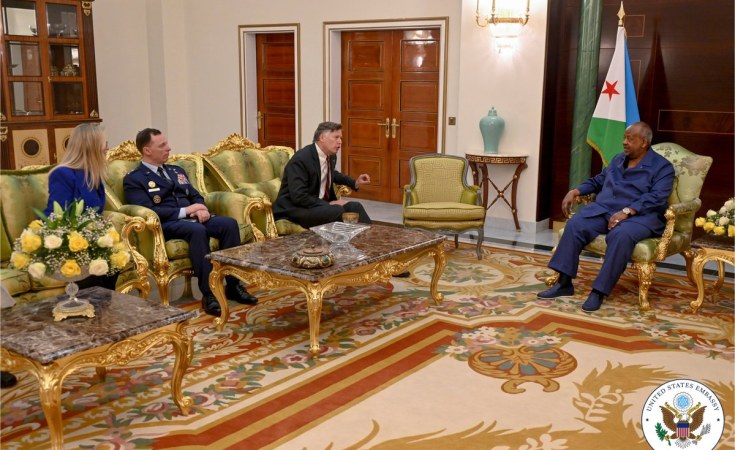
Washington has said a visit by Deputy Secretary of State Christopher Landau to Africa aims to strengthen bilateral ties, but the timing raises questions about the US's interests in the Red Sea corridor.
US Deputy Secretary of State Christopher Landau is on a diplomatic tour of Egypt, Ethiopia, Kenya and Djibouti from January 24 to February 1.
According to the Department of State, Landau's visit aims to promote President Donald Trump's priorities of "rebalancing trade, ensuring a positive business environment, and promoting security and peace."
Landau has described the trip, his first to the region, as "one of the great privileges" of his job, which allows him to exchange ideas with world leaders.
Follow us on WhatsApp | LinkedIn for the latest headlines
Out of the four countries Landau is touring, three are part of the US-led multinational naval force deployed in the Red Sea to defend against attacks from Houthis.
The trip also comes on the back of a statement by Ambassador Tammy Bruce, deputy representative of the US to the United Nations, referring to the Houthis as a "terrorist organization who, with the support of the Iranian regime, pose a continuing threat to regional stability and freedom of navigation in the Red Sea and surrounding waterways."
Some analysts believe this trip to the Red Sea region could be part of America's push for dominance in the geopolitical competition for global influence.
"The visit signals how the US views East Africa and the Red Sea as a single interconnected strategic theater," Charles Amo-Agyemang, a senior lecturer of politics and international relations at the University of Ghana, told DW. "The choice of these countries was not accidental. It was deliberate, strategic and it was conscious."
How crucial is the Red Sea region?
The Red Sea region, which encompasses Egypt, Eritrea, Djibouti, Sudan, Saudi Arabia and Yemen, stretches from the Suez Canal through the Bab el-Mandeb Strait to the Gulf of Aden.
It covers approximately 438,000 square kilometers (170,000 square miles) and borders some of the world's most volatile regions: the Horn of Africa, the Arabian Peninsula and the western shore of the Indo-Pacific area.
The International Maritime Organization says its waters "constitute one of the most critical maritime routes enabling global trade, and present immense opportunities for development and prosperity in the region."
Despite the crucial role it plays in international trade, the region is also plagued by increasing regional instability, conflict, piracy and transnational organized crime, which the US is committed to tackling.
Timing of Landau's trip
General Dagvin Anderson, commander of US Africa Command (AFRICOM), stressed that the visit signifies America's readiness to help resolve threats in the Red Sea region.
"There are threats that we share here in the Horn [of Africa]. Threats of al-Shabaab, ISIS and a coordination across the Red Sea with the Houthis trying to destabilize the region," said Anderson, who has accompanied Landau during his visit.
However, Etse Sikanku, dean of the School of Journalism and Media Studies at Ghana's University of Media, Arts and Communication, believes the timing is due to a shift in global power alliances.
Dozens killed in US strike on Yemen, Houthis say
"There is that recognition that the US is loosing its hold within the continent and there is a certain eagerness to make sure that they can reinsert themselves into the global relationship as far as Africa is concerned," Sikanku told DW.
For Amo-Agyemang, Africa is caught between two great powers.
"The US intends to maintain a strategic foothold despite China's expanding presence," he said, adding that in international relations, there is a lot of interest in these kinds of great power rivalry.

Sign up for free AllAfrica Newsletters
Get the latest in African news delivered straight to your inbox
"But importantly, we must be careful not to use Africa as a launching pad for great power competition."
The African Union has emphasized that Africa and the US can build on a strategic partnership "grounded in mutual respect, shared interests and a common commitment to peace, stability, and prosperity."
But experts are split on whether the continent can truly benefit from this renewed interest.
Sikanku suggests African nations must reassess their relations with the United States "on new terms and in ways that will also benefit the continent."
Edited by: Chrispin Mwakideu
Adwoa Tenkoramaa Domena Ghanaian author and multimedia journalist
