

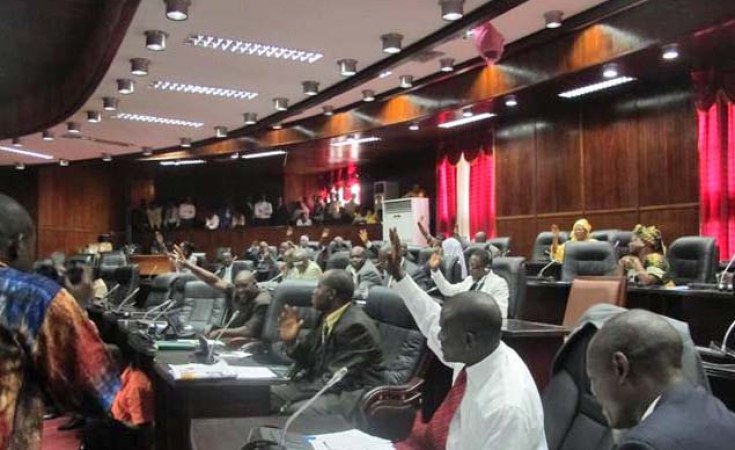
CAPITOL HILL — Liberia's House of Representatives last Thursday abruptly halted a controversial attempt to expand presidential power over the country's anti-corruption watchdog, returning a proposed amendment to the Liberia Anti-Corruption Commission (LACC) Act to committee after lawmakers warned it could undermine constitutional safeguards and weaken the independence of the anti-graft body.
In a unanimous decision taken during the 14th Day's Sitting of the First Quarter of the Third Session, lawmakers rejected immediate consideration of the amendment and voted instead to send the proposal back to the Joint Committee on Public Accounts and Expenditure, Judiciary, and Good Governance & Government for an additional three weeks of scrutiny.
The controversy stems from a proposal to amend the LACC Act and sections of the Criminal Procedure Law to eliminate the current requirement that LACC commissioners may be removed only with the approval of two-thirds of the Liberian Senate.
The amendment would instead grant the President unilateral authority to remove commissioners upon establishing "probable cause," without legislative concurrence, a change that has triggered sharp debate about constitutional limits on executive authority.
Keep up with the latest headlines on WhatsApp | LinkedIn
Constitutional Questions Dominate Debate
Lawmakers who backed the decision to slow the bill's progress said the proposed changes raise serious constitutional concerns, particularly regarding due process, equal protection and the separation of powers.
Members of the House noted that the proposal could conflict with Article 20(a) of the 1986 Constitution, which guarantees due process, and Article 11(c), which ensures equal protection under the law.
They also warned that the amendment may undermine Article 3, the constitutional provision establishing Liberia's doctrine of separation of powers among the executive, legislative and judicial branches.
Montserrado County District 3 Rep. Melvin Cole, who introduced the motion to return the bill to committee, told colleagues the Joint Committee's findings made clear that lawmakers should proceed cautiously.
"Owing to the Joint Committee's recommendations, which raise valid and serious constitutional issues, this matter should be returned for robust scrutiny," Cole said on the House floor.
However, Rep. Musa Bility of Nimba County District 7 went further, arguing that the legislation should be returned entirely to the Executive Branch for reconsideration.
"I think the President did not see this law in its entirety," Bility said during the debate. "It contains numerous constitutional violations."
Committee Raises Red Flags
In its report to the plenary, the Joint Committee warned that proposed amendments to the Criminal Procedure Law could alter key legal standards governing criminal prosecution.
Specifically, the committee noted that the changes could affect the burden of proof and modify existing statutes of limitations, potentially placing the revisions at odds with constitutional protections.
The committee also concluded that the proposed modifications to the LACC Act could weaken the commission's institutional independence and blur the constitutional separation between the executive and legislative branches.
Among its recommendations, the committee urged lawmakers to formally notify the President of the Republic about the potential constitutional risks embedded in the proposed legislation.
The report also called for broader consultations with legal experts, civil society organizations and governance stakeholders before advancing reforms affecting Liberia's anti-corruption architecture.
Committee members stressed that any legislative reform must align not only with Liberia's Constitution but also with international best practices governing anti-corruption institutions.
LACC Warns of Threat to Independence
During those hearings last month, Cllr. Alexandra Zoe, chairperson of the Liberia Anti-Corruption Commission, warned lawmakers that allowing the President to remove commissioners without legislative oversight would severely weaken the commission's independence.
"A proposed amendment granting the President or the Executive the sole authority to remove commissioners directly undermines the independence of the Commission, which is essential to its effectiveness," Zoe told lawmakers.
"Security of tenure is not a privilege; it is a safeguard."
Zoe argued that anti-corruption institutions must remain insulated from political pressure, especially from the branch of government they are mandated to investigate.
She cited Article 6 of the United Nations Convention Against Corruption, as well as anti-corruption instruments adopted by the African Union and ECOWAS, all of which encourage member states to establish independent oversight bodies protected from undue political interference.
"Allowing unilateral executive removal compromises the checks and balances enshrined in our Constitution and exposes the Commission to real or perceived political pressure," Zoe said.
She warned that any removal carried out without legislative review "should be null and void."
Law Reform Commission Defends Amendment
Despite the criticism, the proposal has found strong support from the Law Reform Commission, which drafted the amendment.
In that same appearance, Cllr. Bornor M. Varmah, chairman of the Law Reform Commission, argued that the existing statutory protection requiring Senate approval for removing commissioners is itself unconstitutional.
"We only have one organic law in this jurisdiction, and that is the Constitution of the Republic of Liberia," Varmah told lawmakers.
"All other laws derive their authority from it."
Varmah cited Article 56(a) of the Constitution, which states that officials appointed within the Executive Branch serve "at the will and pleasure of the President."
According to Varmah, any statute that restricts that authority is subordinate to the Constitution.
"If there is a conflict between statute and Constitution, the Constitution prevails," he said.
Varmah also rejected claims that granting the President broader removal authority would undermine Liberia's anti-corruption fight.
"To suggest that removing a commissioner for malfeasance or nonfeasance undermines the anti-corruption fight is unfounded," he said.

Sign up for free AllAfrica Newsletters
Get the latest in African news delivered straight to your inbox
"If an official is not performing, or is acting improperly, the President must have the authority to act."
The Law Reform Commission has repeatedly argued that the current two-thirds Senate requirement improperly restricts executive authority over presidential appointees.
Institutional Implications
Experts warn that if the amendment ultimately becomes law, it could create precedent for revisiting tenure protections at several other key governance institutions.
These include the Liberia Revenue Authority, the General Auditing Commission, and the Public Procurement and Concessions Commission, all of which operate under statutory frameworks designed to shield senior officials from political interference by granting them fixed terms and limited removal conditions.
Some senators, speaking privately, welcomed the House's decision to pause the amendment.
"The House made the right call, prioritizing the LACC's independence and Liberia's anti-corruption framework," one senator said on condition of anonymity.
"This demonstrates that lawmakers are serious about preserving checks and balances."
The Liberia Anti-Corruption Commission itself was reconstituted in 2022 under former President George Weah, but legal and constitutional debates have persisted over the structure of its enabling legislation, particularly regarding tenure provisions and removal procedures.

