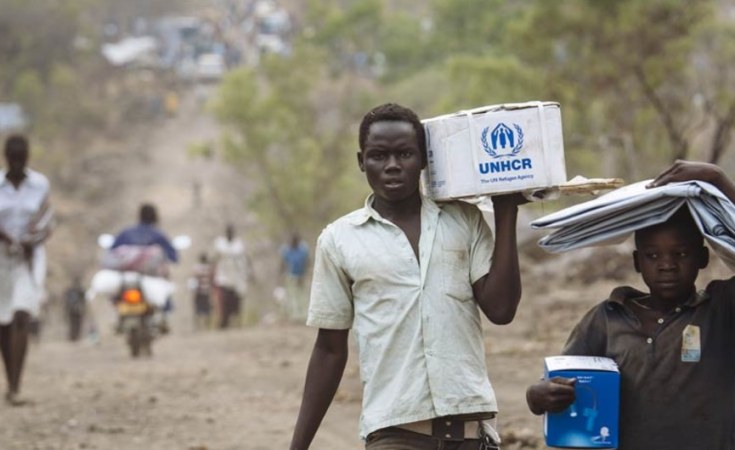
STORY HIGHLIGHTS
- Over 3 million Ugandans now enjoy better social infrastructure, environmental services and enhanced livelihoods.
- The Development Response to Displacement Impacts Project (DRDIP) created jobs for more than 174,660 people including 27,380 refugees, while expanding access to health care and education and restoring local ecosystems to enable fish farming and resilient land use.
- Phase II will create at least 60,000 new jobs and improve access to basic social and economic services for 3 million more people, including 1 million refugees.
In Nkoma, Uganda, dozens of refugees and local students attend classes in two brand-new classroom buildings. A few years ago, the lone school building was so crowded that children often went outside and studied under trees. "At first, we had poor classrooms that leaked whenever it rained, and we had to walk long distances just to fetch water. But now we have modern classrooms with enough seats and even rainwater tanks--we no longer go out of the school to fetch water," says Jack, a student in Uganda's Kamwenge District.
Jack's community is one of many beneficiaries of the World Bank Group-supported Development Response to Displacement Impacts Project (DRDIP) which is helping turn the challenge of hosting refugees into an opportunity for inclusive development.
Keep up with the latest headlines on WhatsApp | LinkedIn
When refugees are given the right to work and the tools to earn, the economics of displacement change, and Uganda has taken this path--one where jobs are the foundation of a durable response to displacement. Uganda's experience shows that when refugees and host communities are given the tools to work, earn, and build enterprises together, displacement can become a driver of shared prosperity.
Between 2016 and 2025, Uganda's refugee population grew eightfold, from 220,000 to roughly 2 million people, the largest number in Africa. The government's approach to supporting refugees promotes access to land, freedom of movement, and work rights, but the inflow of people has also strained local resources and services. In 2017, with $200 million in World Bank financing, the government launched DRDIP to relieve these pressures in 15 refugee-hosting districts. Host communities and refugees came together to identify investment priorities and oversee subprojects--an inclusive approach that has built trust and cooperation across group lines, while strengthening local economies and labor markets.
Boosting Livelihoods and Job Opportunities
Beyond infrastructure, DRDIP helped refugees and host communities restore livelihoods and build diverse sources of income. In Moyo District, Leya, a single mother of five from South Sudan received training and a grant of $6,000 to build her own sewing business. With the income her business generated, she purchased farmland where she now cultivates crops to support her family. "With this, I'm able to provide all the basic needs of my children and have acquired farmland I am cultivating," Leya shared in a March 2024 interview.
Across Uganda's refugee-hosting districts, thousands share similar stories. Livelihood initiatives range from agriculture and livestock cooperatives to skills training and small business support, with participating households seeing annual incomes increase by more than 17% compared to non-participants. DRDIP has employed refugees and residents to restore over 5,100 hectares of land and new community woodlots, providing employment as well as sustainable sources of fuel and construction materials. Tree-planting projects alone provided paid work to over 124,100 people. Women are a major part of this success, forming savings groups, starting small businesses, and gaining vocational skills. DRDIP also established hundreds of village revolving funds and self-help groups to spur community-driven development.
Building Trust Through Improved Service Delivery
Between 2017 and 2024, DRDIP invested heavily in improving the social infrastructure used by both refugees and host communities, easing strains on local services that once fueled tensions between the two. Communities built or upgraded 290 schools, benefiting over 490,000 students, resulting in a 47% rise in primary school enrollment and a 9% rise in secondary enrollment. Clean water systems were extended to both refugees and host communities. The construction or rehabilitation of 130 health clinics cut patient wait times, resulting in a 36% drop in annual health expenditures. By focusing on host communities' needs and expanding access to shared services, DRDIP helped alleviate pressure on social infrastructure and promote social cohesion.
Through an innovative Displacement Crisis Response Mechanism, the project also monitored spikes in refugee inflows and rapidly disbursed extra funds to upgrade crowded schools, clinics, and water points in the most-affected districts, ensuring basic services kept pace with population shocks and reducing competition over scarce resources.
A New Model for Refugee-Inclusive Development
Uganda's experience demonstrates how inclusive development can transform areas impacted by displacement. DRDIP Phase II will build on this. Backed by an additional $328 million in WBG financing, it will support an estimated 3 million people, including 1 million refugees, by scaling investments in infrastructure, public services, and environmental management. With roughly 60,000 new or better jobs anticipated and 6.1 million workdays created through public works, the project places an even stronger emphasis on economic opportunity. Uganda continues to lead by example, demonstrating that with the right laws, policies, and investments, refugee-hosting communities can thrive and strengthen economic growth.

Sign up for free AllAfrica Newsletters
Get the latest in African news delivered straight to your inbox
"Uganda has long championed progressive approaches that welcome refugees and invest in them and their host communities," says World Bank Country Manager for Uganda Francisca Ayodeji (Ayo) Akala. "DRDIP II builds on that leadership by scaling community-driven investments that create jobs, unlock local enterprise, enhance access to schooling, health care and water, and strengthening the social fabric that holds diverse communities together."
The World Bank Group is committed to walking with Uganda as it turns policy ambition into tangible results for host communities and refugees. By investing in refugee-hosting districts and including refugees in national services, Uganda has built trust and social stability while improving outcomes in education, health, household income, and environmental resilience.
