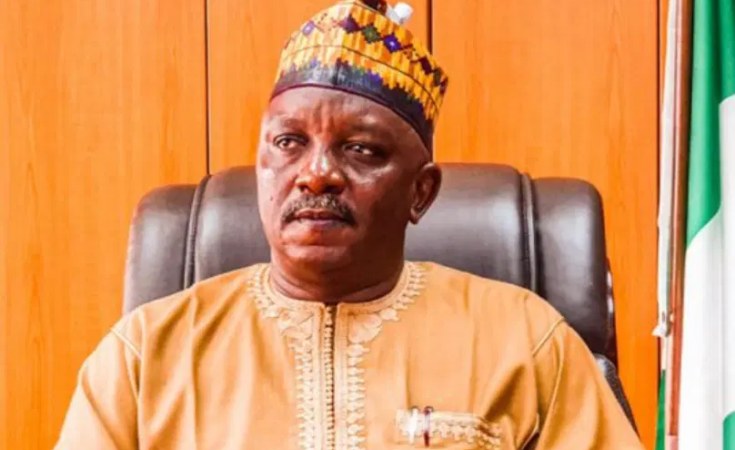
Olubunmi Tunji-Ojo, Nigeria's Interior minister stands out among President Bola Ahmed Tinubu's ministers because since his appointment, he has consistently worked silently to create a new image for his hitherto notoriously corrupt sector. He is neither publicity conscious nor does he usurp the role of agency heads he is mandated to supervise. As Minister, Tunji-Ojo keeps to policy issues having clearly evolved empirical targets and impeccable processes for all those who have roles to play for achieving set goals in the sector.
Little wonder that only 48 hours ago, this national newspaper picked him out for honours as Vanguard Personality of the year - a choice that is difficult to contest. Some other ministers are however able to hide under a shield which covers their incompetence. Many others that should have been dropped because of indictments by one group or another may have been kept on board, perhaps not to rock the party's family boat or to help them with soft landing.
When President Tinubu assumed office, he made one simple appointment that would have heavily impacted on the performance of the federal executive. Many may not have realized it but if allowed to function effectively, the post of Special Adviser to the President on Policy Coordination ought to have kept every appointee on his toe especially as the president picked an outstanding Nigerian - Hadiza Bala Usman to occupy it. Those of us who had thought that reports from Hadiza would see underperforming ministers sent packing from the cabinet almost every week were shocked that the office raised no visible queries. Within a short time, the uneasy calm from that angle generated an atmosphere that made it look as if we were back to the days of former President Buhari who had a policy of not touching any appointee once sworn-in as minister.
Keep up with the latest headlines on WhatsApp | LinkedIn
The calm atmosphere notwithstanding, the bubble had to burst on its own at the Ministry of Humanitarian Affairs and Poverty Alleviation, where millions of naira allegedly vanished under the ministership of Betta Edu. Nigerians who are in love with action hailed President Tinubu when he promptly suspended the Minister. The excitement however gradually waned and till today, no one knows whether the suspect was guilty or not. Although presidential spokesman, Bayo Onanuga once said on national television that the lady was 'gone for good' there is no confirmation that she might ever face any sanction. One national weekly magazine even imagined at a time that she may have been quietly reinstated. In July 2024, she used the letter-head of her 'former' ministry to send condolence messages to the people of Jos over a major disaster. Indeed, while congratulating Tinubu on his 74th, a few weeks ago, she described him as her boss.
Allowing indicted officials to walk about freely on the streets or in fact to only sack such an official without prosecution is a blow to the image of an administration because actions speak louder than voice. Why then are other Nigerians accused of one misdemeanour or another facing trial? Considering that a proper sack from office is not the prescribed punishment for corruption, is it not irritating to see that some persons accused of corruption are not even facing any sanction whatsoever? Put differently, there does not appear to be any difference between ministers dropped during cabinet reshuffle and those dropped on account of gross allegations of misconduct. Could it be that the government is afraid to penalize an indicted minister or is it better to find a soft-landing pad for an offending minister in the team spirit of 'esprit de corps?'
Apart from the Olusegun Obasanjo's government which openly castigated its Minister of Education for leading his officials to hold a meeting with Senators to materially lobby them to increase budgetary allocation to education, almost every other government since 1999, goes cold whenever a minister is indicted. In his 8 years in office, former President Muhammadu Buhari was only able to drop two ministers without telling the nation what they did. The two ministers were those in charge of power, Saleh Mamman and his Agriculture and Rural Development counterpart, Alhaji Sabo Nanono. A government statement that should have revealed the infractions of the ministers merely said the positions of the two ministers that were leaving the cabinet will be taken over by the Minister of Environment, Mohammed Mahmoud Abubakar and the Minister of State for Works, Abubakar Aliyu respectively.
Unknown to government, the implication of dropping people from office without public enlightenment leaves the public with the impression that nothing substantive really happens in and around government. At the same time, government owes the people a duty to let them known public officials that have proven to possess little capacity to serve. For example, it is unfair for government to allow the people to ignorantly elect a person as governor of their state because they had no idea that the same person showed little capacity when he had opportunity to build roads or generate electricity as a minister. If the President had dropped him as an underperforming minister, he probably would not have had the courage to aspire to be governor when he failed as a minister. Whereas the president might look harsh for so acting but as a statesman public interest should matter most to the president.
Most importantly, Nigeria must learn to embrace the doctrine of ministerial responsibility - a doctrine which requires a person who holds the post of a government minister to accept responsibility for the outcome of his mandate. This is because the post of a minister is no doubt an important public position. Anyone who is appointed into it is expected to be properly equipped to perform well and to at all times take responsibility. In civilized societies, when a public event suffers a loss, those in charge of it accept responsibility for it and bow out in honour. As a result, the culture of accepting responsibility is firmly rooted in such societies whose leaders bear vicarious liability for whatever transpires within their functional jurisdiction. Interestingly, the leader who has a duty to take responsibility may not have personally participated in the implementation of the issue at stake; it is just enough that he was minister at the time.
The efficacy of the doctrine of ministerial responsibility still holds sway in many democracies with good examples dating back to as far as almost a century. In the United Kingdom, Sir Thomas Dugdale saw it as his duty in 1954 to resign as minister for agriculture after an inquiry criticized civil servants in his ministry over a compulsory purchase of some farmland even though there was no evidence of his personal involvement. The doctrine facilitates the greater principle of democratic accountability because to make a political officeholder answerable for every single government decision under his areas of supervision can propel him to ensure that the right things are done under his watch. Many countries follow the same principle. There was the story in Romania many years ago where the then minister of interior, Vasile Blaga, resigned a week after 5,000 police officers went on a one-day strike in protest over a 25% pay cut.

Sign up for free AllAfrica Newsletters
Get the latest in African news delivered straight to your inbox
Remarkably, Blaga had publicly described the strike as illegal but he never-the-less resigned as a gesture of honour. In India, two political leaders, including the infrastructure minister resigned after nearly two weeks of strike action by coal miners and health workers. Quite often in Nigeria, the same events occur and no one takes responsibility. Only last week retired police operatives stormed the Villa gate to protest poor remittances of their pensions and gratuity without a word from the Minister of Police Affairs. Perhaps the most frequent protests in Nigeria have been those of university teachers ASUU and medical doctors. All we see is meetings between the unions and Labour Ministers who end up threatening no work no pay; yet the protests are quite legitimate as they happen only because government reneges on agreements it voluntarily signed.
The point to be made is that societies can be better developed if ministers are sensitized into understanding that they have an obligation to ensure diligent implementation of projects that can improve the living conditions of the people. At the same time, breakdown in transactions would not occur where the doctrine of ministerial responsibility is functioning appropriately. One sign which explains dysfunction is when underperforming or indicted ministers are shielded or given soft landing which encourages lethargy in government. Did Wale Edun resign as Minister of Finance or was he fired? The narrative did not show he left on a positive note. Instead, the stereotype of leaving for health reasons as is usually fabricated for others was adopted. It would have been better to let the public know his contributory negligence if any to our current economic predicament.

