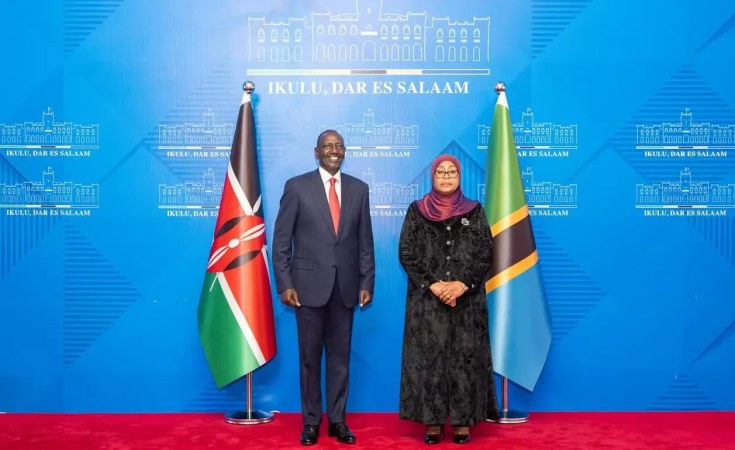
Dar es Salaam — TANZANIAN President, Dr Samia Suluhu Hassan, and President of Kenya, William Ruto, have witnessed the signing of eight Memoranda of Understanding (MoUs) and bilateral agreements aimed at strengthening regional cooperation and advancing economic development between the two nations.
The agreements were signed during high-level talks between the two leaders, reflecting a shared commitment to deepen diplomatic and economic relations in order to accelerate progress in infrastructure, trade, and institutional collaboration.
According to official statements, the eight agreements cover several strategic sectors. First, both countries agreed to enhance cooperation in the development and management of railway systems, a move intended to facilitate the movement of people and goods while improving trade efficiency within the East African Community.
Follow us on WhatsApp | LinkedIn for the latest headlines
In the agriculture sector, Tanzania and Kenya committed to strengthening collaboration to boost production, improve food security, and develop agricultural value chains. Policy analysts indicate that such coordination, if supported by investments in technology and infrastructure, could increase joint agricultural output by over 20 percent in the medium term.
Additionally, in maritime transport, the two countries agreed to improve shipping services and port operations, focusing on enhancing the efficiency of sea transport systems, particularly through the Port of Dar es Salaam and the Port of Mombasa, which serve as key trade gateways in the East African region.
The leaders also witnessed the signing of an agreement to conduct a feasibility study for the construction of a natural gas pipeline from Dar es Salaam to Mombasa. The project is expected to significantly impact the energy sector by increasing access to affordable energy and strengthening strategic cooperation in energy resources.
In the area of security and rule of law, both countries agreed to enhance mutual legal assistance in criminal matters, targeting cross-border crime. Furthermore, agreements on standards and quality assurance aim to harmonize product standards, reduce trade barriers, and ensure that goods traded between the two countries meet acceptable quality benchmarks within the common market.
Other agreements focus on institutional strengthening through training, skills development, and exchange programs for public servants. These initiatives are expected to improve public sector efficiency and enhance service delivery.
Overall, the agreements signal a strategic direction toward building an integrated economy grounded in coordinated infrastructure, policy alignment, and effective resource governance across the East African region.


