

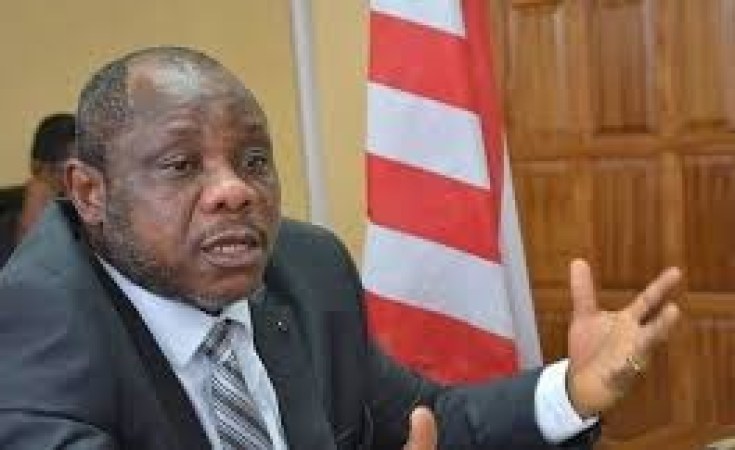
MONROVIA -- The ink was barely dry on his acquittal when the government came for Samuel D. Tweah Jr. again.
Less than a week after a Criminal Court 'C' jury cleared Liberia's former finance minister of every charge in the most closely watched corruption trial of the Boakai administration, the Asset Recovery and Property Retrieval Task Force summoned Tweah on May 13 to answer questions about the alleged misuse of more than US$20.5 million earmarked for rice subsidy payments during his tenure under former President George Manneh Weah. The charges under investigation, theft of property, economic sabotage, criminal conspiracy, criminal facilitation and misappropriation of public funds, read almost identically to the ones a jury just rejected.
In an immediate response, Tweah called the investigation "bogus," described it as political witch-hunting, and announced he had anticipated it even before AREPT's letter arrived.
What AREPT Is Alleging
Follow us on WhatsApp | LinkedIn for the latest headlines
The task force, established under Executive Order No. 161 with the mandate to identify, trace, investigate and recover stolen or suspicious public assets, told Tweah in its May 13 communication that documents and records in its possession allegedly show that government payments intended to reduce the market price of 25-kilogram bags of rice were "stolen and diverted to personal use."
The investigation covers the period from September 2021 to October 2022, during the core of the Weah administration's time in office, when the government spent about US$20.5 million on a rice subsidy program, as reported by AREPT. According to the task force, the program had "no impact on the reduction in the price of rice" during that period, which they cite as evidence that the funds never served their intended purpose.
AREPT further alleged that Tweah, in collaboration with other individuals currently under separate investigation, approved and processed payments connected to the program. The task force invited him to appear for questioning on Tuesday, May 19, at 11 a.m., and advised him to bring legal representation.
The rice subsidy allegation is structurally distinct from the FIA funds case that just ended in acquittal. That case centered on classified security spending and the movement of funds through the Financial Intelligence Agency under disputed national security authority. This one concerns a consumer subsidy program, a more conventional, paper-heavy expenditure with a clearer documentary trail and a straightforward measure of impact: did the price of rice go down?
According to AREPT, it did not.
Tweah's Defense: Lawful, Approved, Politically Motivated
The former minister's public response covered several fronts simultaneously -- legal, political and personal -- and he deployed them all within hours of AREPT's summons becoming public.
The subsidy payments, Tweah said, were fully authorized at every relevant level of government. "The subsidies in question were lawfully paid after approval from the President of the Republic, His Excellency Dr. George Manneh Weah, and the National Legislature, in consultation with the IMF," he wrote in a statement on social media. He said the payments were made in good faith. He claimed they followed the full chain of institutional approval, from the executive to the legislature to Liberia's most important international financial partner.
If accurate, it means that any prosecution of Tweah over the subsidy program would require the government to argue that a finance minister committed criminal acts while implementing a program that the sitting president, the national legislature, and the IMF had all signed off on.
According to the former finance minister, the investigation is part of what he called a sustained and deliberate effort to target officials of the former administration. He claimed the timing -- days after his acquittal -- was not coincidental, and said he had anticipated the probe before AREPT's letter arrived. "I had already discussed this letter on my page in anticipation of what I described as a bogus investigation into the legal fulfillment of my responsibilities as Minister of Finance and Development Planning," he said.
Despite all of that, he confirmed he will show up. "I will appear in person at 11:00 AM on Tuesday, May 19, 2026, along with my lawyer to answer any queries you may have into my responsibilities as the Minister concerning this matter," he said.
The Timing Problem
Tweah was acquitted on May 8. AREPT's summons is dated May 13. Five days separated his discharge from the Temple of Justice and his receipt of an entirely new investigation notice from a different arm of the same government that just failed to convict him.
That timeline will be difficult for the Boakai administration to explain to a public already skeptical of its anti-corruption motivations. The acquittal in the FIA funds case was not a technicality or a procedural dismissal. A jury of ordinary Liberians heard nearly two years of evidence, including the testimony of eight state witnesses, 18 documentary exhibits, Central Bank ledger records, and the deputy minister of budget's own confirmation that the underlying transactions bypassed lawful budget processes, and still found the government had not proved its case beyond a reasonable doubt.
Justice Minister Oswald Tweh acknowledged after the verdict that his ministry was "kind of disappointed," while insisting the prosecution had done its job well. He simultaneously announced an internal review of every phase of the case, from investigation through jury selection, to identify what could be improved.
The optics are not helped by the fact that AREPT's mandate, established by executive order, places it firmly within the executive branch's control. Unlike the Liberia Anti-Corruption Commission, which has a statutory basis and some degree of institutional independence, AREPT operates as a task force under direct executive authority. When that task force opens a new case against the government's most prominent recent acquittee five days after his discharge, the appearance of coordination, whether or not coordination actually exists, is nearly unavoidable.
The Subsidy Program: What the Record Shows
The rice subsidy program that AREPT is investigating was one of the Weah administration's more visible economic interventions. It was conceived as a response to food price pressures during a period of global commodity inflation, and it carried the political logic common to subsidy programs everywhere.
Whether it worked is a separate question. AREPT's claim that the program had no measurable impact on rice prices during the review period touches on one of the most contested areas of subsidy economics. Price effects are difficult to isolate from other market variables, and the absence of a visible price reduction does not, by itself, establish that funds were diverted rather than spent inefficiently, lost to middlemen in the supply chain, or absorbed by market dynamics beyond the government's control.
That distinction, between criminal diversion and administrative failure, will be the central legal question if the investigation proceeds to prosecution. AREPT will need to show not only that the money did not produce the intended outcome, but that it was deliberately redirected for personal benefit. Proving the former is relatively straightforward. Proving the latter, as the government just learned in the FIA funds case, requires evidence that can survive cross-examination by a motivated defense and the scrutiny of a jury applying a reasonable doubt standard.

Sign up for free AllAfrica Newsletters
Get the latest in African news delivered straight to your inbox
Tweah's invocation of IMF consultation in his public response is a particular challenge for the government. The IMF maintains its own records of policy consultations with member governments, including those related to subsidy programs. If the fund's engagement with Liberia during the relevant period is on record and is consistent with Tweah's account of the approvals the program received, the government will face questions about why it is treating the implementation of an IMF-consulted program as potential economic sabotage.
A Pattern Emerging, or a Mission Continuing?
The broader context in which this new investigation arrives is one that the Boakai administration has consistently framed as a systematic effort to hold the Weah government accountable for years of alleged financial misconduct. The LACC and AREPT have opened multiple investigations involving former officials. The FIA funds case was the first to reach trial.
That case's result, three partial convictions, two full acquittals, multiple charges sent back for retrial, gave the government's critics sufficient ammunition to argue that the prosecutorial effort has been more aggressive than it has been competent. Tweah's acquittal was the sharpest piece of that ammunition. He was, by the government's own account, the architect of the scheme. The jury did not agree

