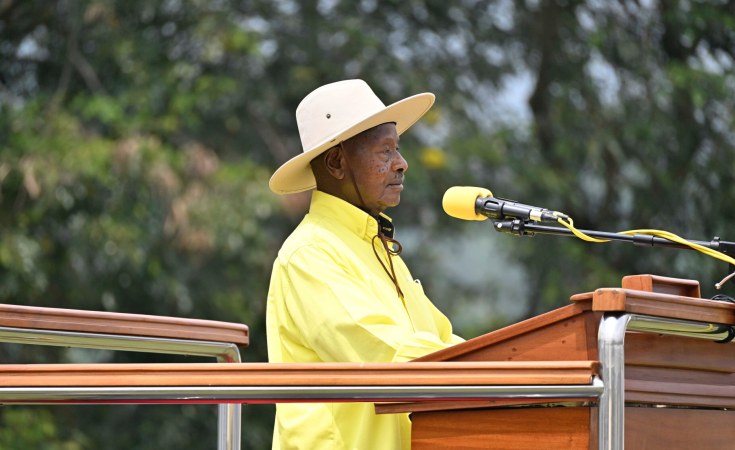
President Museveni on Tuesday reshuffled his Cabinet in a sweeping political reset that ended the long careers of several senior lieutenants. From General Moses Ali and Matia Kasaija to Ruth Nankabirwa and Generals Jeje Odongo and David Muhoozi, the changes reflected Museveni's trademark political chessboard--where pieces are moved, replaced, and occasionally sacrificed to sustain momentum in what has been branded the "Kisanja No Sleep" term.
Here, we examine some of the figures removed from the Cabinet and the context behind their exit.
General Moses Ali
Follow us on WhatsApp | LinkedIn for the latest headlines
The 87-year-old West Nile political heavyweight has in recent years been visibly weakened by health challenges, prompting questions about his continued role in active politics. Born on April 5, 1939, the retired military officer has served under Museveni for decades, his political career often linked to his role in stabilising West Nile after years of rebellion and conflict.
A veteran of Uganda's political transitions, Ali previously served in the Uganda Army before going into exile during periods of upheaval, later returning to join the NRM. He has since represented Adjumani District in Parliament and remained a constant figure in national leadership.
Though widely seen as having been eased out, his exit also reflects a transition, with his son Siraje Musa Ali stepping in as State Minister for Works and Transport.
General Jeje Odongo and the Foreign Affairs overhaul
Former army commander General Abubaker Jeje Odongo oversaw a Foreign Affairs ministry that, at various points, attracted criticism over diplomatic missteps and internal controversies. The ministry also faced public scrutiny over the conduct of some missions abroad.
Odongo, along with his deputies Henry Okello Oryem and John Mulimba, was dropped in a broader clean-up of the docket. Their exit was followed by the appointment of Adonia Ayebare, with Calvin Echodu and Haruna Kasolo replacing the junior ministers.
The reshuffle signalled a collective accountability approach, with both senior and junior officials affected.
Matia Kasaija
At 82, Finance Minister Matia Kasaija's long tenure had increasingly been characterised by reliance on his technical teams, particularly in budget preparation and fiscal coordination. Critics often pointed to his reduced direct engagement in day-to-day ministry operations.
The long-serving minister, who has also publicly indicated that this term would be his last, appears to have stepped aside as part of a generational transition in economic management.
Betty Amongi
Amongi's political year was defined by turbulence within the UPC-NRM political arrangement and internal electoral battles in Lango. Her husband, Jimmy Akena, entered the presidential race against expectations of the informal understanding with NRM, further complicating the political equation.
In the parliamentary race, Amongi lost the Lira City Woman MP seat to Dr Jane Ruth Aceng in a bruising contest, weakening her political standing in the aftermath of the election cycle.
Francis Mwebesa
Francis Mwebesa, 81, exits the Trade, Industry and Cooperatives ministry after decades in business and public service. A seasoned industrialist, his tenure coincided with efforts to strengthen Uganda's manufacturing and trade sectors.
Age and long service appear to have influenced his exit, with Sanjay Tana taking over the docket.
General David Muhoozi
David Muhoozi's tenure was increasingly shaped by tensions around citizenship, identity politics, and immigration enforcement, particularly in relation to Kinyarwanda-speaking communities.
His exit follows political and administrative shifts within that broader debate, including rising public voices advocating for recognition and rights of Banyarwanda citizens. His replacement signals a reset in the ministry's approach to internal security and immigration matters.
Ruth Nankabirwa
Nankabirwa's tenure at the Energy ministry was marked by both reform efforts and persistent operational challenges in the power sector. A major point of tension emerged over her attempt to restructure leadership at UEDCL following a performance review.
Her directive to dismiss senior managers was halted after Prime Minister Robinah Nabbanja intervened, warning against destabilising the power sector during a sensitive transition period following Umeme's exit. The episode exposed internal disagreement over reform pace and institutional control.
Obiga Kania
Obiga Kania's removal reflected what appeared to be a broader Cabinet rationalisation exercise, as several state ministers were dropped in the reshuffle.
Raphael Magyezi
A widely regarded political conciliator, Magyezi built a reputation for approachability and effectiveness in engaging local leadership structures. He previously served as MP for Igara West before stepping away from elective politics ahead of the 2021 elections, describing it as a break from parliamentary life.
His exit from Cabinet suggests a full withdrawal from active government roles.
Hellen Adoa
Adoa lost the Serere District Woman MP seat after a tight electoral contest, including challenges from within the NRM and independent challengers. Her defeat weakened her political base heading into the reshuffle.
Wilson Muruli Mukasa
A long-serving NRM stalwart born on July 5, 1952, Muruli Mukasa has held multiple Cabinet portfolios, including Minister for Public Service and Minister for the Presidency. He previously represented Bugabula County South in Parliament and has remained a consistent figure in the ruling party's leadership structure.

Sign up for free AllAfrica Newsletters
Get the latest in African news delivered straight to your inbox
His exit is widely viewed as part of a generational rotation in Cabinet.
Joyce Moriku Kaducu
Kaducu lost the Moyo District Woman MP seat in the 2026 elections, ending her parliamentary tenure and, by extension, her Cabinet position.
Evelyn Anite
Anite's tenure at the Uganda Investment Authority (UIA) docket was defined by clashes over governance and control of investment-related decisions. A dispute over honoraria payments linked to Kampala Industrial and Business Park infrastructure works escalated into a major standoff between her ministry and UIA leadership.
Her directive to recover the funds was resisted by UIA management, who insisted the payments were duly approved. The matter escalated until higher government intervention effectively halted her push for immediate disciplinary action, marking a turning point in her influence over the agency.
Peter Lokeris
Peter Teko Lokeris exits after losing the Chekwii East County seat in Nakapiripirit District to Stephen Lokoru, ending a parliamentary career that began in 1996. His departure closes a long chapter in Karamoja and national politics, where he previously served as Minister for Karamoja Affairs and Minister of State for Mineral Development.
