

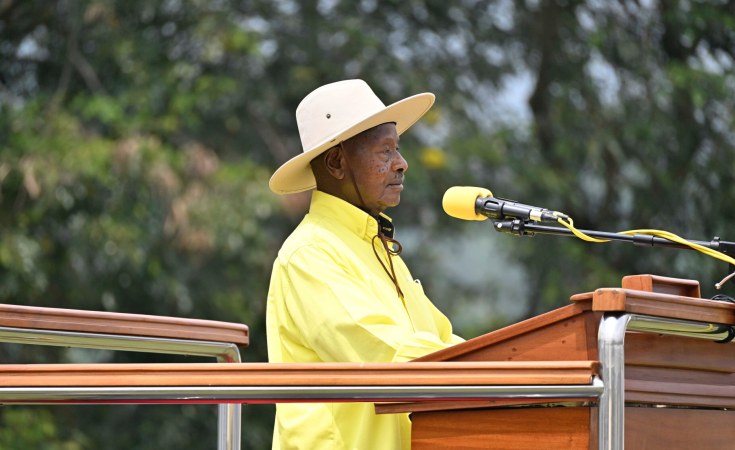
Parliament has approved a constitutional variation increasing the number of Cabinet Ministers and Ministers of State, formally regularising President Museveni's latest executive appointments and reigniting debate over patronage, governance efficiency and public expenditure.
The motion, passed on Thursday with 320 MPs voting in favour, six against and two abstaining, aligns Uganda's executive structure with the President's Tuesday appointments of 30 Cabinet Ministers and 51 Ministers of State.
The last Cabinet and the new one formulated on Tuesday have both been done outside the constitutional mandate and the 12th Parliament sought to fix that on-the-go.
Keep up with the latest headlines on WhatsApp | LinkedIn
MPs adopted the resolution under Articles 113(2) and 114(2) of the Constitution. Article 113(2) limits Cabinet Ministers to 21 unless Parliament approves otherwise, while Article 114(2) applies the same provisions to Ministers of State.
Prime Minister Robinah Nabbanja moved the motion seeking parliamentary approval to raise the ceiling on Cabinet Ministers from 21 to 30, and the number of other Ministers from 21 to 51.
The approval effectively makes the current executive structure constitutionally compliant.
However, government officials stressed that no additional ministers or ministries were being introduced beyond those already operational.
Uganda's current executive structure now comprises 30 Cabinet Ministers, 51 Ministers of State, the Vice President and the Prime Minister.
Defending the proposal, Nabbanja argued that Uganda's governance needs had significantly evolved since the promulgation of the 1995 Constitution.
She cited the increase in districts from 39 to 146 and population growth from about 20 million in 1995 to 45.9 million according to the 2024 census.
"This motion is not about numbers alone; it is about efficiency, accountability, inclusivity and alignment with Vision 2040 and the National Development Plan. While concerns about costs and duplication have been raised, Uganda's governance demands are unique, and the Constitution provides for this adaptive approach," Nabbanja said.
She also insisted government was not creating new positions beyond those already functioning under the previous Parliament.
"Members, the number of Ministers and Ministers of State that have been carrying out duties is the same number we have brought. We have not changed. Rationalisation was because we were having ambiguity and duplication of work. UNRA was doing the same work as the Ministry of Works. So we are here to present the same number we had in the last Parliament," she said.
Supporters of the motion argued that the Constitution anticipated flexibility in governance structures where necessary for efficient administration.
Deputy Attorney General Jackson Kafuuzi, who is also MP for Kyaka South County in Kyegegwa District, cited Article 111 of the Constitution, which establishes Cabinet and provides for "such other Ministers" as may appear necessary for the efficient running of the State.
"We have gone through an election where a new mandate has been given to the Head of State and all of you. The Head of State traversed the country explaining a manifesto which Ugandans have approved, so he needs a team that will work to effect that manifesto. It is our mandate as MPs to approve the variation," Kafuuzi said.
During debate on the motion, Speaker Jacob Marksons Oboth-Oboth pressed Nabbanja on the practical implications of the changes, particularly whether ministries affected by rationalisation reforms would be restored.
"Are you on record that you are coming back here to reactivate them?" the Speaker asked.
The exchange reflected wider concerns among MPs over whether the expanded executive would reverse earlier reforms that merged agencies and ministries in the name of efficiency.
Opposition legislators warned that expanding ministerial appointments risked undermining the constitutional intent of limiting executive patronage.
Mukono Municipality MP Betty Nambooze Bakireke argued that the framers of the Constitution imposed limits to prevent leaders from using appointments as political rewards.
"We should think about the framers of this Constitution, what they thought about when they came out to limit the number of Ministers. Mr. Speaker, I wanted to guess that the idea was to limit top leaders from using appointments to patronise the country," she said.
Patrick Oshabe of Kassanda North and Paul Mwiru of Jinja South Division East also opposed the motion, arguing that government had recently justified mergers of ministries and agencies on grounds of cost-cutting and efficiency.
Despite the objections, government maintained that the move was primarily a constitutional regularisation exercise rather than an expansion of the executive.
Presidential Assistant on Communications Ian Gumisiriza also defended the move through his X account.
"There's no cause for alarm. There will be no new additional ministers. The truth is we have been operating in violation of the Constitution. The new Speaker is just doing his job," Gumisiriza wrote.
The debate unfolded against the backdrop of internal political tensions following Museveni's Cabinet reshuffle, which left out several politically active figures aligned to ruling party power centres.
Patriotic League of Uganda (PLU) Secretary General Daudi Kabanda briefly deactivated his X account on Wednesday after facing online trolling over his exclusion from Cabinet despite his vocal mobilisation efforts ahead of the appointments.

Sign up for free AllAfrica Newsletters
Get the latest in African news delivered straight to your inbox
The controversy deepened after PLU Chairman and Chief of Defence Forces General Muhoozi Kainerugaba publicly questioned some omissions from the new executive lineup.
"I didn't see my big brother Okello Oryem in the cabinet? Surely can that be possible? Whoever is fighting us in these appointments is an enemy," Muhoozi wrote.
Henry Oryem Okello, son of former President Tito Okello Lutwa, had served as Minister of State for Foreign Affairs in charge of International Relations but was dropped and replaced by Soroti City West MP David Calvin Echodu.
Muhoozi also commented on Kabanda's exclusion, suggesting his PLU role was more significant than a Cabinet post.
"My young brother Hon. Kabanda is the General Secretary of the Patriotic League of Uganda, a much more important position than being a cabinet minister. His job is to organise and mobilise the millions of young people in our country. Kabanda will get a ministerial job when Todwong gets one," he wrote.
Kabanda later reactivated his X account on Thursday, saying he had been "ordered to come back."
The exchanges exposed simmering tensions within ruling party-aligned networks over loyalty, patronage and access to executive positions.
With Parliament now having approved the variation, President Museveni is legally cleared to maintain the current executive structure within constitutional limits.

