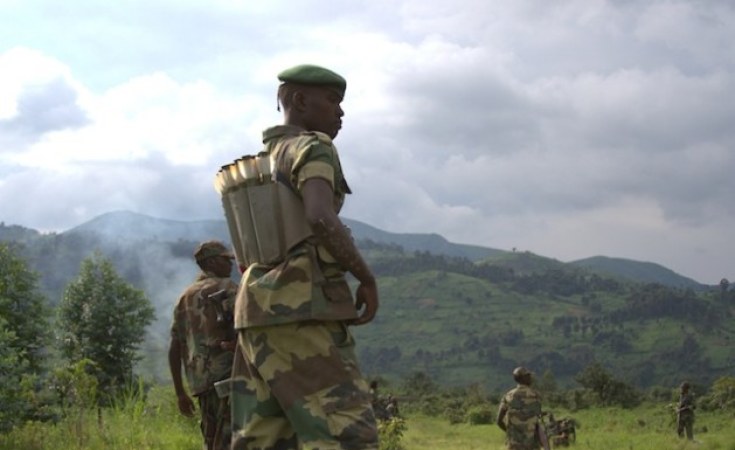
The FDLR has sustained its operations in DR Congo through multiple streams of income ranging from agriculture and mining to taxation, timber, charcoal and wildlife trafficking, while also receiving support from Kinshasa, according to a former member of the militia.
ALSO READ: Kagame: Tolerance has limits if national unity is at stake
The Kinshasa-backed militia has long maintained a plan to destabilise Rwanda alongside its supporters, carrying out cross-border attacks over the years.
Keep up with the latest headlines on WhatsApp | LinkedIn
Speaking during at a Unity Club meeting on the history of the Genocide against the Tutsi and the struggle to stop it, held on Saturday, June 27, 'Col (Rtd)' Augustin Nshimiyimana, who graduated from Mutobo Demobilisation Centre in 2022, shared his account of how the militia financed its activities and maintained its operations in DR Congo over the past 30 years.
"The FDLR crossed into DR Congo after the Genocide against the Tutsi with virtually nothing, but we never lacked money or equipment," Nshimiyimana said.
ALSO READ: Congolese rights groups say FDLR drives insecurity in Walikale
Weapons and military support
According to Nshimiyimana, the militia continued receiving weapons and ammunition from individuals within the Congolese military establishment and other individuals, allowing it to remain operational despite years of armed confrontations.
Among those he named as suppliers were Brig Gen David Rugayi, Col Tokolonga, Maj Gen Mayanga and Brig Gen Mugabo.
He said the quantities delivered were substantial enough to sustain the group's military activities over the years.
ALSO READ: Inside FDLR's frontline base 3km from Rwanda border
Agriculture and illegal taxation
According to Nshimiyimana, one of the FDLR's largest sources of income came from the vast agricultural land it controlled in eastern DR Congo.
He said the militia occupied extensive farmland across Kishishe, Kibirizi, Kawumiro, Binza, Kinyandoni, Kazaroho and Tongwe in Rutshuru Territory, North Kivu, estimating that the total area exceeded the size of Rwanda's Nyabihu District.
The former combatant reported that Congolese citizens were required to work on FDLR farms for two days each week before cultivating their own fields.
Even their own farms, he said, were located on land leased from the militia.
Each farmer paid about $80 per hectare and after harvest, surrendered about 40 kilograms of produce, such as beans, maize and soybeans.
"You can imagine the volume of crops we received because every farmer paid us both in cash and in crop yields," he said.
ALSO READ: DR Congo: FDLR razes village in Walikale, killing four
Selling land
The militia also earned money by selling land under its control.
Nshimiyimana said land in Nyakagina, Masisi Territory in North Kivu, near Goma, was sold for $350 per hectare.
According to him, some of the buyers were officials from DR Congo.
"We sold land that had been allocated to us as though it had been inherited from our parents," he said.
Political influence and election financing
Nshimiyimana said the FDLR also built influence through politics.
He reported that provincial and national parliamentary candidates seeking election in areas under FDLR control first negotiated with the militia before campaigning.
According to him, candidates brought cash, medicines and other supplies in exchange for the group's support.
The militia then instructed local voters which candidates to elect.
He said this happened in Masisi and Walikale territories in North Kivu, as well as Fizi Territory in South Kivu where there are deputies of their choice.
"Virtually all the provincial deputies from areas where the FDLR was based could not get elected without FDLR support," he said.
ALSO READ: Uganda: Army on high alert over FDLR attacks against civilians
Relations with the Congolese government
Nshimiyimana said many actors became involved with the FDLR over the years, making military operations against the militia increasingly complex.
"[President] Tshisekedi pays [FDLR] as he pays the FARDC. He provides them with salaries, food supplies, and medicine. In addition, Europeans also provide them with financial assistance," Nshimiyimana said.
According to Nshimiyimana, after suffering multiple defeats in the war with AFC/M23 rebels, Kinshasa formally incorporated the FDLR into FARDC under the banner of Wazalendo.
"Today, you cannot distinguish the FDLR from the FARDC, the Mai-Mai, the Nyatura or other armed groups because Tshisekedi placed them all into one structure and made them one force," he said.
ALSO READ: Ex-FDLR militia fighter speaks out on MONUSCO, FARDC support
Burundian forces, Wazalendo and MONUSCO
Nshimiyimana said the Burundian leaders in the ruling part CNDD-FDD and the FDLR shared the Hutu extremist ideology opposed to Tutsi.
According to him, FDLR cadres and cadres of the CNDD-FDD conducted training together.
He also said Burundian forces, FDLR, Wazalendo and MONUSCO coordinated during the battle for Goma before the city was captured by AFC/M23, with further plans to attack Rwanda.
Nshimiyimana reported that MONUSCO provided technical support, while the FDLR gathered intelligence on military deployments.
He further said coordination meetings were held to plan attacks and that FDLR officers were responsible for coordinating those operations.
ALSO READ: FDLR kills 10 in eastern DR Congo
Mining and mineral trade
Mining generated another significant source of income for the FDLR, according to Nshimiyimana.
He said the FDLR controlled mining activities in Oninga, Walikale Territory in North Kivu, where more than 30,000 miners operated.
Every miner, he said, paid the equivalent of $0.50 each month.
They were also required to purchase food at FDLR checkpoints and, instead of paying in cash, often paid using minerals.
He added that gold miners were required to sell their production exclusively to the militia.
"A large share of the money came from mineral extraction," he said.
ALSO READ: Ex-FDLR leader: DR Congo's support for Genocidal militia still the biggest threat to peace
Timber and charcoal
The militia also earned revenue from logging and charcoal production.
Nshimiyimana said timber harvested from forests under FDLR control was transported by truck to Uganda, Goma and Bukavu.
He added that charcoal consumed in Goma largely originated from areas controlled by the militia.
Before transporting charcoal, owners first paid taxes to the FDLR.
Cannabis and MONUSCO
Cannabis cultivation formed another source of income.
According to Nshimiyimana, the crop was extensively cultivated in Ikobo, Walikale Territory, where little else was grown.
He said some of the cannabis was transported to Goma, some to Kisangani and other output sold to MONUSCO.

Sign up for free AllAfrica Newsletters
Get the latest in African news delivered straight to your inbox
He noted that MONUSCO personnel packed the cannabis into barrels before loading it onto aircraft.
Nshimiyimana also reported that MONUSCO supplied equipment to the FDLR through relationships established around cannabis and mineral trading.
"MONUSCO was also among those who supplied us with equipment because our dealings in cannabis and minerals connected us with them," he said.
Bornite extraction
Nshimiyimana also identified bornite mining as another source of income.
He said the FDLR believed the deposits had been hidden underground in DR Congo by Belgians and Germans.
According to him, whenever Belgians and Germans came to extract the mineral from areas controlled by the militia, they brought food, medicines, money and ammunition before leaving by aircraft after two or three days.
He also reported that Europeans financially supported the FDLR.
ALSO READ: FDLR links to Habyarimana's son raise regional security concerns - report
Illegal wildlife trade
Poaching also generated income for the militia, Nshimiyimana said.
He reported that the FDLR killed elephants and sold ivory to MONUSCO.
He added that lion fat was highly valued and bought by traders as well as MONUSCO personnel, while buyers also travelled from Chad to purchase it.
The militia also slaughtered hippos, salted the meat for preservation and transported it to Goma, Bukavu and Kanyabayonga in Lubero Territory, North Kivu.
Nshimiyimana said many FDLR members have remained in DR Congo because of the guilt associated with their role in the Genocide against the Tutsi.

