

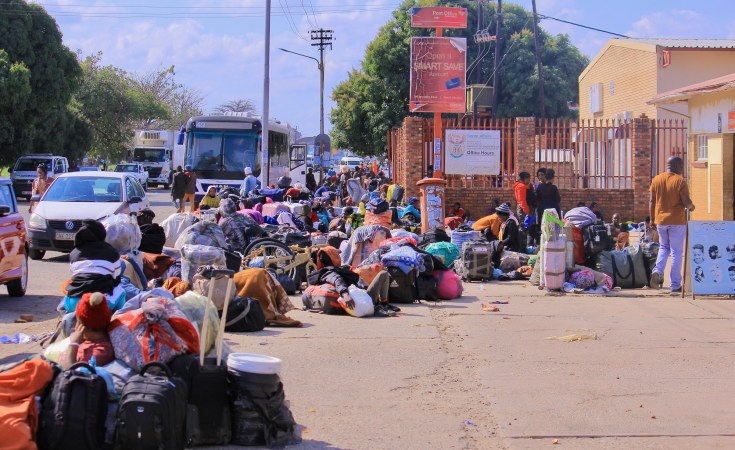
With the looming 30 June deadline approaching, community organisers in parts of Johannesburg say the threat posed by March and March's anti-migrant campaign is no longer limited to the group's planned protests or public statements.
Despite March and March's rise in recent months, and the proliferation of similar groups across the country, some communities in Johannesburg say the xenophobic rhetoric and mobilisation isn't the popular view of many South Africans who live side by side with migrants, do business with each other, and often even create families together.
In Thembelihle, south of Johannesburg, Siphiwe Mbatha, a member of the Thembelihle Crisis Committee, says March and March's attempts to mobilise in their community has instead created a space for local criminals to target migrants under the cover of protests against so-called "illegal immigration". Communities such as Thembelihle and Freedom Park near Soweto have been working together and mobilising people to not only protect migrants and their businesses, but also to stand up against the wave of xenophobia.
The police and government have been slow to react in recent months, mostly being spectators as the xenophobic vigilante groups gathered momentum ahead of the June 30 deadline. Acting police minister Firoz Cachalia said this week that it would cost around R600 million to mobilise police and security resources for the planned shutdown and protests.
Follow us on WhatsApp | LinkedIn for the latest headlines
He added that threats of violence presented considerable risk to the country's national security, and acknowledged the heightened levels of "public concern and anxiety". That anxiety is most notable in communities where migrants live, work, and raise families. Community organisers such as Mbatha say the line between political campaigns and street-level intimidation has already collapsed.
That has been seen more widely in recent weeks where anti-migrant protests and public threats across the country have been followed by incidents of violence, harassment and intimidation in several parts of the country. Migrants have been killed in violence in places including Mossel Bay, Pietermaritzburg and Alexandra. Not all of these incidents have been directly linked to March and March structures, but activists say the group's rhetoric has helped create a climate in which migrants are being made more vulnerable.
Mbatha, a long-standing member of the Thembelihle Crisis Committee, said that became clear when March and March announced plans to come to the area around 18 June. He said some local criminals understood the announcement not as a political event, but as an opportunity.
"They know that migrants live here, but they work that side," he said, referring to neighbouring Lenasia. "Criminals from the community blocked migrants on their way to work, robbed them of their phones and targeted them because they believed March and March's presence would make it easier to get away with it."
"March and March almost emboldens or empowers these thugs to be more brave," he said. "Not because they're members of March and March, but because they see opportunity."
For Mbatha, these attacks showed how quickly organised anti-migrant rhetoric can be absorbed by people who are not necessarily part of any movement, but who understand the political moment as permission.
"If March and March didn't say they were coming, would they have done that?" he asked.
He said Thembelihle, like so many others across the country, was not a community where migrants existed separately from South Africans. They are neighbours, friends, and often family members.
"Most of my friends have children with South African women," he said. "So if we chase them, who is going to support these children?"
He said many of the arguments made by anti-migrant groups ignore the reality of communities where families, friendships and livelihoods have been built across national lines. In one case, he said, a teenager who was born in South Africa to Mozambican parents had joined other young people making anti-migrant remarks, apparently without seeing how easily the same hostility could be turned against him.
"You can see how easily these youngsters can be influenced," Mbatha said. "He doesn't think about himself as a migrant, even though he was born in South Africa but his parents are migrants."
That influence, he said, is being driven in part by social media, where xenophobic posts circulate far beyond formal meetings or marches. "Even smaller kids, you hear them. It's becoming normal. It's something that you can say without thinking or without blinking, which is bad, because it creates hatred."
In Freedom Park, community activist Peter Monethe described the xenophobic mobilisation as "a politics of the stomach", saying many opportunistic local political actors have jumped onto xenophobic campaigns because they had something to gain from it.
Monethe, who says he only became political later in life when he joined a union, said his experiences of living in Yeoville for years and making friends with people from all across the continent helped make him more conscious about xenophobia. He also experienced his own form of discrimination being from Limpopo originally and tells how in 2015 he was stopped by a group of men carrying weapons and started questioning him about his nationality.
"They asked me where I was from because of my darker skin. They asked for my ID, and I did not have it. Then I started speaking my home language, and some of them picked it up and said 'no, he is one of us'. But I was very scared. I could see that I was nearly hit for no reason. How does this make sense? How can we do this to people?" he asked.
March and March also planned on visiting Freedom Park on June 16, but Monethe says that was later cancelled because of the mobilisation in the community against the group. "They couldn't come, they had to cancel. It was basically because we were highly organised.

Sign up for free AllAfrica Newsletters
Get the latest in African news delivered straight to your inbox
"We commemorated June 16 here in Freedom Park. On our register we had more than 600 people who signed, and I am sure the register was not signed by everyone. We also had migrants who came to speak," he said. "We will continue to work together because migrants aren't the enemy, capitalism is the enemy."
In many other communities across the country where Abahlali baseMjondolo has a presence, xenophobic mobilisation has also been limited or entirely prevented in the past. "Abahlali baseMjondolo has always rejected xenophobia and ethnic politics... we will remain the movement that represents all poor and marginalised people in our country and will defend and uphold the dignity of all African people," it said recently.
"Xenophobia will not fix broken toilets, unemployment, or housing. It will not ensure a fair distribution of land and wealth. It will not restore the dignity of the oppressed."
Prof Loren Landau, co-director of the Wits-Oxford Mobility Governance Lab (MGL), said: "What's often lost in debates over xenophobic violence is the degree to which most South Africans live peacefully with people of diverse religious, ethnic and national backgrounds. Many have stood firm - at risk to themselves - to protect their neighbors. Even those who may not embrace their community's cosmopolitan character recognise and fight the risks of vigilante justice and gangsterism."

