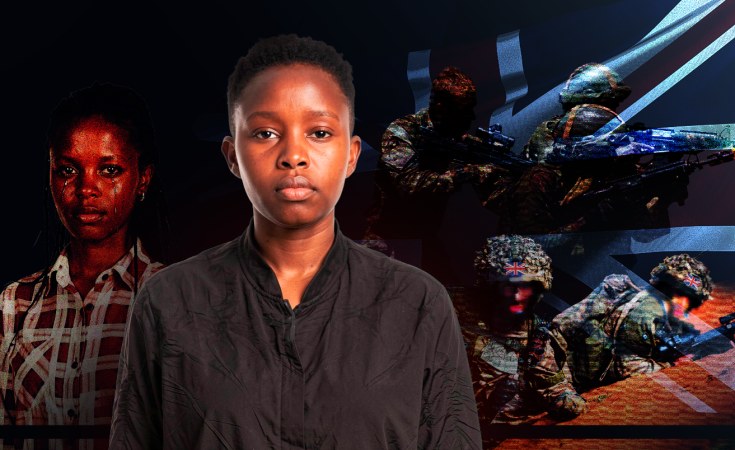
The UK Ministry of Defence has found money to rebrand the base where Agnes died. It has not found the will to compensate her child.
For fourteen years, Agnes Wanjiru's daughter has lived with a question no child should have to carry: why has nothing changed?
She was a baby when her mother died. She is no longer a small child confused by absence. She knows her mother was killed. She knows a British soldier has long been accused in connection with that killing. She knows British officials have met her family, expressed sympathy and spoken of justice. She also knows that none of this has repaired the life that was broken when Agnes was taken from her.
Her question is no longer only why her mother died. It is why, after all the meetings, letters, investigations, statements and promises, the British government has still not compensated her family.
Agnes Wanjiru was a young Kenyan woman and mother. Her death in 2012, during a period when British soldiers were training in Kenya, became one of the most troubling cases associated with the British Army Training Unit Kenya, known as BATUK. It did not come to public attention because the Ministry of Defence chose, on its own, to expose institutional failure. It was investigative reporting by The Sunday Times that forced the case into the open and kept it there.
The Times has since reported that a former British soldier has been formally charged in Kenya in connection with Agnes's death, and that the Kenyan authorities are seeking his extradition from the United Kingdom. The same reporting has underlined the wider significance of the case: if extradition proceeds, it would be an unprecedented test of accountability for a former British soldier accused of murder abroad.
The Ministry of Defence now says the United Kingdom remains committed to helping Agnes's family secure justice. In a written statement published by the UK government, the MoD said the Defence Secretary met Agnes's family in Kenya in April 2025 and met me in London in October 2025. The same statement said the UK was aware that Kenya's Director of Public Prosecutions had determined that a British national should face trial in relation to Agnes's unlawful killing.
Those words matter. But words are not compensation. Words do not raise a child. Words do not undo fourteen years of hardship.
Our family has attended meetings. We have written letters. We have followed formal processes in Kenya and in Britain. We have engaged in good faith with officials who asked for patience. We were led to believe that compensation would come. We held on to that belief because we wanted to believe that a government which acknowledged our pain would also accept a moral responsibility towards Agnes's daughter.
That belief has been exhausted.
On behalf of Agnes Wanjiru's family, I am saying clearly: we cannot continue attending meetings that lead nowhere. We cannot keep sitting across from officials who repeat sympathy but bring no concrete answer. If the British government is ready to make a substantive commitment, we are ready to listen. But we are done with process being used as a substitute for justice.
The family has now instructed lawyers in the United Kingdom to pursue compensation from the Ministry of Defence. This is not the path we wanted. It is the path left to us after fourteen years of delay.
To be fair, there has been movement in the criminal matter. We acknowledge that. The MoD's written statement says Kenya holds jurisdiction because the alleged offence was not committed in the course of official duties, and that Britain has provided support to Kenyan investigators when requested. That is important. But it does not answer the question Agnes's daughter asks every day.
A criminal process is not the same as compensation. It may take years. It may involve appeals. It may force Agnes's daughter to relive the details of her mother's death through evidence, testimony and legal argument. If the government's position is that the family must wait until every criminal avenue is exhausted, then it is asking a child to spend most of her life waiting.
That is not justice. That is delay dressed as procedure.
The government's apparent concern is that compensation could prejudice a fair trial by implying liability. We reject that argument. Governments can compensate victims' families without making a formal admission of criminal guilt. The question here is not whether a suspect should receive a fair trial. Of course he should. The question is whether Agnes's daughter must be denied support until that trial, and every possible appeal, is complete.
These are separate obligations. Criminal accountability concerns the accused, the courts, evidence and procedure. Compensation concerns the harm already suffered by Agnes's child and family. One should not be used to indefinitely postpone the other.
If the suspect's lawyers wish to argue that helping the child of a murdered woman somehow prejudices him, let them make that argument in court. The world will understand what is being said.
The greater prejudice has already been suffered by Agnes's daughter. Her mother is gone. Her family has carried the cost. The man accused in connection with the killing was not arrested for more than a decade. For years, the process did not protect Agnes. It did not protect her child.
There have also been inquiries. Britain and Kenya have both examined aspects of BATUK's presence and conduct. The UK's own Service Inquiry into alleged unacceptable behaviour by British Army personnel in Kenya recognised the Agnes Wanjiru case as a marked exception in local perceptions of British soldiers' conduct. It also examined wider issues including sexual exploitation and abuse policy, transactional sex, training, command culture and control measures.
The problem is not that governments have never looked. The problem is that looking has not been followed by meaningful action for the family.
Reports can create the appearance of accountability. Committees can sit, evidence can be gathered, recommendations can be written, and ministers can point to a process. But if no one implements what matters to victims, the result is not justice. It is paper.
The same contradiction is visible around BATUK itself. The UK government points to cooperation, oversight, development projects and the value of the military relationship with Kenya. The House of Lords International Agreements Committee, when examining the UK-Kenya Defence Cooperation Agreement, cited the government's position that BATUK gives the UK access to one of the best infantry training environments in the world, while bringing benefits to Kenya through training, capacity building, operational assistance and community projects.
No one denies that communities may benefit from schools, hospitals, jobs, water projects or infrastructure. I do not begrudge any community the development it receives. But community benefit is not compensation to Agnes's daughter.
A child cannot be raised by a development project. A murdered woman's family cannot be told that general goodwill in the region is a substitute for direct responsibility. Agnes's daughter cannot eat a policy statement. She cannot be educated by an apology that never becomes action. She cannot build a future on meetings that end with more waiting.
If the British state can fund and maintain its military presence in Kenya, if it can defend the strategic value of BATUK, if it can speak proudly of the partnership and the benefits that flow from it, then it can also find the will to compensate a family whose life was permanently altered in connection with that presence.
This is the moral centre of the case.
We are not asking Britain to abandon due process. We are not asking it to interfere with a criminal trial. We are asking it to separate two obligations that should never have been confused: the obligation to assist criminal accountability, and the obligation to compensate a child whose mother was killed and whose family was left to struggle for fourteen years.
Agnes's daughter is watching. She sees adults walk into rooms with powerful people and come out with nothing. She hears that Britain is committed to justice. She sees no change in her life. She knows the British government has compensated families in other cases. So she asks the most direct question of all: why not us?
That question deserves an answer.
It is easy for governments to speak in the language of process. It is harder to look at a child and admit that process has become another form of harm. Every unanswered letter, every meeting without substance, every public statement without material consequence tells Agnes's daughter something about the value placed on her mother's life.
The Ministry of Defence has had enough time to consider the case. Successive governments have had enough time to understand its human cost. The current government came to power speaking of accountability and restoring trust. This is where those words are tested.
So I ask the British government plainly: will you compensate Agnes Wanjiru's family - yes or no?
If the answer is yes, then say so and act. If the answer is no, then say that clearly too, so that Agnes's daughter does not have to grow up around promises that were never meant to be kept.
Fourteen years is long enough to wait for honesty. Fourteen years is long enough for a child to learn that sympathy is not justice. Fourteen years is long enough for Britain to answer.


