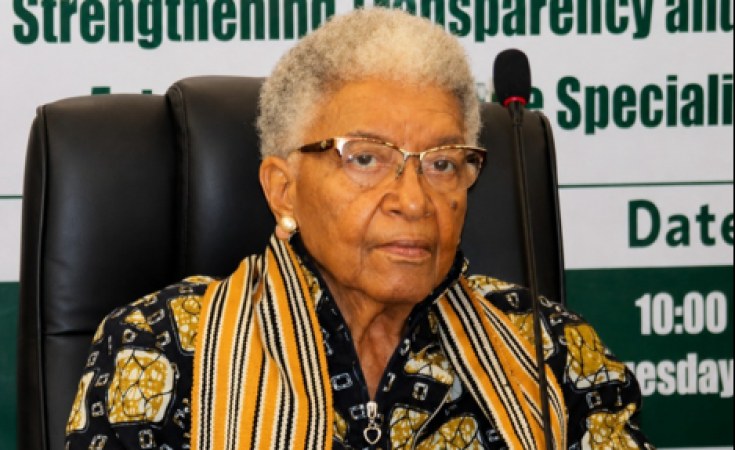
More than eight years after leaving office, former President Ellen Johnson Sirleaf continues to cast a long shadow over Liberian politics. Her presidency is still measured against the devastation wrought by civil war, the reconstruction that followed, and the democratic institutions she helped build. Yet, increasingly, another question has begun to dominate discussions of her legacy: Did Ellen Johnson Sirleaf's political decisions in 2017 inadvertently -- or deliberately -- shape one of the country's most consequential electoral outcomes?
That debate has resurfaced forcefully following comments by Liberian musical diva Miatta Fahnbulleh -- a longtime ally, confidante and respected intellectual -- who delivered perhaps the harshest public assessment yet of Sirleaf's post-presidential legacy.
"Her lasting legacy will be that she unleashed George Weah on us. That's the legacy I give to Mrs. Sirleaf," the diva told a Ghanaian journalist in an interview last week.
The statement is remarkable not simply because of its severity, but because it comes from someone long associated with the nation's reform movement and who worked alongside Sirleaf during pivotal moments in the country's democratic transition.
Follow us on WhatsApp | LinkedIn for the latest headlines
Fahnbulleh was a political ally of Sirleaf for decades, supporting her political activities for many years before she eventually won the presidency in 2005. The musical icon was by Ellen's side when she won the Nobel Prize for Peace in 2011--gracing the stage at the event to do a beautiful rendition of her son Obaa, this is our time, as her friend walked on the stage to receive the Nobel Prize. Ellen also appointed Fahnbuleh as Ambsaddor for Maternal Mortality, as she traveled across the country creating awareness while also seeking global support to reduce the menace.
Rather than criticizing Sirleaf's governance record, Fahnbulleh targeted what she believes was the former President's decisive political role in elevating George Manneh Weah to the presidency -- a decision she argues ultimately cost Liberia six years of ineffective governance.
Fahnbulleh's criticism extends beyond George Weah himself. It questions the political judgment of a leader internationally celebrated for rebuilding Liberia after fourteen years of civil conflict.
Explaining her position, Fahnbulleh argued that Sirleaf did not merely remain neutral during the 2017 elections but actively influenced Weah's rise.
"Mrs. Sirleaf... literally held up his hand as the successor," she said.
Although she stopped short of alleging outright electoral manipulation, her remarks revived long-standing political suspicions surrounding Liberia's 2017 transition.
The 2017 presidential election remains one of the most analyzed political contests in the country's democratic history. Officially, it represented the country's first peaceful democratic transfer of power from one elected government to another in more than seven decades.
But politically, it left behind enduring questions.
Sirleaf's Vice President for twelve years, Joseph Nyuma Boakai, entered the 2017 election as the standard bearer of the ruling Unity Party. Conventional political wisdom suggested that a sitting vice president would benefit from the support of the outgoing president.
Instead, Boakai found himself fighting not only the opposition Coalition for Democratic Change (CDC), but also persistent perceptions that elements within his own government were indifferent -- or even hostile -- to his candidacy.
Throughout the campaign, reports circulated that influential figures within the outgoing administration were quietly distancing themselves from the Unity Party campaign.
Among those frequently mentioned in political discussions were Robert Sirleaf, the former President's influential son, and then Finance Minister Amara Konneh, both accused by critics of favoring Weah's candidacy over Boakai's.
In late September 2017, in one of the last news interviews of her presidency, Sirleaf told CNN International Correspondent Christiane Amanpour on live television: "I'm sending a strong signal; not only should we respect the Constitution and the law, but I also say it's time for generational change." She was responding to Amanpour's question about the next phase for Liberia. "We have young people that are vying for leadership, that have the capacity ... passion and ... capability... it's time for them to take over and we've got to make way for them," Sirleaf declared.
Many in Liberia interpreted her "generational change" statement as a tacit endorsement of former football star-turned-politician George Weah, what was the youngest contender for the presidency in that election, compared to her much older Vice President, Joseph N. Boakai, Sr.
Addressing the tense debate days later, Sirleaf's Information Minister at the time, Jerolinmek M. Piah, Mr. Piah said the CNN host's question to President Sirleaf was specifically about transition in Africa, where some leaders have been in power for well over 30 years, and was keen on the fact that the President was keeping a commitment, having served for two terms, to turn over authority to whoever is elected at the ensuing October polls. "Yes, the President emphasized that it was the right thing to do so that another generation of leaders can have the opportunity to take over.
When you serve at the head of an administration, you represent a generation of people; there are several others, who are part of the leadership that represent a generation that she is heading, including the key opposition contender, Senator from Montserrado County (George Weah); the Vice President is another. When you transition, as she is about to do, and have the leadership changed, obviously that is a new set of generation of leaders," Piah explained
While no court or electoral body has established that Sirleaf orchestrated Weah's victory, the political narrative has remained remarkably persistent. It was reinforced by Sirleaf's highly publicized groundbreaking ceremony with Weah shortly before the runoff election -- an event that many Unity Party supporters interpreted as symbolic endorsement.
For Boakai loyalists, that image became emblematic of what they viewed as abandonment by his boss and many key officials of an administration he had loyally served for over a decade.
Liberians remain divided over Sirleaf's role. Some argue she merely respected democratic neutrality. Others believe her political signals significantly influenced elite opinion and voter perceptions during a closely watched election.
In Liberian politics, symbolism matters. The image of an outgoing President publicly engaging with the opposition candidate while her own Vice President sought succession inevitably fueled speculation about divided loyalties within her government. Whether intentional or not, that perception has become part of the historical narrative surrounding the 2017 transition.
Fahnbulleh's comments therefore reflect a broader argument advanced by some political observers -- that Sirleaf's greatest political miscalculation was not her governance, but her succession strategy.
Judging Weah's Presidency
Fahnbulleh spared no criticism for George Weah's administration. Calling his presidency "a disaster," she questioned both his preparedness and his interest in governance.
She argued that Weah possessed extraordinary sporting talent but lacked the technical capacity required to manage the complexities of national administration. Her criticism reflects concerns raised throughout Weah's presidency regarding public financial management, declining investor confidence, corruption allegations, murders of four auditors, rising living costs and other governance challenges.
Supporters of Weah, however, reject that characterization.
They argue his administration expanded road infrastructure, promoted housing projects, improved sports development and represented historically marginalized Liberians who had long been excluded from elite political circles.
Fahnbulleh's comments immediately triggered strong reactions from CDC officials and supporters. Former presidential aide Sekou Kalasco Damaro dismissed her remarks as evidence of enduring political elitism.
According to Kalasco, critics such as Fahnbulleh never accepted Weah because he emerged from the nation's impoverished neighborhoods rather than the country's traditional political establishment.
In his view, Weah's presidency represented a broader democratic transformation in which ordinary Liberians rejected what he described as an entrenched ruling class.
Former Representative Acarous Gray echoed similar sentiments. He argued that the nation's educated political elite governed the country for decades without eliminating poverty or underdevelopment.
According to Gray, criticizing Weah's educational background ignores broader failures by previous administrations that possessed considerably greater technocratic expertise.
Those responses attempt to reframe the debate from whether Weah was competent enough to lead, to broader systemic issues that became even more pronounced during his six-year presidency.
It is also about competing visions of leadership, meritocracy, class and political legitimacy in modern Liberia.
Ellen's Larger Legacy
Yet reducing Ellen Johnson Sirleaf's legacy to the events of 2017 risks overlooking the profound transformation Liberia experienced during her twelve-year presidency. When Sirleaf assumed office in January 2006, Liberia was emerging from one of Africa's most devastating civil wars.
Government institutions had largely collapsed. Infrastructure lay in ruins. Foreign investment had evaporated. Public confidence in state institutions was almost nonexistent. The economy was heavily dependent on humanitarian assistance. Against that backdrop, Sirleaf inherited what many international observers described as a failed state.
And world leaders were lining up to help.
Over the next twelve years, Liberia experienced significant institutional reconstruction.
Her administration secured the cancellation of approximately US$4.6 billion in external debt under the Heavily Indebted Poor Countries (HIPC) Initiative, dramatically improving the country's fiscal outlook.
Her government established and strengthened institutions such as the Liberia Anti-Corruption Commission (LACC), the Public Procurement and Concessions Commission (PPCC), the General Auditing Commission (GAC) and other governance mechanisms aimed at improving accountability.
She also oversaw major reforms in public financial management, attracted substantial foreign investment, expanded basic infrastructure, restored the nation's international credibility and re-engaged the country with multilateral institutions.
Her administration successfully navigated two major national crises -- the Ebola epidemic and the global commodity downturn -- while preserving constitutional order and avoiding democratic collapse.

Sign up for free AllAfrica Newsletters
Get the latest in African news delivered straight to your inbox
Perhaps most importantly, Sirleaf completed two constitutional terms and peacefully transferred power through democratic elections, reinforcing Liberia's democratic credentials in a region where peaceful transitions have often proven elusive.
None of this places Sirleaf beyond criticism with some terming her legacy as imperfect. Her administration faced persistent allegations of corruption, patronage, slow institutional reform and growing public frustration over unemployment and inequality.
Critics frequently argued that economic growth failed to translate into meaningful improvements in the daily lives of ordinary Liberians. Others questioned aspects of her reconciliation agenda following the recommendations of the Truth and Reconciliation Commission.
These shortcomings remain legitimate subjects of historical evaluation. Yet history often judges leaders not solely by their failures, but by the conditions they inherited and the institutions they leave behind. Measured against that standard, Sirleaf's presidency fundamentally altered Liberia's trajectory.
Miatta Fahnbulleh's remarks have reopened an important national conversation.
Should Ellen Johnson Sirleaf primarily be remembered for what happened after she left office? Or should her legacy be assessed over the entirety of her twelve-year presidency?
The answer likely lies somewhere between celebration and condemnation.
History will probably remember Sirleaf as the leader who guided Liberia from the ruins of civil war toward democratic stability, restored international confidence, rebuilt state institutions and secured unprecedented debt relief.
It may also be remembered that the political choices surrounding the 2017 succession remain among the most contested episodes of her career.
Whether she intentionally facilitated George Weah's rise is a matter of continuing debate rather than established fact. What is beyond dispute is that those perceptions have become part of the broader conversation about her legacy.
For a president whose tenure transformed the country's international standing, history is unlikely to define her by a single election. Yet neither is it likely to ignore the enduring questions surrounding one of the country's most consequential political transitions.
In the end, Ellen Johnson Sirleaf's legacy remains both extraordinary and contested -- a reminder that the achievements of nation-building and the politics of succession often coexist uneasily in the historical record.
