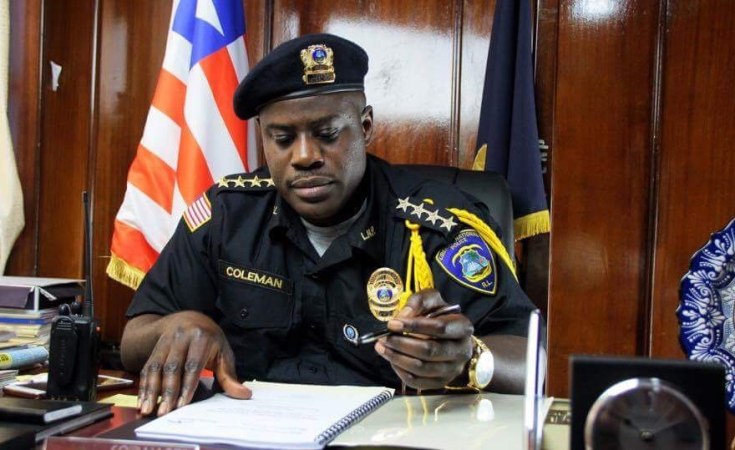
Serving Liberian police commanders drove escort for the country's largest cocaine consignment as it was moved from the shoreline where it came ashore to the stash house where it was later seized, and two of them were charged and sent to court Thursday, Inspector General of Police Gregory Coleman said.
It is the first time the state has accused officers of moving the narcotics themselves rather than of interfering with the investigation after the fact, and it puts the police at the center of the trafficking operation they are investigating.
"We have identified key state actors who played a role in transporting, escorting the movement of these narcotic substance from the landing site to the holding ground using police vehicles as escort, one in the front, one in the back," Coleman said at the Ministry of Information's regular press briefing.
Follow us on WhatsApp | LinkedIn for the latest headlines
He named the chief of highway patrol, Wadell Quaboe and the chief of major crimes Anthony Blaye, both of whom were detained at Police Headquarters and, he said, would be turned over to court the same day for prosecution. A deputy commander at Roberts International Airport for the Liberia Drug Enforcement Agency has also been identified as a key actor, Coleman said, and other state actors remain under investigation.
"The investigation continues with them," he said. "When the time is right, we will be putting the information out."
Coleman said investigators have established that the shipment could not have entered the country without official protection. "One key thing that you all should know is that these traffickers would never be brave to enter our country with this particular extent of narcotic substances," he said. "They had assistance."
He went considerably further than the police have gone before on who provided it, telling reporters the operation was authorized at the top of a previous government. The investigation has reached 2021, he said, and is examining people who held presidential appointments between 2019 and 2023.
"This thing was definitively sanctioned by state actors at very, very senior level," Coleman said.
He did not name anyone at that level, produce documents, or say whether any of those former officials have been questioned.
The seizure was not a lucky interception, according to Coleman, but the end of a surveillance operation that ran more than a year, led by the National Security Agency with the Executive Protection Service and the police joining later, and authorized for takedown by the National Security Council. He said an earlier attempt to bring the drugs in by air failed, after which the traffickers switched to a sea route.
Coleman framed the case as the return of an industry Liberia had once driven out. He said a United States Drug Enforcement Administration special operations mission requested by then President Ellen Johnson Sirleaf ran from 2008 to 2013, that 11 people connected to cartel operations were expelled to the Southern District of New York, and that all were convicted and sentenced to between five and 33 years. Cartels stayed away until roughly 2018, he said, and returned about two years into the current administration on the belief that the networks that once protected them could be reactivated.
Foreign assistance has since been secured at the president's request, Coleman said. "The DEA is currently in-country working alongside us. We have agents, we have analysts here working along with us on this investigation." Morocco has responded to a request for support, he said, and he spoke Thursday with the inspector general of the Rwanda National Police about sending a team.
Justice Minister and Attorney General Cllr. Oswald Tweh, who heads the joint investigative team, said cooperation had also been sought from the Netherlands. He said he and the national security adviser met the Dutch justice and security minister in Accra on July 21, and that he and the officer in charge of the LDEA had met Dutch officials in Accra in November on the margins of a conference on West African drug markets convened with the Global Initiative Against Transnational Organized Crime.
Asked directly whether the investigation had been blocked from questioning Joseph Nyuma Boakai Jr., the president's son, whose name has circulated in connection with the case, Cllr. Tweh said no one is exempt.
"There will be no limits," he said. "We will not jump on people because the crowd out there is yelling. Everything will be evidence-based."
"If the evidence leads to you, you'll be investigated," Tweh said.
Coleman said the same, and declined to go further. "At any point in time when the need comes up, you will hear from us," he said.
On the money, Coleman gave a figure far below what has circulated publicly. He said the raid was accompanied by a court sheriff, that the returns are on file with the court, and that the cash recovered was inside the suitcases with the drugs.
"The cash that I remember that was seized there was 7,000 US dollars," he said.
Coleman also accused unnamed people in the media of taking cartel money, saying the traffickers have effectively unlimited resources. "We've been able to verify and establish that they have infused money into the media to change the narrative, distract the key players in the investigation, and just sow a serious seed of discord," he said.
The Ministry of Information clarified that within minutes, telling reporters that the inspector general was referring to elements within the media community, some of which operate platforms that are not Liberian entities, and that "he was not suggesting that the Liberian media collectively is receiving money from the drug cartel." Coleman accepted the clarification. "I 100 percent agree with what the minister said because that was my intent," he said.

Sign up for free AllAfrica Newsletters
Get the latest in African news delivered straight to your inbox
He offered no evidence for the allegation and named no outlet or individual.
Coleman refused to specify the number of suspects, mentioning that two more had been brought in while he was on his way to the briefing. "Every hour we're finding new suspects," he said. He described the case as a multi-layered conspiracy and claimed that police are intentionally withholding details to protect a prosecution, referencing the collapse of an earlier case.
"You saw what happened here to the $100 million drug case. You saw how people walked away from the court," he said. "We don't want to make that mistake again."
The seized narcotics were being transported to a burn site Thursday under a court order, with representatives of the Environmental Protection Agency present and samples retained as evidence, Coleman said.
He also addressed the video of masked men that circulated after the seizure, dismissing it as staged.
Coleman, who has also faced allegations from opposition figures, said he still has the president's support. "The confidence of the people, the confidence of the appointing power remained, and the instructions were clear," he stated.
"So to those of you who know yourselves and you know the roles that you've played, we're on you," he said.
