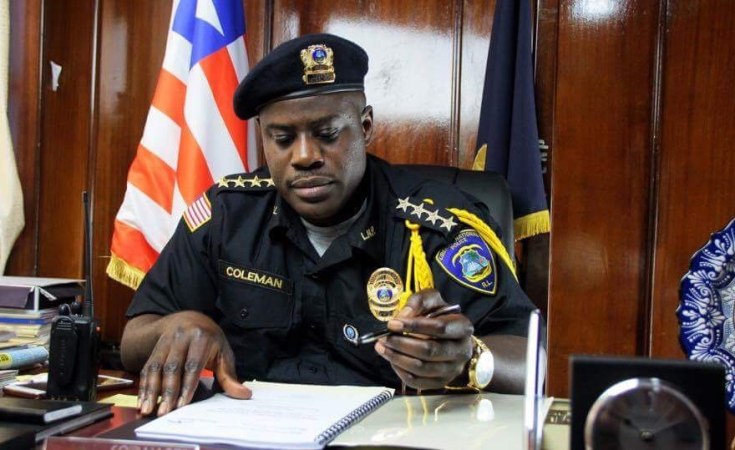
Monrovia — Coleman's statement, posted to his personal Facebook page, reads less like a routine institutional update and more like a man answering a question nobody asked him directly, because everybody has been asking it indirectly for weeks. "Criminal organizations thrive where fear, silence, and institutional weakness prevail. They will not prevail in Liberia again," he wrote. "The Liberia National Police will not be intimidated, distracted, or deterred from enforcing the law."
He was explicit about where his loyalties sit, in language built to preempt exactly the kind of insinuation that has followed him for weeks: "Our commitment is not to personalities, political interests, or public applause. It is to the Constitution, the laws of Liberia, and the safety and security of the Liberian people. No individual, network, or organization is above the law, and every case will be pursued based on credible evidence, due process, and lawful authority."
The statement then turned forward-looking, framing the police force's mission in terms that doubled as a personal pledge. "We will continue to identify and disrupt narcotics networks, protect communities, strengthen cooperation with national and international partners, and bring those responsible before the courts," Coleman wrote. "We will remain professional, impartial, and accountable, but we will also remain resolute." He closed with the line that has since traveled furthest online: "We will not retreat. We will not be distracted. We will continue to work firmly, lawfully, and without fear."
A Statement Aimed at Doubt, Not Just Critics
Keep up with the latest headlines on WhatsApp | LinkedIn
What makes the post notable is not simply what it says, but what it doesn't: at no point does Coleman name an accuser, cite a specific allegation, or address any of the individual claims that have circulated about his own conduct in recent weeks. Read one way, that is restraint -- a chief declining to dignify speculation with a point-by-point rebuttal. Read another way, it is a statement carefully built to sound like an answer without engaging the specific questions that prompted it. Both readings have circulated freely since the post went up, which is itself a reflection of how contested Coleman's standing has become in the middle of the very investigation he leads.
The Allegations That Won't Go Away
Coleman's position in this scandal has been complicated from multiple directions at once. He was the one who put the phrase "sanctioned at very, very senior level" into public circulation in the first place, describing the trafficking network's protection in terms serious enough to implicate senior officials without ever naming one -- a claim that, however he intended it, has also been read by critics as circling uncomfortably close to his own office. Separately, Coleman has faced allegations, aired by critics and unnamed sources rather than proven in any court, that he personally gave the order for his own deputies to escort cocaine shipments, that suspects were promised freedom in exchange for silence, and that a protection arrangement shielded at least one implicated officer from the consequences facing others in the case. He has denied all of it, framing himself instead as a target of the corruption he is trying to root out.
None of those allegations has been substantiated in the reporting available to this newspaper, and Coleman is entitled to the same presumption of innocence as anyone else named in this scandal. But the fact that a sitting Inspector General has had to publicly deny personal involvement in the very network his department is prosecuting says something on its own about how deeply this case has unsettled public confidence in Liberia's security leadership -- regardless of where the facts ultimately land.
How Liberia Got Here
Coleman's Facebook post did not emerge from nowhere; it is the latest data point in a scandal that has been widening for two months. It began with the June 8 seizure of roughly $19.2 million in cocaine at Roberts International Airport and grew dramatically in July with the discovery of a $317 million cocaine haul in a Duazon warehouse -- a seizure large enough that the government eventually destroyed it in public. In the weeks since, two police commanders have been accused of personally escorting cocaine through the capital in marked cruisers, an LDEA officer named Moses Jallah has been charged with obstructing the investigation, Paynesville bar owner George "Leroy" Harris has been charged with drug trafficking and money laundering after his venue was tied to the case, and a Monrovia Central Prison operations chief was arrested over allegations his phone was used to keep suspects in contact with their financiers. RIA deputy director Mark Kuiah was dismissed, along with three other officials, in a five-agency purge that has become the most visible symbol of the government's response so far.
At the center of nearly all of it sits Coleman's own police force -- the agency that arrested some of the officers now implicated, and the one whose own leadership has been publicly accused of shielding others. Deputy Inspector General Nelson Freeman has defended the department's willingness to prosecute its own, telling the public to judge the force "by the evidence, not the emotion." Coleman's own Facebook statement reads, in many ways, like an extension of that same argument -- a plea to be judged on results rather than rumor, at a moment when the line between the two has grown genuinely difficult for ordinary Liberians to see.

Sign up for free AllAfrica Newsletters
Get the latest in African news delivered straight to your inbox
A Chief Investigating Himself?
The uncomfortable structural reality underneath all of this is one Coleman's statement does not resolve and perhaps cannot: he is simultaneously the chief overseeing Liberia's response to this scandal and one of the people whose own conduct within it has been publicly questioned. That is not, by itself, evidence of wrongdoing -- someone must lead the police through a crisis inside the police, and stepping aside is its own kind of statement most chiefs are reluctant to make absent a formal charge. But it does mean that every claim of progress Coleman makes on behalf of his department will continue to be read, by at least some of the public, through the lens of the questions still hanging over him personally. "No individual, network, or organization is above the law," he wrote. Whether Liberians read that as a chief's genuine conviction or a chief's most convenient possible defense may depend less on the words themselves than on what, if anything, this investigation eventually turns up about the man who wrote them.
