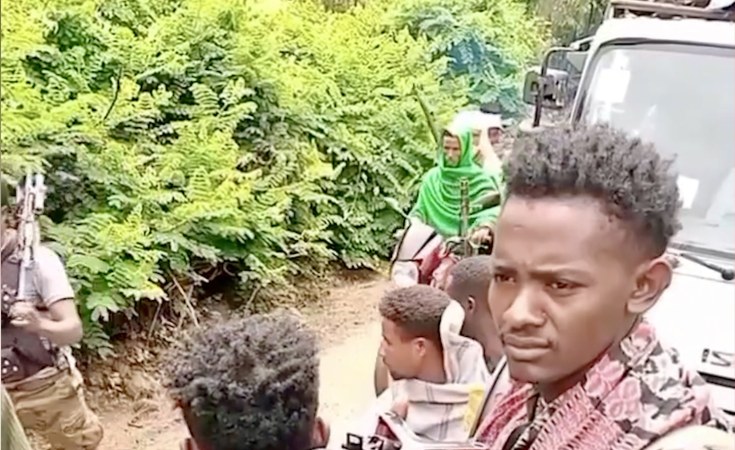
Addis Abeba — The Oromo Liberation Army (OLA) has publicly distanced itself from the armed group operating in Wollega under the name Fano while, in the same statement, acknowledging that a broader alignment among Ethiopian opposition forces is "taking shape" across the country.
Africans & DiasporaDiscover moreSocial Issues & AdvocacyHistorypolitical The position, contained in a 17 September statement by the OLF-OLA High comes as violence in East Wollega has recently brought Oromo-Amhara tensions, competing armed formations and the government's use of regional and irregular forces into sharp focus.
The statement draws a distinction between two developments that have increasingly become intertwined in public debate: the armed confrontation in Wollega and the emerging cooperation among armed forces.
Keep up with the latest headlines on WhatsApp | LinkedIn
Geographic Reference On Wollega, the OLA says that a small armed faction claiming to operate in the name of the Amhara was initially trained, armed and deployed by the federal government to counter the OLA during the war in Tigray. According to the OLA, elements of the group later broke formally from government militia structures after the ongoing war in the Amhara region erupted circa August 2023, after which the government changed how it used the group.
Discover moreDemographicsLocal NewsMagazines The OLA says that the group was subsequently maintained as an instrument for inflaming Oromo-Amhara tensions, including by attributing attacks on Oromo civilians to the faction. It further alleges that government and Oromia forces repeatedly withdrew from confrontations with the group under circumstances that left weapons and other resources behind.
The statement nevertheless marks a significant escalation in the OLA's call for Amhara forces to clarify their relationship with the Wollega faction.
"Amhara forces across the river saw in this small, armed faction that spoke their language and jumped on it as an opportunity to extend influence beyond the Amhara region," the OLA said. It warned that association with the group could carry political consequences and urged Amhara forces "to make their position unequivocal by dissociating themselves from it."
Politics Discover moreGeographic ReferencePoliticsJournalism & News IndustryNewspapersPoliticalWar & ConflictpoliticsAfricans & DiasporanewsNews The demand comes against the backdrop of increasingly organized Fano activity in western Oromia. On 13 August, Asres Mare, head of public relations and an executive member of the AFNM, said that Fano in Wollega is not simply an Amhara force transplanted from the Amhara region. He described it as a movement "rooted locally", saying that its leaders "were born and raised in the land of Wollega" and that its fighters were also born there.
Earlier in August, Amhara Fano National Movement chairman Zemene Kassie said Fano factions had been consolidated under a "single national movement" and "single command," and said armed groups representing several Ethiopian communities had formed a coalition to coordinate against Prime Minister Abiy Ahmed's government.
Africans & Diaspora Gida Ayana: competing armed structures, competing narratives
The violence that intensified in Gida Ayana in August did not fit neatly into the familiar framing of either a federal government-Fano confrontation or an Oromo-Amhara communal conflict.
As Addis Standard reported on 21 August, federal forces, Oromia regional security structures, Fano forces and local militias were operating in an environment already shaped by years of insurgency and communal violence. Messages received from the affected area described civilians struggling to determine which armed actors were confronting one another.
Newspapers The competing accounts have also made independent verification difficult.
Fano supporters claimed in August that forces operating under what they described as the AFNM's Wollega/Bizamo Ansha Seyid Command had attacked combined ENDF and Geda Commando forces in Gida Ayana, claiming that military vehicles were destroyed and weapons captured. Those battlefield claims were not independently verified by Addis Standard.
At the same time, Asres claimed that cooperation between Fano and the OLA had continued through information sharing, logistics and other forms of coordination.
The OLA has rejected that characterization.
A senior OLA official told Addis Standard on 21 August that the characterization of the force as Fano was "ludicrous," saying: "Whether called Bizamo or Ayisha, there is no Fano in Wollega. Only a bunch of regime-backed tugs."
The official said the OLA's earlier characterization of the group as a government-backed militia "stands."
The latest OLA statement makes a direct political demand: that Amhara forces clarify whether they identify with, cooperate with or otherwise accept responsibility for the Wollega faction.
Politics The Geda Commando question
The dispute is further complicated by the involvement of the Geda Commando, a state-backed regional security force operating within Oromia's security structure.
Reports published in late August indicate that Geda Commando forces were involved in attacks against Amhara civilians in Gida Ayana and surrounding areas in which dozens of civilians had been killed and thousands displaced. Prior to that attacks targeting Oromo civilians and attributed by locals to Fano fighters claimed the lives of many, including patients being transported by ambulance.
The precise scale of the violence, the identity of all perpetrators and the extent of direct command responsibility remain unknown.
For the OLA, however, the presence of regional security forces in the conflict is part of a larger argument: that the government is increasingly relying on irregular or locally mobilized armed actors in its campaign against insurgency.
The 17 September statement says the proliferation of such forces is evidence that the Prosperity Party government can no longer rely indefinitely on conventional forces. The OLA says that civilian mobilization in areas where it operates dates back to at least 2021.
"The urgent task now is to separate the regime from the Oromo people behind whom it desperately seeks cover," the OLA said. "Abiy Ahmed should not be allowed to hide behind the Oromo."
A history that predates the latest fighting
The current confrontation also sits within a much longer cycle of violence in western Oromia.
Gida Ayana and neighboring districts in East and Horo Guduru Wollega have experienced repeated attacks, displacement and communal tensions involving both Oromo and Amhara civilians.
In December 2022, Addis Standard reported that attacks in Kiremu district killed dozens, including district court judge Damtew Kefyalew Gemeda, with residents and local officials attributing the violence to armed groups identified as Fano militants.
Newspapers Gida Ayana subsequently became a major destination for people displaced from Kiremu and surrounding areas. At the time, more than 30,000 displaced civilians were reported to be stranded in Gida town, with local officials describing severe shortages of food, water, shelter and medical care.
Neither the OLA's allegations of government manipulation nor Fano's claims of protecting Amhara communities can be assessed in isolation from the accumulated record of violence against civilians from both communities.
A February 2022 Addis Standard investigation documented the displacement of hundreds of Amhara residents from western Oromia following months of violence and persecution. That experience remains part of the political memory underpinning Amhara demands for security in Wollega.
At the same time, Oromo communities have repeatedly experienced killings and displacement attributed to armed groups identified as Fano, creating a deeply entrenched perception of threat on both sides.
It is this accumulated history that makes the latest confrontation particularly combustible.
The alliance question: separating process from substance
The second and potentially more consequential part of the OLA statement concerns 'Tsimdo' and the broader armed groups' alignment now taking shape.
The OLA explicitly says it "is neither involved in, nor is not a component of Tsimdo." Yet it acknowledges that "an alliance involving opposition forces stretching from west to east and from south to north is taking shape."
Politics The apparent contradiction has already become a subject of public discussion. But the distinction made by the OLA reveals the emerging cooperation is not a political settlement among the participating forces. It is not an agreement resolving questions over federalism, territorial claims, the constitutional order, self-determination or the future structure of the Ethiopian state.
Instead, the OLA describes it as a procedural understanding built around two objectives: ending "horizontal confrontations" among opposition forces and creating conditions for a broad-based transitional political opening.
"It is not an agreement on substantive political questions. It is a procedural consensus," the statement says.
The OLA further insists that no participating organization has been authorized to predetermine those questions.
"Those questions belong to the people themselves and must ultimately be addressed through their direct participation," it said.
Recent public debate has linked the TPLF, Fano, OLA and other armed groups to discussions around the coalition. The OLA's latest statement appears designed to draw a boundary between tactical or procedural cooperation and substantive political agreement.
"That distinction helps explain why disagreement with Fano does not necessarily constitute a contradiction with participation in a broader opposition process," an Ethiopian political analyst told Addis Standard when requested to comment on the statement.
Africans & Diaspora Discussions between the OLA and Tigrayan political actors did not begin with the latest public debate around the potential coalition of armed groups operating across Ethiopia. They have reportedly extended back several years.

Sign up for free AllAfrica Newsletters
Get the latest in African news delivered straight to your inbox
"The present alignment is consequently better understood as an attempt by actors with substantially different political projects to establish a minimum framework for cooperation rather than as evidence that their long-standing disagreements have disappeared," the analyst who responded to questions on conditions of anonymity said.
Where OLA differs with Fano
The emerging alignment brings together forces that have historically regarded one another as adversaries. A number of reporting have documented discussions involving Fano and other opposition groups, while AFNM chairman Zemene Kassie has publicly described agreements with armed groups representing different Ethiopian communities.
Tigrayan officials have also repeatedly acknowledged the existence of the alliance. Most recently, the president of the Tigray Region and chairman of the TPLF, Debretsion Gebremichael, said the coalition among opposition forces had become institutionalized and "irreversible."
But the OLA's latest statement does not endorse every armed group operating under an Amhara banner.
Newspapers Instead, it distinguishes between opposition cooperation at the national level and the specific armed faction operating in Wollega.
Speaking to Reyot Media on 16 September, Asres reiterated that the Fano forces operating in Wollega are part of the movement's broader armed structure. "The Ayisha Said Command located in Wollega is led by youths who were born and raised right there in Wollega, survived numerous torture and genocidal attacks, and speak the Oromo language fluently. We have stated that it has its own structure with a leadership chain of command," Asres maintained.
"The OLA's call for Amhara forces to 'dissociate themselves' from the Wollega faction can therefore be read as an attempt to force precisely such a clarification," the analyst said, adding that it also creates a test for the broader opposition alignment. "If cooperation is primarily procedural, as the OLA maintains, then participation in a common process would not require agreement on every armed actor, territorial question or political objective. But the credibility of such a process would still depend on how its participants address violence involving forces claiming to operate in their name. Whether the emerging alliance can contain such fault lines without resolving them, and whether it can prevent localized conflicts from undermining broader political cooperation, may prove as consequential as the alliance itself."
