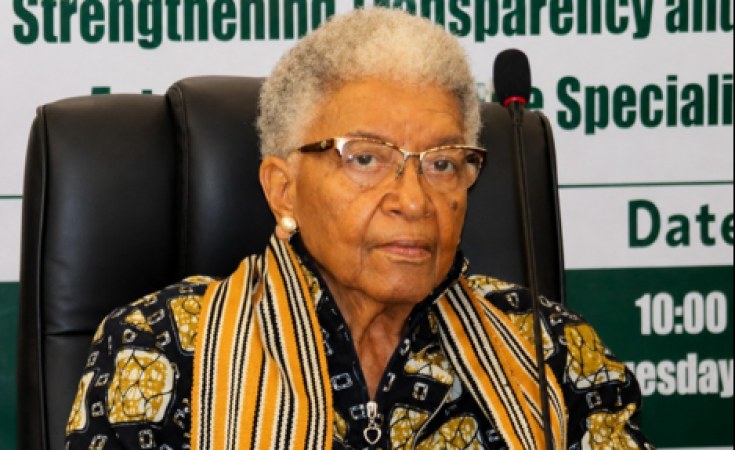
Former President Ellen Johnson Sirleaf has challenged Liberia to move beyond passing anti-corruption laws and establishing integrity institutions, urging the country to give those laws "teeth" by ensuring that violations lead to investigations, prosecution and meaningful consequences.
Speaking Tuesday during the Governance Commission's Month of Good Governance symposium in Monrovia, Sirleaf said Liberia's long-running struggle with corruption demonstrates that laws and institutions alone cannot guarantee accountability.
Her remarks came under the theme, "Promoting Good Governance Through Accountability and Transparency," as Liberia begins a month-long national observance focused on strengthening transparency, integrity, accountability and citizen participation in governance. President Joseph Nyuma Boakai proclaimed October as the Month of Good Governance, creating a national platform for discussions and activities on governance reform.
Sirleaf, who served as Liberia's president from 2006 to 2018, used her keynote address to reflect on the country's progress and shortcomings in the fight against corruption, including the reforms undertaken during her administration.
Keep up with the latest headlines on WhatsApp | LinkedIn
"When I took the Presidential Oath of Office in January 2006, Liberia was a nation where corruption was largely the operating system," she recalled, saying her administration declared corruption "the public enemy number one."
She said her government subsequently strengthened several institutions intended to improve accountability and transparency, including the Governance Commission, Liberia Anti-Corruption Commission, Public Procurement and Concessions Commission and other integrity mechanisms.
Liberia also enacted important transparency and accountability measures during that period, including the Freedom of Information Act, which gave citizens a legal basis for requesting public records.
But Sirleaf acknowledged that the reforms did not fully achieve their intended purpose.
"I wish that I could tell you that with all this effort, we won the corruption fight. We did not. And we are facing the same thing today," she said.
According to the former President, one of the central problems has been the failure to translate investigations and legal provisions into consistent prosecutions and convictions.
"Orders were published and then forgotten. Too few cases reached a courtroom, and few ended in conviction," Sirleaf said, adding that some institutions were given mandates without the budgetary resources necessary to carry them out.
Her assessment echoed a broader concern she raised about Liberia's accountability architecture: institutions may exist on paper, but they cannot function effectively without political commitment, adequate resources and independence.
"Institutions are necessary, but they are not enough," she stressed.
Sirleaf argued that accountability must begin with political leadership, insisting that the conduct of leaders determines whether citizens trust and follow public institutions.
"Accountability begins at the top. The very top. Or it does not begin at all," she said.
She called on the executive branch to demonstrate integrity through its decisions and actions, while urging integrity institutions to receive the full budgetary support and independence required to perform their mandates.
She also challenged the Legislature to strengthen oversight and ensure that public resources are allocated in ways that promote equity and public trust. The judiciary, she said, must ensure that court decisions are respected and implemented and that the justice system is staffed by competent and people of integrity.
For Sirleaf, the effectiveness of anti-corruption laws ultimately depends on whether institutions are prepared and empowered to enforce them.
"Accountability without consequence will only be a report on the shelf," she warned. "Transparency without citizens who use the information factually will provide only an escape. Laws give us tools."
She therefore called on citizens to make greater use of Liberia's transparency laws, particularly the Freedom of Information Act.
"Ask for the records," she urged.
She also challenged journalists to continue investigating public institutions and officials, telling them to "keep asking the hard questions."
Sirleaf further emphasized the importance of a professional civil service in reducing opportunities for corruption. She said public servants recruited on merit must be adequately compensated and protected from political interference.
"A civil servant hired on merit must be paid a living wage and protected from political pressures, as this is one of our strongest defenses against corruption," she said.
Her remarks also carried an element of self-criticism. Sirleaf acknowledged that her administration, despite introducing major governance reforms, did not succeed in eliminating corruption.
"I say so today even though it means that I'm criticizing my own administration because we tried, but we did not succeed for the reforms that are necessary," she said.

Sign up for free AllAfrica Newsletters
Get the latest in African news delivered straight to your inbox
She stressed that Liberia's governance challenges cannot be solved by one administration or a single branch of government.
"No one president can do it. No vice president or speaker or president of the Supreme Court or Chief Justice can do it," Sirleaf said. "We have to start where we are to make the changes that are necessary."
Acting Governance Commission Chairman Prof. Alaric K. Tokpa welcomed Sirleaf and credited her with helping establish the foundation of Liberia's modern governance reform process. He urged Liberians to embrace good governance as a pathway to national renewal, peace, stability and socioeconomic development.
Governance Commission Executive Director Jallah C. Kesselly said the Month of Good Governance was conceived as more than a ceremonial observance. He said it should remind Liberians of the consequences of poor governance and the need for collective responsibility in strengthening accountability, transparency, integrity, participation, inclusion and the rule of law.
The Commission's broader October program includes public engagements, a national good governance dialogue and activities designed to increase citizen participation and institutional accountability.
For Sirleaf, however, the central challenge is whether Liberia can transform its governance commitments into practical consequences.
