Eunugu, Nigeria — "No family should spend years searching police stations, correctional centres, hospitals, and morgues for a relative in state custody."
After four years in detention without charge, a haggard and emaciated Sunday Ifedi finally returned home only to learn that his wife Calista - who had also been snatched by the security forces - had died in custody two years earlier and was buried in an unmarked grave.
Security officers barged into the Ifedi home in the southeastern town of Ezeagu in November 2021 and took Sunday and Calista into detention without a warrant or any explanation. Although the couple have now officially been cleared of any wrongdoing - posthumously in Calista's case - the hurt done is deep and irreversible.
Keep up with the latest headlines on WhatsApp | LinkedIn
Enforced disappearance is a particular kind of torment. The lack of knowing, the lack of closure, leaves psychological scars. The family had no idea where Sunday and Calista had been taken, if they were alive or dead, whether they would ever be seen again.
Relatives and friends poured time and money into looking for answers, engaging lawyers and rights groups, petitioning the authorities, filing cases across two states to try and trace their whereabouts, all the while being met by official silence.
Sunday and Calista had been swallowed by a system in which the security forces have a license to act with impunity, human rights groups say; one in which arbitrary arrests, unlawful detentions, extrajudicial executions, and enforced disappearances are disturbingly common.
Although Nigeria is a signatory to the UN's International Convention on the Protection of all Persons from Enforced Disappearance, the treaty is yet to be domesticated into local law. Defending people from abuse is therefore largely down to the dogged work of a small group of lawyers and NGOs.
Nigeria's Red Cross is among the most active and best resourced. It is currently tracing 17,000 missing persons, mostly in Nigeria's northeast - a region scarred by over a decade of insurgent violence.
However, the Ifedis' case occurred in the southeast, where separatist unrest and a heavy-handed crackdown by the security forces has led to hundreds of disappearances.
The Ifedis are from a farming town known for its forests and cave networks, which the authorities suspect are hideouts for separatists. The security officers raiding their home were looking for a particular activist and found his number on Calista's phone.
She tried to explain he was simply a customer at her grocery shop, but they took her in anyway - and then Sunday when he tried to protest.
Their eldest daughter, Merit, followed them into the street and saw a convoy of Prado jeeps and Hilux vans, which suggested the men were from the Department of State Services (DSS), Nigeria's secret police. When Merit and her relatives tried to enquire at the DSS's HQ in the southeastern city of Enugu, they were shooed away from the front gate - the first dead-end.
The UN convention against enforced disappearance describes secret state-sponsored detention as a "crime against humanity". Detainees, the treaty holds, must be registered and protected regardless of guilt. It also mandates legal representation for all prisoners, with victims and their families having the right to information about their whereabouts and the cases against them.
Yet in response to a submitted report by Nigeria in 2023, the UN Committee on Enforced Disappearances noted allegations of mass graves, secret detention facilities, and people being held incommunicado.
It urged Nigeria to work the convention into local law, produce accurate registers of those detained, and "redouble its efforts" to ensure all who have been forcibly disappeared are located. It also noted that reparations should be awarded to victims.
The unrest in the southeast
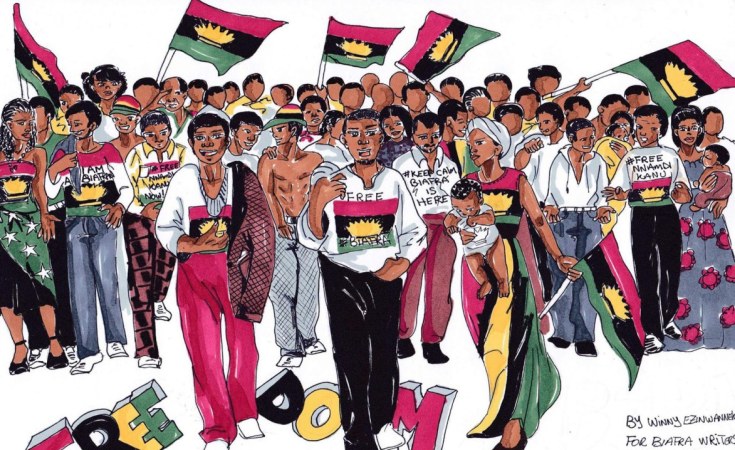
The separatist unrest in Nigeria's southeast has been simmering for over a decade. It is based on a long-standing grievance over the region's alleged political and economic marginalisation, and a sense that it is still being punished for its secession in 1967 as the self-declared state of Biafra, which led to a bitter three-year civil war.
The government's response to revived pro-Biafra political agitation has been to crack down militarily rather than to talk.
In 2021, the army targeted the Eastern Security Network - the paramilitary wing of the Indigenous People of Biafra, which is demanding independence for the southeast. The region has since disintegrated into a mélange of armed groups, each committing extreme acts of violence, triggering displacement and economic pain.
According to Amnesty International, at least 1,844 people were killed between 2021 and 2023 by separatist gunmen, state-backed militias, and federal forces. The missing person cases arising from the security services' attempts to impose order have blurred the line between law enforcement and abduction.
The International Committee of the Red Cross runs the Restoring Family Links project with the Nigerian Red Cross to reunite families separated in situations of conflict. It contacts the authorities in cases of suspected arrests to confirm a detainee's whereabouts and alleged crime committed. Once located, a message is then sent to their distressed families.
In Calista and Sunday's case, Red Cross and human rights workers spotted their names on a list of DSS detainees that had been transferred from Enugu to the federal capital, Abuja. The Ifedi family began chasing whatever leads they could.
One disconcerting tip suggested the couple had been taken to Wawa, a military-run detention centre in the north-central state of Niger noted for its rights violations. Detainees held there are roughly divided between suspected Boko Haram members and IPOB supporters - with conditions uniformly grim.
Sunday and Calista had actually been in Wawa since 2022, it was later confirmed. According to Calista's cellmate at the time, interviewed earlier this year, she was repeatedly denied medical attention during her incarceration, despite her deteriorating health.
The cause of Calista's death has not been recorded, and her grave site is unknown. But a DSS review panel reportedly acknowledged she should not have been detained. The DSS also cleared Sunday, and he was released on 16 December 2025 after four years in detention.
Since then the DSS has reportedly reviewed 200 cases and has paid more than $740,000 in compensation. Sunday was awarded just over $7,400. The payments suggested a recognition of harm done to victims, but there remains no indication that any erring officers have been held to account.
The Southeast Human Rights Bureau, along with other civil liberties NGOs, last month demanded an independent panel to investigate "all reported disappearances, torture, and custodial deaths in the southeast".
It also called for a comprehensive audit of detention centres, including Wawa barracks and DSS facilities, "to log every detainee and their legal status".
The New Humanitarian repeatedly reached out to the DSS for comment prior to publication, but received no response.
Struggling to fix the system
As Nigeria has not passed any specific law against enforced disappearances, treaty rules cannot be used to punish culpable officers in local courts, legal experts explained. The system itself does not see these abductions as a distinct crime.
Without a statutory national authority tasked with registering the disappeared, tracking these cases often falls back on a fragmented patchwork of databases managed by domestic and foreign nonprofits.
Lawyers and activists could file with the UN Human Rights Commission to trigger a non-binding inquiry, but security agencies can simply choose to ignore it.

Sign up for free AllAfrica Newsletters
Get the latest in African news delivered straight to your inbox
In many instances, families are left without an official channel to seek answers, and even modest attempts to fix the problem have stalled.
Anambra, one of Nigeria's southeastern states hard-hit by security crackdowns, created a Bureau of Missing Persons in 2023 following a political reconciliation panel led by human rights lawyer Chidi Odinkalu. But a state-tier office lacks constitutional jurisdiction to probe or subpoena federal entities like the DSS, causing the initiative to remain an isolated project unable to enforce accountability.
The Rule of Law and Accountability Advocacy Centre (RULAAC) connects families of the disappeared to legal and psychosocial support. At a conference it organised in Enugu last month, relatives of the missing wept and nervously fidgeted as they narrated their individual ordeals, with the DSS named in several of the accounts of detention, arbitrary arrest, torture, and denial of custody.
"I wouldn't conclude such operations are more prevalent in the southeast," lawyer Taiwo Olawanle told The New Humanitarian, pointing to the national pattern of rights violations.
Although the "documented abuses in the region remain serious concerns", he said Nigeria must probe all claims of political persecution and ensure the pursuit of security does not de-prioritise human rights.
RULAAC's executive director, Okechukwu Nwanguma, agreed. He said that a catch-all "national security" defence does not absolve the authorities from complying with the law.
"No family should spend years searching police stations, correctional centres, hospitals, and morgues for a relative in state custody," he noted.
Edited by Obi Anyadike.
Stephen Kenechi, An investigative journalist and multimedia storyteller
