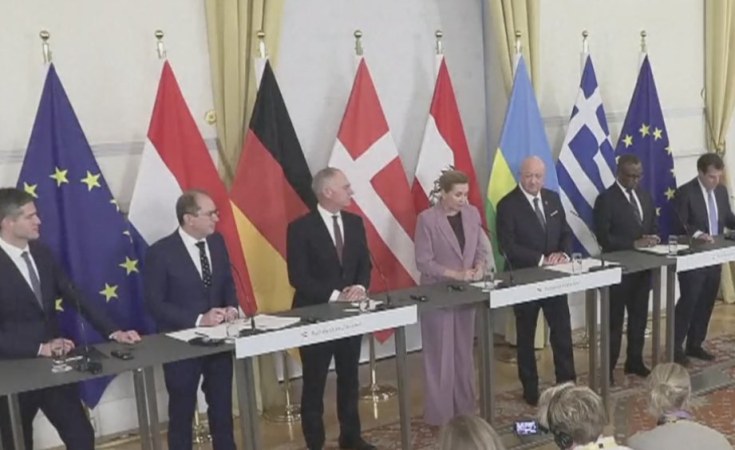
Five EU countries, including Germany and Denmark, unveiled on Monday a plan to establish a migrant deportation centre in Rwanda - the first such facility outside the bloc.
The group, which also includes Austria, Greece and the Netherlands, wanted to open a "return hub" after the European Union cleared the way by toughening migration rules.
The move came despite protests from human rights groups and a warning from the United Nations' refugee agency UNHCR.
"If returning to their home country is not possible, then in the future people without a right of residence will be sent back to a third country such as Rwanda," Austrian Chancellor Christian Stocker said after a meeting of ministers from the five countries in Vienna.
Follow us on WhatsApp | LinkedIn for the latest headlines
"I am pleased that today we have achieved a truly historic paradigm shift in migration policy," Stocker said.
Speaking alongside Stocker, Rwandan Interior Minister Vincent Biruta said the plan would offer "a second chance to people who no longer have the right to remain in the partner country".
Danish Prime Minister Mette Frederiksen described the project as a "milestone" aimed at sending a "signal... that you can no longer enter the European Union illegally and think that you can just stay around".
In a statement after Monday's announcement, 45 NGOs from 15 countries said it marked "a new phase of harmful externalisation policies".
"These plans allow people without a right to stay in the EU to be sent to countries with which they have no connection at all," said the NGOs.
"These policies shift people, and responsibility for their safety and rights, out of public sight and beyond scrutiny," they said.
The EU announcement marks the culmination of a push by the bloc to boost deportations launched in 2024, amid a souring of public opinion on migration.
Arrivals of asylum seekers have steadily declined over the past three years, as the bloc struck deals to stem departures with a host of countries in Africa and the Middle East.
Migration has remained a hot-button issue, exploited by the far right to make electoral gains across the bloc.
The five EU countries have expressed hope to have a centre up and running in 2027.
Diplomatic sources say the hub in Rwanda will be initially run as a pilot, hosting about 100 people, with each of the five nations possibly sending around 20 migrants.
It will not be a detention facility, with Kigali inclined to name it a "welcome centre" to underscore the possibility for some migrants to stay and work in the country.
The choice of Rwanda has caused concern from rights groups.
Human Rights Watch pointed to Rwanda's "well-established record of repression of dissent, arbitrary detention, ill-treatment in detention" and support for an armed anti-government group in the neighbouring Democratic Republic of Congo.

Sign up for free AllAfrica Newsletters
Get the latest in African news delivered straight to your inbox
Asked about his country's human rights record on Monday, Rwanda's Biruta said this image was a "cliché".
In 2022, Rwanda reached a similar deal with Britain to take irregular migrants before their asylum claims were heard, but the accord was later scrapped by London.
It is among several African countries to have received migrants from the United States under a similar, divisive US immigration scheme championed by President Donald Trump.
UNHCR said any plans "must comply with international human rights law", adding that it stood ready to "provide advice to ensure these standards are upheld in any arrangements or process".
