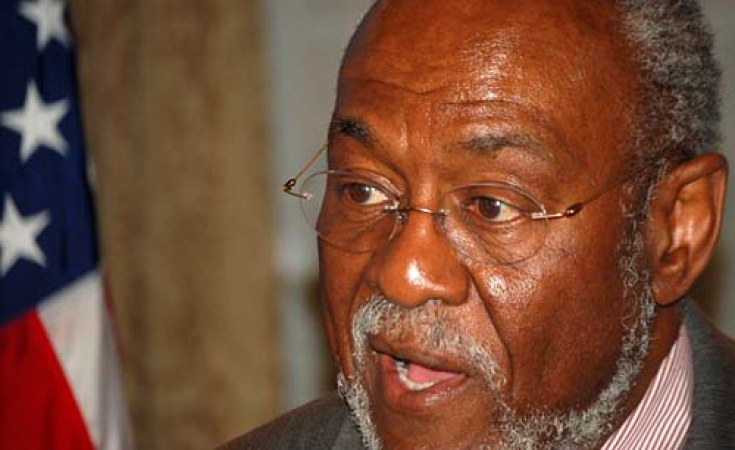
Washington, DC — After a slow start on Africa, the Obama administration is picking up the pace. President Barack Obama will make his first stopover in a sub-Saharan African country next week when he and First Lady Michelle Obama visit Ghana. (Egypt was included in a presidential trip last month.)
In early August, Secretary of State Hillary Clinton is scheduled to take part in the 8th Annual African Growth and Opportunity Act (AGOA) Forum in Nairobi, Kenya and visit several other countries on the continent.
Deputy Secretary of State Jacob Lew is currently on a multi-country African journey. The administration's point person for Africa, Assistant Secretary of State Johnnie Carson, who has been on the job since May 7, says the Obama team is now fully engaged on a range of issues.
In this first AllAfrica interview with the assistant secretary, we explore some of the challenges for United States policies towards Africa. An upcoming conversation will discuss other challenges, other countries - and the progress and potential of Africa in this decade.
What do you see as the role of foreign assistance, and what is the status of USAID and the Millennium Challenge Corporation (MCC)?
USAID has suffered a number of serious reversals over the last decade.
Their staff has been greatly reduced; their efficiency has been eroded; and their expertise has been lost. I think there should be more aid personnel in the field - personnel who are experts in their fields, whether it be agronomy, public health, micro financing, micro enterprise, or working closely with people to ensure that programs are carried out effectively.
I think MCC plays an important role and is a new instrument. But I also argue that MCC growth and continued progress should not be at the expense of having a private aid operation. We have lost ground with AID, and I think it needs to be recovered. Both of these play critical roles: MCC in providing capital over long periods of time to help in infrastructure development [while] AID works effectively in areas of education and agriculture and public health. They should continue to do that work as efficiently as possible - getting more money directly to people.
How do you respond to critics, like Dambisa Moyo, who argues in her book Dead Aid that aid has had a negative impact on Africa's development?
All aid is not effective, and not all aid has been used well. There is too much overhead in aid, too many middlemen, too many contractors, too many people making money off of development assistance. We have to find a way to eliminate that and to ensure that a larger percentage of aid dollars gets to people in critical areas. Dambisa Moyo's voice is an important new one in this discussion, which has been going on for a long time.
I fundamentally believe that aid is important. It plays a key role in assisting African nations to move forward. There is no question that aid that gets down to the grass roots - that is used to deal with issues of public health, to fight HIV/Aids, to assist people in dealing with malaria or schistosomiasis; that helps to build capacity - can be a critical and valuable element in our assistance policy.
Corruption is an issue closely tied to the effectiveness of development assistance. What can the United States do to help eradicate corruption and promote transparency?
Corruption undermines the ability of governments to deliver services, and it siphons off resources into private pockets. We have to make it a topic of conversation with government officials. We have to work with civil society to give them the courage to speak out about it. We have to work with the local media so that they will expose it. We have to work with prosecutors so that they have the courage to prosecute and with judges to have the conviction to convict.
And if we see mega-corruption going on and individuals who are profiting from it, and we have evidence that they are not being prosecuted, we should look at new methods to identify and to stigmatize and to punish, to the extent that we can, those individuals who are engaged in corruption.
Where do you see governments tackling corruption in a serious way?
I think that there are some countries that are exemplars and will remain exemplars. The government of Botswana does an excellent job. Mauritius does an excellent job. The Tanzania government does an excellent job. I recall that within the last year a senior government official in Tanzania was removed from office because of serious allegations of corruption.
Let's talk about Somalia. Why has the administration decided to engage in a new way with the Transitional Federal Government, including the supply of arms and ammunition?
The instability that has prevailed in Somalia for the last 20 years has become a cancer. We now have a war-torn society where probably 60 to 70 percent of the people are dependent upon food aid from the outside - just to stay alive. We see the population of Mogadishu having declined by some two-thirds as a result of the fighting in and around the city, and we see unemployment among youth at astronomical levels. Southern Somalia is a humanitarian problem of enormous proportions.
But it's not just Somalia itself. The cancer has started to metastasize, spreading across the border into Kenya. Today the Dadaab refugee camp in northern Kenya has some 270,000 refugees. That camp, which was established about a decade and a half ago, was built to handle 90,000.
It is estimated by the United Nations High Commissioner for Refugees that some six to seven thousand Somalis are crossing the border into northeast Kenya every day. Eastleigh, a suburb in the northern part of Nairobi, [has become] the largest Somali city. There is enormous pressure on the Kenyan government to handle the refugees and provide the infrastructure needed to cater to them.
Moreover, the problem of Somalia has contributed to the tensions between Ethiopia and Eritrea. It is clear that the Eritrean government is supporting the al-Shabaab militia. It is not because they are in support of Islamist or extremist [elements]. They are doing this largely as a way to undermine and to pressure the Ethiopian government.
So we have both refugees and political tensions, but - even more than that - Somalia has become an international problem that has metastasized internationally in the form of piracy on the high seas. The lack of a central government and the lack of a police force, military, judiciary or any kind of criminal justice system has allowed for impunity.
Equally, the absence of any economy and the devastation of the formal sector and the informal sector have resulted in Somalis becoming desperate.
How effective are arms going to be in addressing that issue? Kenyans are worried that the arms going to Somalia will end up being used in Kenya to terrorize local people. Why military as opposed to development aid, and what about political engagement?
We have tried to make it very, very clear that diplomacy is primary and that support for stability inside of Somalia is what we are doing. We support the 'Djibouti process', which helped to create the Transitional Federal Government (TFG) and we support the TFG, the government of Sheikh Sharif. The Djibouti process has been endorsed by Kenya, and by the AU [African Union].
We have actively sought to engage the Eritreans to encourage them not to support al-Shabaab, not to send money or ammunition to al-Shabaab, not to allow their country to be a conduit for resources to al-Shabaab. We have encouraged them not to allow foreign fighters to pass through their country. All of these things are on the diplomatic side.
And these are also things that the IGAD [Intergovernmental Authority on Development, a grouping of seven East African nations] and the AU support. You may recall that two weeks ago the IGAD and the AU said they felt that Eritrea was playing a spoilers role [and called for] an arms embargo, a blockade of southern ports and a no-fly zone [in Somalia].
This indicates how seriously African nations feel about this.
We have provided arms and munitions to allow the TFG to push back al-Shabaab in order to gain the stability which is absolutely essential for that country to be able to begin to deliver services to people. I would love nothing better than to be able to say to you that the situation on the ground in southern Somalia is such that we have been able to put money into schools, into educational material, into the reestablishment of clinics and hospitals and to the training of nurses and to the reestablishment of electricity and water services. This is what the goal is. Our goal is to find a way to stabilize the situation and then encourage the TFG to begin that process of state building and delivery of services to its population.
You have said that you are willing to engage Eritrea in a dialogue.
Is that happening?
Absolutely. After I took over as the assistant secretary, the Eritrean ambassador came to my office and indicated to me that it was the first time he had been into the office of the Assistant Secretary of State for African Affairs since he had come to Washington.
I told him that the United States clearly wanted to see if we could return to a more normal relationship and that I was prepared to go out to speak with [Eritrean] President Isaias to begin such a dialogue. But I also made it very clear that, in order to move forward, there would have to be some understanding and some cooperation on key issues that affect the Horn of Africa today and that it is absolutely important that there be no support for the al-Shabaab coming out of Eritrea.
What's the next step in that dialogue?
The next step in that dialogue is really up to the Eritreans.
What contribution does the long-standing border dispute between Eritrea and Ethiopia make to rising tensions in the Horn?
The major problem in the region continues to emanate from instability in southern Somalia. There is no question that the number one issue that divides Eritrea and Ethiopia is lack of final resolution on the border dispute. There can and should be a way to resolve that issue, but it can only be done if both parties recognize it is in their fundamental interest to resolve this and not be developing military preparations along the border but developing social and economic opportunities for their people.
It is incomprehensible that some five million people have died in eastern Congo over the past few years. Fighting winds on and on, with no end in sight. What can the United States do to address this huge tragedy?
This deserves attention it does not get, and we are going to spend more time trying to resolve conflict in eastern Congo. We would encourage greater collaboration between the governments of President [Joseph] Kabila in the Congo and President [Paul] Kagame in Rwanda. It is essential that both of those countries work together.
We have to find effective ways to ensure that Monuc [the United Nations Mission in the Democratic Republic of Congo] have the forces that are required to help Congo deal with security problems. We have to work with the government of the Congo to improve the military - which has largely been under-trained, underpaid, and under-equipped - so they can effectively be protectors of people, and not be used against people. We also have to find ways to get the government of Congo to deliver services, creating stability as well as opportunity for people to live normal lives.
The Secretary of State is very much aware of the situation in the eastern Congo and is particularly concerned about the issues of gender-based violence there. We are going to engage much more intensely with both the government in Kinshasa, which bears responsibility for ensuring the safety of the people, and the government in Rwanda to make sure their security concerns are addressed.
On Sudan, following the multi-party talks last week in Washington, convened by President Obama's special envoy for Sudan, Scott Gration, how has the administration decided to engage with the government headed by President Omar al-Bashir, who faces an arrest warrant from the International Criminal Court (ICC) - but also is key to resolving the crisis in Darfur and the north-south conflict?
I look at it as engaging with the government broadly to achieve important objectives that we share with many in Sudan, both north and south, and with many across Africa and the international community. We think that it is absolutely critical that the Comprehensive Peace Agreement (CPA), signed in January 2005, be fully implemented, and that the people of southern Sudan have a right, in 2011, to hold a referendum which will determine their future.
We think it is also important that the issues of the boundary between the north and south be resolved. One of the more positive things to come out of this very successful conference is a commitment on both sides to accept the arbitration ruling on the border of Abyei. Every part of the CPA agreement should be fully implemented.
Gen. Gration has been trying to stop the humanitarian nightmare that has existed in Darfur for far too long and to help to bring about a long-term political settlement in the Darfur crisis. We should use our diplomatic power as effectively as we can to help bring a solution to each of these problems. There's no question that we're going to have to work with the government of Sudan. It is both a part of the problem and part of the solution. Notwithstanding all of this, an arrest warrant has been issued for Bashir by the ICC for war crimes in Darfur. He should do the right thing and face those charges.
On Zimbabwe, it would appear that after Prime Minister Tsvangirai's visit to Washington, there is a willingness by the administration to provide a certain amount of aid, while keeping sanctions in place. How would you describe the United States' policy on Zimbabwe at this time?
We are deeply concerned about what is happening in Zimbabwe and what has happened over the last decade. We believe that the visit by Morgan Tsvangirai gave us an opportunity to hear first hand how the global agreement [between President Robert Mugabe's ruling Zanu-PF and the Movement for Democratic Change led by Tsvangirai] is being implemented and how his relations with Zanu-PF and Mugabe are taking shape. It also gave the administration a chance to share its views with the prime minister and to reaffirm number of things:
The United States supports the forces of democracy in Zimbabwe, and the U.S. supports the people of Zimbabwe. The U.S. supports what the MDC has been trying to do to bring a return to democracy, and we support Morgan Tsvangirai and encourage him to continue to do his work. Equally, we encourage Zanu-PF to play their part. They have an important part to play.
We reaffirmed to Prime Minister Tsvangirai that we would continue to provide assistance in the area of health care. We have done a lot in providing support on HIV/Aids, cholera and child survival. We also affirmed we would be providing assistance in promoting democracy. Both the President and the Secretary of State said they would support additional resources for education - providing learning materials, and for agriculture - providing seeds, fertilizer, and instruments in rural areas.

Sign up for free AllAfrica Newsletters
Get the latest in African news delivered straight to your inbox
Without lifting sanctions?
There is no talk about lifting sanctions right now, until we see progress - irreversible progress - in the implementation of the global political agreement. President Mugabe can and should do a number of things to bolster full democracy and show that he is absolutely, unequivocally committed to implementing the agreement.
He can allow the foreign media to come back in. He can lift censorship and restrictions on the local media. He can end political harassment of civil society leaders. He can end political harassment of MDC officials.
He can swear in all of the MDC ministers, including deputy minister of agriculture Roy Bennett. He can end the emergency security laws that have been put in place.
He can reaffirm publicly that he will allow the next elections, due in approximately 18 months, to be monitored by international groups, including the Commonwealth, EU [European Union], and organizations like the Carter Center, IFES [International Foundation for Electoral Systems] and IRI [International Republican Institute].
These are easy to do, and I've just mentioned a few. President Mugabe has them in his power to do them.
What about U.S. relations with Nigeria, and specifically about continuing unrest in the Delta region, which is the source for a significant share of imported U.S. oil?
Nigeria is, for a variety of reasons, the most important country in sub-Saharan Africa, bar none. It is one of our most important suppliers of petroleum. It has the second largest Muslim population after Egypt and is possibly the seventh largest Muslim country in the world. It is a country that has U.S. $40-50 billion of U.S. investment. It is a dynamic and vibrant country whose citizens have demonstrated over and over again that they're the most entrepreneurial and talented people on the continent.
Its size and its economy make it a place of high interest to the United States, and for that reason, we are always concerned about what happens there. Problems in the Delta are of enormous concern. In the last several weeks, there has been a military offensive designed to break the back of those most responsible for criminal activities - for stealing large amounts of petroleum and for the kidnappings.
Stability and peace must be brought to the Delta so the people there can enjoy better lives. It is also important that, as security forces carry out their work in the area, they do not undertake human rights violations, that they're careful and discriminating in the way that they use force, that they not undermine work they do going after criminal elements by killing innocent civilians. This is an issue that we should all be concerned about, because Nigeria and Nigerians deserve the opportunity to have better lives that would allow them to use their enormous potential in good ways.
Assistant Secretary Carson outlined the administration's views on the future of U.S. relations with South Africa in a recent address at the Woodrow Wilson International Center for Scholars. He also presented an overview of U.S.-Africa policy at a National Press Club briefing, sponsored by the African American Unity Caucus. He outlined the administration's policy priorities during his confirmation hearing before the U.S. Senate Foreign Relations Committee. Testifying before the Senate Africa Subcommittee last week, he described the administration's described how the administration is confronting drug trafficking in West Africa.

