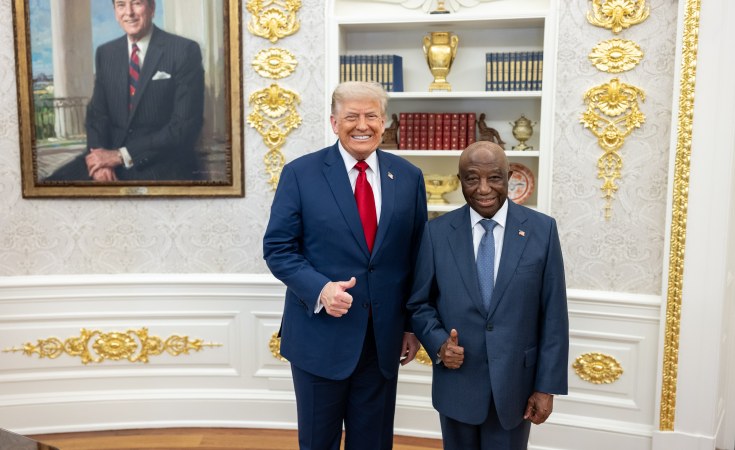
Monrovia — Liberians have responded after their president, Joseph Boakai, visited the White House with U.S. President Donald Trump and heads of state from Mauritania, Guinea-Bissau, Gabon, and Senegal. The leaders were invited as part of the new U.S. Africa policy that prioritizes U.S. commercial interests over aid.
Like other leaders, Boakai and his team must surely have been upbeat about the opportunity to make Liberia's case before a global audience - but also apprehensive, given the unpredictable nature of some Oval Office meetings, most notably the discussions with South African President Cyril Ramaphosa.
Uncertain about what lay ahead, the government expidited the process of signing an overdue agreement with U.S. mining giant High Power Exploration (HPX) before Boakai's trip to Washington, DC, in what some analysts say was a calculated move by the government to avoid any repeat of the undiplomatic comments Trump made about South Africa.
Liberia's political climate is vibrant and quite polarising at the same time. While many adopt a more nationalistic view on an invitation to the president by a major world leader like Trump, other views are usually channeled through partisan lenses. And this one was no different.
Follow us on WhatsApp | LinkedIn for the latest headlines
Liberians began voicing their opinions on the different media outlets, including social media, when it became known more than a week ago that Boakai was invited by the U.S. president.
Some hailed it as proof that the Boakai administration is gaining international recognition - a key campaign promise he made in 2023. Others, including supporters of his predecessor, George Weah, downplayed the significance by comparing it to Weah's 2022 meeting, along with a select group of African leaders, during the U.S. Africa summit, with then-President Joe Biden.
When Boakai made his bid for Liberia at the White House on Wednesday, citing the country's investment potential and support for the Trump policy, Liberians were watching intently. Social media erupted in a frenzy when the U.S. president commended Boakai for speaking "good English" and asked where he learned to speak it so well.
Some users saw the remark as a backhanded insult, given that English is the official language of Liberia. "In the West, when we say your English is good, it's not a praise; it's a mockery," former representative Vincent Willie said. Others, however, interpreted it as validation that the Liberian leader had much favorable rating in international circles compared to other past leaders. A few criticized Boakai for being what they described as "too deferential" in his "yes sir" response to the U.S. President.
Liberia was founded in the 19th century by the American Colonization Society to resettle enslaved Americans who had been freed. Its national symbols and culture are a reflection of its Americanised roots, including the flag, which mirrors that of the US, and the name of the capital, Monrovia, which was named after former U.S. president James Monroe.

Sign up for free AllAfrica Newsletters
Get the latest in African news delivered straight to your inbox
The U.S. media criticized Trump for seemingly being unaware of Liberia's U.S. link when he marvelled at Boakai's English proficiency.
