

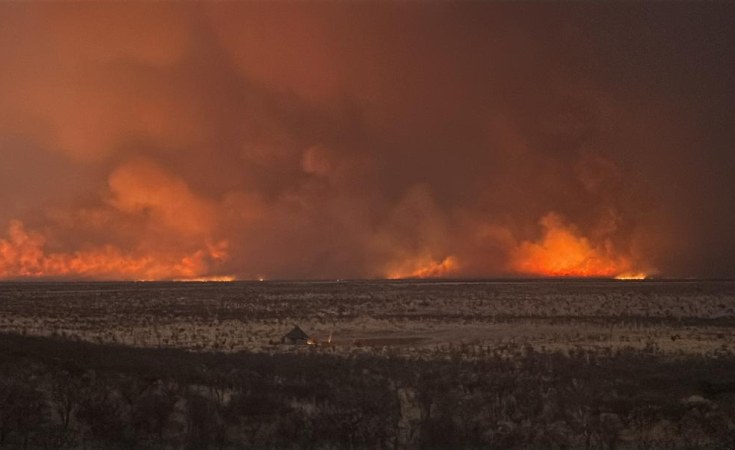
National leaders have described the devastating fire that started a week ago, and spread to two northern regions as the worst in recent years.
The flames swept through Etosha National Park, and burned across multiple regions, including Oshana and Omusati, leaving villagers, the police and soldiers struggling to contain its rapid spread.
Over the weekend, the government announced that it deployed 500 soldiers to fight the fires.
According to the Ministry of Environment and Tourism, about 1.1 million hectares of land have burned, including about 775 000 hectares within the park, approximately 34% of its area.
Follow us on WhatsApp | LinkedIn for the latest headlines
Meanwhile, around 171 000 hectares of land outside the park has been affected, including 156 000 hectares north of the park and about 15 000 hectares to the south.
The Presidency yesterday said the fires pose a threat to the biodiversity, wildlife and livelihood of the communities in the affected areas.
However, no state of emergency has been declared yet and a decision will be taken once all information is obtained, the office added.
"An unknown number of wildlife has been killed, while, thankfully, no human casualties have been reported," the Presidency said.
It said two helicopters and Namibian Defence Force (NDF) fire extinguishers were also dispatched yesterday, while the environment ministry has been directed to confirm support from nearby farms for helicopter assistance, including associated expenses.
"The Namibian Police has deployed one helicopter to carry out surveillance of the extent of the fire in the Omusati region. Additional manpower assistance has also been received from the police through the Oshana region, Kunene region and the Office of the Prime Minister," the Presidency said.
Omusati police regional commander commissioner Ismael Basson has confirmed that the fire is not yet contained as it continues to destroy vast areas, with limited manpower and resources on the ground.
"We don't know the cause of the fire, but we are at the receiving end," Basson said yesterday.
"I don't know, actually, where the fire started, but it appears that it started somewhere in the Outjo area. It runs through the whole park, it comes into Oshana, as well as Omusati.
"It started very far, but it's now with us here. It's not yet been put down. I am just from there now, it's burning," Basson said.
He said villagers and the police are trying their best to contain it, but that the area is too large to cover.
Otamanzi constituency councillor Johannes Iiyambo told The Namibian yesterday that the fire reached his constituency on Friday evening and it was still burning by yesterday afternoon.
"It's very difficult to contain the fire during the day," he said. "The flames are as high as a double-storey building. You can only try to fight it at night when the wind dies down. During the day, it will burn you," Iiyambo said.
So far, the fire has destroyed large areas of grazing land and fences, but no livestock deaths have been officially reported at Otamanzi by yesterday.
However, Iiyambo admitted this is the worst veld fire he has seen in his constituency.
At Onkaankaa village, community leader Muna Shaanika paints a more tragic picture. He has confirmed that several goats have perished, some burned, while others died after inhaling excessive smoke.
"Farmers have lost grazing land, and they are in the process of relocating their animals," Shaanika says. "We managed to put out the fire in our village last night, but areas nearby were still burning as of this afternoon."
Environment minister Indileni Daniel says the most affected areas include Dolomite (north and south), Okatutu, Renostervlei, Jackalswater, Halali, and the area between Olifantbad and Halali.
Several villages have been impacted, including Omutambo-gomawe, Okambango, Okerine, Onghunya, Osagalwa, Omalika, and Ovenduka, among others.
At least nine antelope casualties have been sighted in fire-affected areas.
Daniel says the strong winds and dry vegetation are causing the fire to spread rapidly leading to a wildfire crisis at Etosha National Park and surrounding areas. She says the fire poses a significant threat to Namibia's biodiversity, local livelihoods, and critical infrastructure.
"About 60 environment ministry staff, and more than 20 neighbouring farmers and community members are currently on the ground. Forestry teams from Outapi, Tsandi, Engombe, and Ongwediva have been deployed, alongside NDF (Oshakati) and regional council teams. Community members are actively involved in Okakango, Amarika, Ovenduka, and Onkani," she says.

Sign up for free AllAfrica Newsletters
Get the latest in African news delivered straight to your inbox
Former environment minister Pohamba Shifeta says while veld fires occurred during his term, this is the worst he has seen.
"Veld fires are a natural occurrence. Even when I was the minister of environment, we had fire outbreaks in the park. However, it was not as devastating as the current one even though I'm not sure of the extent of the damage. When I was the minister, we always made sure to do firebreaks before the vegetation dries out just to avoid the veld fires even though they are hard to avoid," he says.
Shifeta says the ministry would make cutlines and firebreaks, particularly at the Okashana area around the months of May to prevent fire outbreaks as they are hard to contain once they start.
He dismisses the possibility of poachers starting the fire to create a diversion, arguing that they use the bushes to hide their activity.
He advises the environment ministry to always conduct firebreaks and cutlines before the natural vegetation dries out in order to avoid possible veld fire outbreaks that could lead to devastation.
Uncontrolled veld fires across the country are reported to destroy up to a million hectares of land each year.

