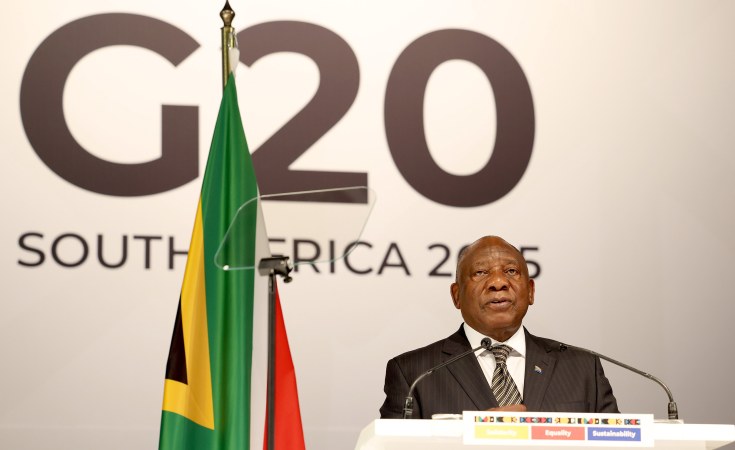
According to the G20 framework, prioritising resilient and equitable health systems is essential to achieving the health-related 2030 Sustainable Development Goals (SDGs) and building a fairer and safer world.
The Director-General of the Africa Centres for Disease Control and Prevention (Africa CDC), Jean Kaseya, has announced that Nigeria will serve as one of the pilot countries for the integration of health financing under the G20 partnership.
Mr Kaseya made this known in Abuja on Thursday, day two of the 2025 Joint Annual Review of the Health Sector, themed "All hands, one mission: Bringing Nigeria's health sector to light."
"We are so proud of Nigeria. By next year, we will take Nigeria as one of the countries where we will integrate everything and measure the success we are making," he said.
Follow us on WhatsApp | LinkedIn for the latest headlines
"If Professor Pate talks about Nigeria, people will say he is the Minister. But when I, as a neutral person, speak, I want the world to know that Nigeria is making real progress."
What the G20 health financing plan entails
The G20 health financing integration plan seeks to help countries strengthen their health systems by expanding funding for pandemic preparedness, sustainable health financing, universal health coverage (UHC), and science and innovation for health and economic growth.
According to the information on the G20 website, the health agenda will highlight the need for equitable multilateral solutions to address 21st-century health challenges.
At the centre of this approach is UHC, with a focus on Primary Health Care (PHC) as an inclusive, equitable, cost-effective, and efficient model for improving both physical and mental health and for responding to health emergencies.
Over 4.5 billion people are estimated to lack access to essential health services globally, while two billion face catastrophic or impoverishing health costs due to out-of-pocket spending.
According to the G20 framework, prioritising resilient and equitable health systems is essential to achieving the health-related 2030 Sustainable Development Goals (SDGs) and building a fairer and safer world.
Africa CDC commends Nigeria's reforms
Mr Kaseya lauded Nigeria's ongoing health sector reforms, including the Sector-Wide Approach (SWAp), digital payroll systems, and broader private sector involvement, describing them as proof of its commitment to improving efficiency and accountability in health spending.
He said Nigeria's model demonstrates how strong political will, evidence-based planning, and strategic partnerships can help reduce dependency on foreign aid and drive sustainable development.
"Nigeria's Sector-Wide Approach is evidence-based. It is cutting inefficiencies, fragmentation, and weak governance," he said.
"Countries could save between 20 and 40 per cent of their budgets simply by improving planning and coordination. In Mozambique, we are saving 38 per cent just by having one plan."

Sign up for free AllAfrica Newsletters
Get the latest in African news delivered straight to your inbox
The Africa CDC chief also praised Nigerian private sector contributions and commended industrialist Aliko Dangote for his role in strengthening local manufacturing of essential commodities.
Call for reform across Africa
Presenting an overview of Africa's health financing challenges, Mr Kaseya noted that out-of-pocket payments remain the dominant source of health funding across the continent, averaging 40 per cent and rising to as high as 75 per cent in some countries.
He said over 20 African nations still depend on Official Development Assistance (ODA) for more than 30 per cent of their health budgets, warning that such reliance is unsustainable.
"It means poor people are paying. In some fragile states, more than 60 per cent of health funding depends on ODA. This must change," he said.
"You cannot deal with out-of-pocket payments through ODA. You deal with it by putting in place a national health insurance scheme."
Mr Kaseya recalled that the Abuja Declaration of 2001 urged African countries to allocate at least 15 per cent of their national budgets to health, but the continental average remains 7.4 per cent.
The Africa CDC boss also spoke about the new "Lusaka Agenda", a framework being developed with donor nations to ensure global health initiatives align with national plans instead of operating independently.
"We are convincing donor countries to make their support Lusaka-compliant. When the Global Fund or Gavi provide funding, they must support national plans," he explained.
