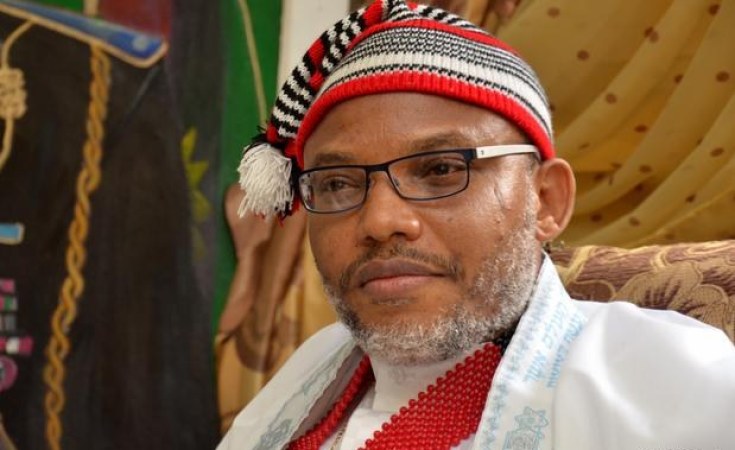
The judge said he ought to sentence Mr Kanu to death but for the scriptural persuasion for one to be merciful.
The Federal High Court in Abuja on Thursday sentenced Biafra agitator Nnamdi Kanu to life imprisonment for acts of terrorism.
Trial judge James Omotosho, who convicted Mr Kanu on all seven charges, said he ought to sentence him to death given the gravity of the convict's offences and lack of remorse but for scriptural persuasion to be merciful.
Mr Omotosho said he drew on the book of Matthew in the Bible to commute Mr Kanu's punishment to life imprisonment instead of death penalty. He therefore sentenced the convict to life imprisonment for counts 1, 4, 5 and 6, "instead of death sentence".
Keep up with the latest headlines on WhatsApp | LinkedIn
He added, "With respect to count 3, he is sentenced to 20 years' imprisonment without fine. He is sentenced to five years' imprisonment for count 7."

He ordered that the sentences should run concurrently.
The judge also ruled that he should not be allowed to use digital devices and be kept in protective custody.
He ordered the forfeiture of the radio transmitters, which the prosecution said he smuggled into the country in 2015, to the federal government.
Mr Kanu's conviction on Thursday draws parallels with the conviction of another controversial Biafra agitator, Simon Ekpa, by a Finnish court on 1 September. But Mr Ekpa received a lesser punishment of six years' imprisonment.
Both men were convicted of using terrorism as a tool for campaigning for the indepence of Nigeria's Igbo-dominated South-east and parts of neighbouring regions as sovereign Biafra.
Through several online broadcasts, for years, they incited violence and issued death threats to security personnel and their families, ordered the destruction of police stations and other government facilities as well as foreign embassies.
Commenting on Mr Kanu's conduct during trial, which dated back to 2015, Mr Omotosho said he noted Mr Kanu's unruly behaviour since the start of the case to date, including during Thursday's proceedings when he aggressively maintained that the court could not proceed to deliver the scheduled its judgement. The judge had to order the operatives of the State Security Service (SSS) to eject him from the courtroom for the rest of the hours -long proceedings.
He said his review of the case file from inception in 2015, showed that "No doubt, the convict has not acted well throughout this period. He caused a delay and then cried that he was being held unlawfully."
The judge said the convict was full of arrogance, cocky, aggressive, full of himself, unremorseful and unmindful of the consequences of his actions.
The judge stressed throughout his five-hour-long judgement that the prosecution left the evidence presented by the prosecution uncontroverted by failing to enter defence in the case.
Mr Omotosho said despite the convict's conduct, the court would not consider that in his sentencing.
"This court is only being merciful to him. The court has been reminded to sentence the convict to death," the judge said.
"I must temper justice with mercym"The judge said he would rely on chapter 22, verse 23 of the book of Matthew.
"It is in this note that I would follow the admonishment of Jesus Christ," adding that "death penalty globally is frowned upon."
He said, "I hereby sentence the convict to life imprisonment for Counts 1, 4, 5 and 6 instead of the death sentence. Life is sacred to God.
"With respect to count 3, he is thereby sentenced to 20 years' imprisonment.
"For count 7, he is sentenced to five years' imprisonment with no option of fine."
He said the sentence would run concurrently.
He added that the convict "has a tendency towards violence; it is based on this that he must be kept in a facility that is suitable for his custody."
He also noted that Mr Kanu must not be allowed any digital device. If he has to, it must be with guidance and the advice of the National Security Adviser.
Given the number of people that have been killed as a result of his actions, the judge said, the convict "deserves protective custody. I order that the convict be kept in protective custody in any custodial centre in the country."
"The transmitter is forfeited to the Federal Government," Mr Omotosho added.
Charges
The judge earlier convicted Mr Kanu on six terrorism charges of the seven charges filed by the prosecution. Among the terrorism charges on which the judge convicted the IPOB leader are terrorism acts, inciting violence against security personnel and their families, foreign embassies and officials, the Lagos State government and those who flouted the sit-at-home order in the South-east region. The court punished him for these offences with life imprisonment.
Mr Kanu was also convicted of illegally importing a Tram 50L radio transmitter concealed in a container with the label of used household items into Nigeria in 2015. The prosecution said he kept the transmitter in Ubulisluzor in Ihiala Local Government Area of Anambra State. The judge sentenced him to five years imprisonment for this offence.
He was also convicted of being a member of the proscribed Independent People of Biafra (IPOB), designated as a terrorist organisation by a court order in September 2017. He was jailed 20 years for the offence.
In its judgement, the Päijät-Häme District Court in Finland, sentenced Mr Ekpa, to six years in prison.
Before sentencing Mr Kanu on Thursday, the judge listened to the prosecution lawyer, Adegboyega Awomolo, a Senior Advocate of Nigeria, and a member of the House of Representatives, Obi Aguocha, who represents Mr Kanu's constituency - the Umuahia North/Umuahia South/Ikwuano Federal Constituency.
While Mr Aguocha urged the judge to be lenient in his sentencing, Mr Awomolo called for the death penalty for five of the seven counts.
Mr Aguocha said, "The matter has come to a closure. For now, I'm not his lawyer. I wouldn't know whether there was a safety appeal, but for now, the Lord he's my brother.
"He's my friend. I went to school with him. We attended primary and secondary schools together, though he was my junior. But it is my responsibility and obligation as a member of the National Assembly to represent him as well as the Lord."
But the prosecutor said the judge had no discretion to exercise in sentencing, given the framing of the law under which the terrorism charges were brought. He also said the court was duty-bound to impose the death sentence on Mr Kanu for the terrorism-related counts 1, 2, 4, 5 and 6.
The senior advocate said, "Nothing further remains but the lawful imposition of sentences. The punishment prescribed for the offences in counts 1, 2, 4, 5 and 6 is the death penalty.
"Pursuant to Section 12(h) of the Terrorism Prevention Amendment Act 2013. My Lord, I say, Sir, as the prosecutor, this court has no discretion in that regard.
"The only sentence that my Lordship will impose for counts 1, 2, 4, 5, and 6 is the death sentence. This court has the power to do so and, with respect, must do so."
The prosecutor also asked the court to deny the convict of electronic devices and be kept in the safest custodial centre.
The charges stemmed from his violent secessionist campaigns for the independence of the Igbo-dominated South-eastern part of Nigeria as Biafra.
The dual Nigerian and British citizen repeatedly denied wrongdoing but failed to offer defence when asked to by the court.
Background
The case lingered in court from 2015, passing through four trial judges in its 10-year journey.
Mr Omotosho, who took over the trial in March this year, was the fourth judge to oversee the trial. The three prior judges withdrew from the case in turns after Mr Kanu accused them of bias.
Mr Kanu was detained in SSS custody from 2015 to 2017 when the then trial judge Binta Nyako granted him bail.
But he fled the country upon soldiers' invasion of his home in Afara-Ukwu, near Umuahia, Abia State, in September 2017.
He was captured by the Nigerian government in Kenya in June 2021 and brought back to Nigeria to continue his trial. His disappearance from the country interrupted the trial for about four years.

Sign up for free AllAfrica Newsletters
Get the latest in African news delivered straight to your inbox
The case, which initially started as treasonable felony charges in 2015, morphed into terrorism indictment with an amendment of the charges by the federal government to take into account Mr Kanu's inciting broadcasts, including during the 2020 #EndSARS protests and on several occasions between 2018 and 2021, when he was outside the country.
The Court of Appeal in Abuja struck out the charges in October 2022, on the grounds of the illegality of his capture in Kenya and extraordinary rendition to Nigeria in June 2021. The court held that the illegality of the Nigerian government invalidated the charges.
However, the Supreme Court overturned the Court of Appeal's judgement in December 2023.
While the Supreme Court confirmed that Mr Kanu's abduction and his extraordinary rendition to Nigeria was illegal, unfair and oppressive, it ruled that the action of the government did not affect the validity of the charges or rob the Federal High Court of the jurisdiction to try him.
After the prosecution closed its case in June this year with five witnesses, Mr Kanu filed a no-case submission, insisting that the prosecution failed to lead credible evidence against him. But Mr Omotosho dismissed the no-case submission in September. He said Mr Kany had a case to answer and should enter his defence.
Since then, several proceedings were scheduled for Mr Kanu to start his defence. In the midst of that, Mr Kanu suddenly disengaged his lawyers and told the court that he would defend himself.
The case was adjourned several times to keep the window of defence open, while Mr Kanu continued to maintain that there was no valid charge against him to defend. He argued that the charges against him "were brought under a repealed terrorism law."
He filed a notice of preliminary objection in which he raised the issues, including that he was being charged based on a repealed law and the illegality of his extraordinary rendition from Kenya, in calling on the court to quash the charges against him and free him.
The court in its judgement on Thursday dismissed all the issues Mr Kanu raised in the preliminary objection.