

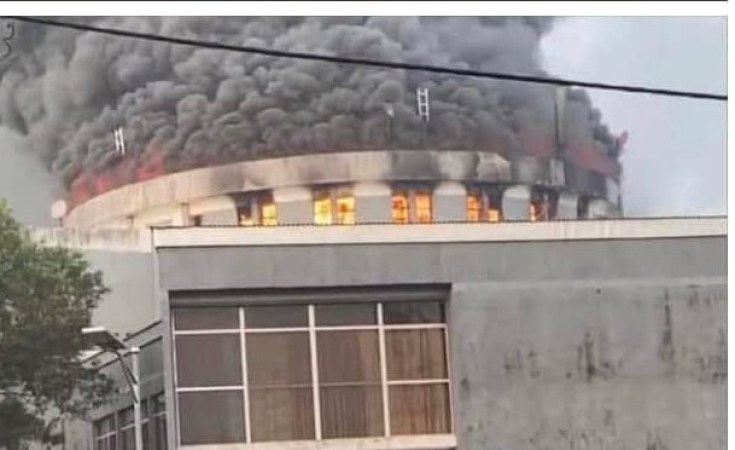
The Capitol Building arson trial jolted forward this week when the state's first witness, Rafael Wilson, admitted that prosecutors spent weeks trying--and failing--to recruit defendant John Nyanti as a state witness. The disclosure, made under cross-examination at Criminal Court 'A'. The admission revived longstanding questions about the integrity of the investigation into the December 18, 2024, blaze that destroyed two floors of Liberia's Legislature.
Wilson, who took the stand as the government's opening witness, confirmed that authorities hoped to secure Nyanti's cooperation early in the probe. Prosecutors believed Nyanti, arrested in Ghana and extradited to Liberia, could provide crucial testimony linking alleged co-conspirators to the fire. But Wilson's testimony revealed that the plan to flip Nyanti ultimately collapsed.
Under intense questioning by defense lawyer Cllr. Arthur T. Johnson, Wilson said the government housed Nyanti in a hotel near the Roberts International Airport shortly after his arrival, ostensibly to limit outside influence while investigators negotiated with him. However, Wilson acknowledged that he did not conduct the interrogation, did not witness the statement-taking process, and could not confirm whether Nyanti wrote or signed the statement prosecutors have relied on.
Wilson further admitted that he did not know if Nyanti was first taken to the National Security Agency, a key issue in the trial, given repeated claims that the NSA has been used to detain and pressure suspects outside legal procedures. He maintained that Nyanti's rights were "respected." Still, he could not provide details on whether the defendant had access to counsel or the chance to contact family members during his initial detention.
Follow us on WhatsApp | LinkedIn for the latest headlines
A Public Outburst That Reshaped the Case
On June 13, 2025, officers escorted Nyanti into Criminal Court 'A' as he shouted to reporters that government officials had offered him US$200,000 to falsely implicate former House Speaker Jonathan Fonati Koffa in the arson plot.
"You say you have evidence, but you want to give me 200k to lie against Fonati Koffa!" he yelled at the time.
Nyanti insisted he had been in Liberia since June 6, long before his purported arrest, and accused state actors of pressuring him to fabricate testimony. Thursday's courtroom revelations, particularly Wilson's inability to confirm basic procedural steps, appeared to reinforce Nyanti's claims that investigators aggressively sought his cooperation through irregular means.
Opposition Claims: Coercion, Torture, Fabricated Statements
On June 24, 2025, four major opposition political parties, the CDC, ANC, Citizens Movement for Change, and MOVEE, released a joint statement accusing the Liberia National Police and the NSA of coercing witnesses, torturing detainees, and offering cash inducements to secure statements implicating opposition lawmakers.
The parties said the probe had been compromised by unlawful conduct that violated the Constitution and revived security practices Liberia had supposedly left behind.
Former legislative staffer Thomas Etheridge alleged he was taken to the NSA's White Plains facility at night and tortured for days in an attempt to force him to accuse former Speaker Koffa. He said investigators presented him with a pre-written statement and insisted he sign it. He refused.
Another alleged victim, Andrew Lawson, claimed he and fellow detainee Albert Weah were held for eight days, beaten, and forced to drink urine before officers offered them money to testify against lawmakers. Lawson later said NSA operatives apologized and offered him US$2,000 if he would sign the prepared statement. He still refused.
The opposition parties also highlighted Nyanti's own allegations: that he was lured to Liberia by family members cooperating with police, housed at Lifestyle Luxury Hotel for eight days, and repeatedly offered between US$50,000 and US$200,000 to implicate political figures. Members of his family publicly confirmed elements of the story.
The parties additionally reported that several residents of District #16, represented by opposition lawmaker Dixon Seboe, were arrested simply because of their residence in the district. They said Baccus Karpeh, Patrick Hallie and Gabriel Fansieh were detained and pressured to implicate others before being released when they refused.
The opposition argued that the police engaged in discriminatory enforcement. Five lawmakers were charged under the same writ with identical offenses, yet only the four opposition lawmakers were detained, they said. Rep. Priscilla Cooper of the ruling coalition was released on personal recognizance, despite the fact that arson is not a capital offense and does not bar recognizance under Liberian law.
Police Push Back, Call Allegations Fabricated
The Liberia National Police has consistently rejected the allegations as politically motivated. At a June 19 press briefing, Inspector General Gregory Coleman denied that officers bribed or pressured any suspect.

Sign up for free AllAfrica Newsletters
Get the latest in African news delivered straight to your inbox
"At no time did police offer or authorize any financial deal," Coleman said. "No money was offered, and no statement was obtained unlawfully."
He said Nyanti gave written and video-recorded statements in the presence of his lawyer and that the police would present both during trial. Coleman also confirmed that Interpol Red Notices were being prepared to track down suspects still outside the country.
"We are following the law," he said. "No one will be forced to lie, and justice will prevail."
Inside the Alleged Arson Plot
Despite the controversy, prosecutors maintain that the attack on the Capitol Building was a coordinated criminal act planned days in advance. The state alleges that in the evening of December 17, 2024, Nyanti met with suspects Kivi Bah, Jerry Pokah, and others at a used-car lot in Jallah Town to finalize plans to burn the building. Investigators say money was distributed to carry out the act.
According to police, the group later moved to the Capitol, waited for corridor custodian James Mulbah to unlock the building at about 5:40 a.m., soaked the third and fourth floors with gasoline and set them ablaze. Some defendants have admitted being present but deny direct involvement, while others say their statements were coerced under torture.

