

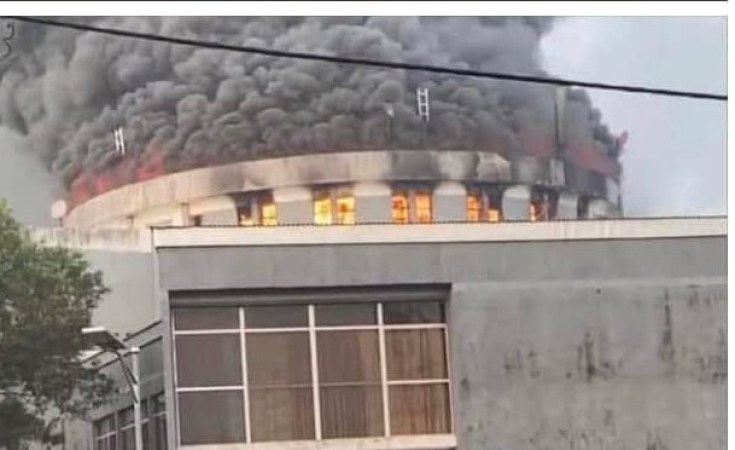
- The prosecution's case in the Capitol Building arson trial suffered a major setback Monday after its star witness was contradicted by call-log records, police reports, and forensic documents introduced by the State itself, prompting the presiding judge to question the credibility of the testimony openly.
Raphael Wilson, an assistant commissioner of police and head of the Liberia National Police Crime Services Department, testified that defendant Thomas Etheridge was at the Capitol Building around 5 a.m. on Dec. 18, 2024, when the fire allegedly broke out.
Under cross-examination, however, defense lawyers pointed to call-log records submitted by the prosecution showing Etheridge was at the Liberia Electricity Corporation compound on Bushrod Island at 5:07 a.m., then at Capitol Bypass at 5:51 a.m., before arriving at the Capitol Building at about 6:25 a.m.
Keep up with the latest headlines on WhatsApp | LinkedIn
Police incident reports further showed officers were not dispatched to the Capitol Building until about 6:30 a.m., with entry records placing Etheridge at the scene at 6:32 a.m. -- more than an hour after the alleged arson.
The contradictions drew pointed remarks from the presiding judge of Criminal Court "A," who said the witness was "not properly arranged," noting that the testimony could not be reconciled with the call-log evidence.
Vehicle 98 Testimony Challenged
Proceedings were further complicated by conflicting testimony surrounding Vehicle 98, which prosecutors allege was linked to the incident.
A prosecution witness testified that the vehicle was impounded at the Capitol Building and later taken to Liberia National Police headquarters along with Etheridge and other defendants. The witness initially said the vehicle was not connected to the arson but was later suspected of transporting individuals and materials allegedly used in the attack.
Defense counsel objected, arguing the testimony was prejudicial and improperly suggested criminal use of the vehicle without supporting evidence. Lawyers stressed that no forensic or investigative report conclusively linked Vehicle 98 to the arson.
According to testimony, Cllr. Massaquoi signed for the vehicle before it was taken to police headquarters for further investigation.
Call Logs Form Basis of Alibi
Defense lawyers relied heavily on the call-log data to advance an alibi defense, arguing that the records established physical impossibility, that Etheridge could not have been at the Capitol Building at the time the fire was allegedly set.
Although prosecutors said an expert witness would later testify on GPS and call-log analysis, the court ordered Wilson to explain the records since he had already referenced them in his testimony. Wilson acknowledged that the logs placed Etheridge at LEC at 5:07 a.m. and Capitol Bypass at 5:51 a.m., and that Etheridge was in communication with co-defendant Kevi Bai and others during that period.

Sign up for free AllAfrica Newsletters
Get the latest in African news delivered straight to your inbox
Forensic Evidence Also Disputed
Additional inconsistencies emerged over alleged arson materials.
Wilson testified that an empty chloride bottle was found about 25 feet from where the Speaker's vehicle was parked and that a box of matches was discovered on the second floor of the Capitol Building.
Defense lawyers countered by referencing the Special Investigative Report -- signed by Wilson himself -- which states that the chloride bottle was lifted from the ground near William R. Tolbert Hall, while a box containing several matches was found inside the joint chambers.
The report was formally read into evidence by the court clerk.
Judge Flags Credibility Concerns
In closing remarks before adjourning the matter, the judge cited multiple inconsistencies between the witness's testimony and the documentary evidence, particularly regarding Etheridge's movements and the timing of the incident.
The high-profile trial is expected to resume on Tuesday as the prosecution continues presenting its case.

