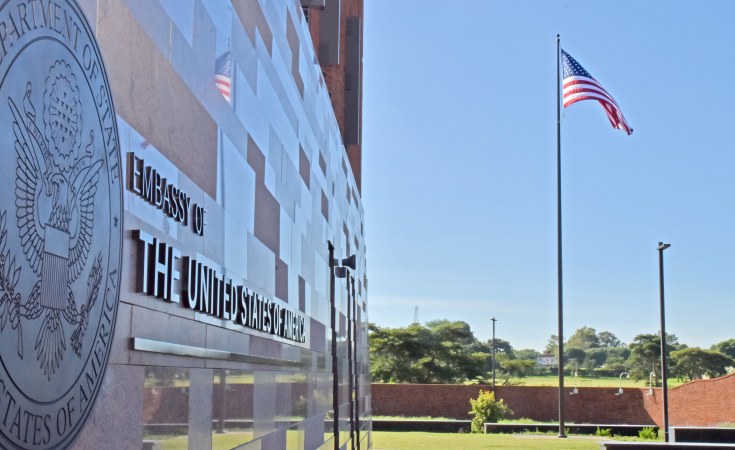
The Donald Trump administration is recalling nearly 30 career diplomats from ambassadorial and other senior embassy posts, including the country's envoy to Nigeria, as it moves to reshape the US diplomatic posture abroad with personnel deemed fully supportive of the President's "America first" priorities.
The chiefs of mission in at least 29 countries were informed last week that their tenures would end in January, according to two state department officials, who spoke on condition of anonymity to discuss internal personnel moves, Guardian UK reported.
All of them had taken up their posts in the Joe Biden administration, but had survived an initial purge in the early months of Trump's second term that targeted mainly political appointees. That changed on Wednesday when they began to receive notices from officials in Washington DC about their imminent departures, the report said.
Keep up with the latest headlines on WhatsApp | LinkedIn
Ambassadors serve at the pleasure of the president, although they typically remain at their posts for between three and four years. Those affected by the shakeup are not losing their foreign service jobs but will be returning to Washington for other assignments should they wish to take them, the officials said.
When contacted by THISDAY, the US embassy in Nigeria re-echoed the fact that envoys serve at the pleasure of the President, describing the ongoing process as 'standard'. "Any change in ambassador is a standard process in any administration. An ambassador is a personal representative of the President," the US Consulate in Nigeria said in response to THISDAY's inquiry.
Besides, the state department declined to comment on specific numbers or ambassadors affected, but defended the changes, calling them "a standard process in any administration". It noted that an ambassador is "a personal representative of the president and it is the president's right to ensure that he has individuals in these countries who advance the America First agenda".
Africa is the continent most affected by the removals, with ambassadors from 13 countries being removed, including: Nigeria, Burundi, Cameroon, Cape Verde, Gabon, Côte d'Ivoire, Madagascar, Mauritius, Niger, Rwanda, Senegal, Somalia and Uganda.
Second is the Asia-Pacific region, with ambassadorial changes coming to six countries, including: Fiji, Laos, the Marshall Islands, Papua New Guinea, the Philippines and Vietnam affected.
Four countries in Europe (Armenia, North Macedonia, Montenegro and Slovakia) are affected; as are two each in the Middle East (Algeria and Egypt); South Asia (Nepal and Sri Lanka); and the western hemisphere (Guatemala and Suriname).
This is coming amid recent tensions between both countries, as the US moved to redesignate Nigeria as a "country of particular concern" on October 31, reportedly in response to a report on the killings of Christians in the West African nation.
Trump went so far as to instruct the US military to prepare for "action" against Islamist groups and other insurgents targeting Christian populations in Nigeria. Nearly a month after Trump's redesignation, it was reported that the United States was still considering sanctions and military action to jolt Nigeria's government into better protecting Christians.
Meanwhile, the Atlantic Council, a 64-year old prominent American non-partisan think tank focused on international affairs, and headquartered in Washington, D.C, has advised the Trump administration to be strategic in dealing with Nigeria, stressing that given current dynamics, US pressure on Nigeria could backfire, inadvertently driving the country into the arms of Russia and China
According to the Council, if Trump continues to pile undue pressure on Nigeria, it would ultimately weaken US influence in a strategically vital region and mirror the path of some members of the Alliance of Sahel States--a bloc comprising Mali, Niger, and Burkina Faso--that have come to depend on Moscow for security and on Beijing for economic support.
"Nigeria faces major security challenges, but carrots, rather than sticks, are more likely to succeed when it comes to US-Nigeria security cooperation. Two primary areas for strategic cooperation should be prioritised.
"First, help professionalise Nigeria's security services. A new US-supported working group presents opportunities for increased engagement with Nigerian military and security forces. This can help Nigeria build a force that appreciates the importance of professionalisation, training, and respect for human rights," the organisation said in a report.

Sign up for free AllAfrica Newsletters
Get the latest in African news delivered straight to your inbox
Similarly, the Atlantic Council advised that the US can support Nigeria as it incorporates advanced technology into its military, highlighting that in recent years, the country has expanded its fleet of unmanned aerial vehicles (UAVs), but said there are risks to such rapid UAV adoption.
Besides, it advocated support for anti-corruption efforts, explaining that security cooperation alone isn't enough.
"There must also be political action that improves government performance and accountability more broadly--something the United States could assist with," the council stressed.
Despite its myriad security challenges, the organisation stated that Nigeria remains a major regional power, but admitted that although Trump is not wrong to focus on the country, a punitive approach or unauthorised military action risks missing key opportunities to deepen engagement.
"If the United States relies solely on sanctions and threats, then it may find itself on the outside looking in. A more effective strategy is to engage Nigeria from within--offering carrots rather than sticks," the council emphasised.
