Nairobi/Brussels — Africa is beset by trouble at home while grasping for options in dealing with today's jumbled global order. The challenges to peace and security are many. This briefing identifies seven that should top the agenda as African heads of state convene for an annual summit.
What's new? Africa faces a plethora of challenges, with wars old and new raging in large swathes of the continent and multilateral institutions traditionally expected to steer resolution suffering deep malaise. The coming year could see yet more trouble, including interstate conflict.
Why does it matter? Wars in the Horn of Africa and the Great Lakes, along with a protracted insurgency in the Sahel, have displaced millions, killed thousands and inflicted an incalculable cost upon local economies. Absent urgent steps to de-escalate, civilians will continue to pay a heavy price.
What should be done? With organisations such as the African Union struggling to make a mark, a pragmatic approach is needed. In some cases, a concert of African states might be best placed to mediate. In others, external players, including Gulf Arab countries and the United States, should lead in proposing pathways to resolution.
Overview
In a world turned on its head, Africa is beset by trouble at home while grasping for options in dealing with global disorder. The challenges are almost too many to list. Swathes of the continent are engulfed in conflict. In 2025, tens of thousands died in wars in the east, west and centre. Millions were displaced, many repeatedly, in Sudan, the eastern Democratic Republic of Congo (DRC) and parts of the Sahel. Economic pressures drive discontent among the youth in countries large and small. The unravelling of the UN-centred multilateral system, meanwhile, leaves the world's poorest continent on edge, with powerful states increasingly disdainful of legal safeguards that since World War II have – at least on paper – proscribed wars of aggression and spelled out consequences for those who author mass killings at home.
In rallying African states to confront these challenges, the African Union (AU) would ordinarily be expected to play an anchoring role. The organisation, after all, enjoys many advantages. It has unparalleled convening power, as every African country has signed up. Surveys show broad, though wobbling, public support. It also has over the last two decades developed norms in a broad range of areas, including prohibitions of coups d'état and an injunction for respect of post-colonial borders. Its peace and security architecture includes a fifteen-member Peace and Security Council, an African peace fund and a peace support operations department responsible for military missions such as the one in Somalia. Importantly, in contrast to its forerunner, the Organisation of African Unity, the AU's Constitutive Act indicated that it was shifting from a stance of "non-intervention" to one of "non-indifference", raising expectations that it would take a bigger part in peacemaking.
At a time when the AU is needed the most, it is arguably at its weakest since it was inaugurated at the start of the century.
Yet, as African leaders travel to Addis Ababa for the organisation's annual summit, which begins on 14 February, little suggests that the institution is up to the task. Indeed, at a time when the AU is needed the most, it is arguably at its weakest since it was inaugurated at the start of the century. The organisation's challenges have long been recognised by its member states. In 2016, meeting in Kigali for their annual summit, African heads of state gave Rwandan President Paul Kagame the task of championing reforms to the organisation. The advisory committee he formed identified a number of problems at the AU, among them repeated failure to carry out its own decisions; a perception of limited relevance to citizens; an unclear division of labour between itself and subcontinental bodies known as Regional Economic Communities; and inefficient working methods, including in the AU Commission. Chronic underfunding and overdependence on partner financing was another key issue.
An internal reforms unit tried to drive implementation of some of the Kagame committee recommendations. It merged a number of departments and also took steps to make the AU Commission chair selection process more competitive by appointing a pre-selection panel and inviting shortlisted candidates to a public debate. At an extraordinary AU summit in March 2018, heads of state signed on to the creation of a continental free trade area, providing for tariff-free commerce among the 48 African countries that have so far ratified the agreement. The AU also set up a secretariat in Ghana to oversee follow-through on the agreement, which aims to spur intra-African trade.
By and large, however, the body has defied meaningful reform. One big challenge is resources. Despite a 2015 decision that African states would work toward fully funding the organisation by 2020, a deadline later extended to 2025, international partners still finance 64 per cent of the AU's total budget of around $700 million. A 2016 recommendation that all states apply a 0.2 per cent levy on certain goods to boost contributions to the AU has been observed in the breach by most. Only seventeen of the 55 member states charge the levy, which they use to pay their assessed contributions. Convincing states to fund peace and security initiatives has been slightly more successful, with contributions to the Peace Fund, also launched in 2016, rising to just over $400 million. Kenya's President William Ruto, who was appointed by his peers to take up Kagame's reform responsibilities in early 2024, has shown an interest in engendering a stronger body. He has urged member states to collectively contribute $1 billion to peace and security initiatives. He will be presenting this and other ideas at the forthcoming summit.
There are other problems, too. The AU and regional blocs remain as rivalrous as ever, hobbling progress in the search for peace in a number of places, including the eastern DRC, where East African countries perceived as more friendly to Kigali and Southern African ones seen as more sympathetic to Kinshasa have repeatedly jostled to lead on the file. The Commission – and particularly its Political Affairs, Peace and Security Department – is also struggling to show it is fit for purpose in the peace and security realm. Among its high-profile failures in 2025, it did not assert itself as a meaningful actor in the search for an end to Sudan's disastrous war; its Chairperson Mahmoud Ali Youssouf was rebuffed by South Sudan's government when he sought to repair splintering relations between President Salva Kiir and Vice President Riek Machar; and it came up short in efforts to raise the funds required to sustain its mission in Somalia. A tin-eared insistence on congratulating incumbents in Cameroon and Tanzania after sham elections also drew widespread public derision.
It is against this backdrop that Crisis Group has shifted the focus of this paper, an annual publication looking at African peace and security challenges, to put less weight on the AU's institutional role and recognise that, right now, the key to conflict prevention most often lies in the hands of other players. These include neighbouring states; newly assertive "middle powers" from the Gulf Arab region and beyond; and a mix of farther-flung actors including sometimes a retrenched United States, which has shown a fitful interest in conflict arenas where it has a stake. The AU also has a meaningful role to play in some cases and, wherever it does, this briefing will urge that it do so – from a perspective that takes account of the institution's proven strengths and weaknesses.
Even as the paper shifts emphasis in this way, there remains an unavoidably aspirational element to Crisis Group's recommendations – one that requires looking past certain contradictions. The African capitals and other power centres that are often best positioned to advance peace and security – for example, Kampala, Nairobi and Pretoria in South Sudan – also have to deal with domestic political and economic challenges, which are the principal concerns of their leadership. The Arab powers that many hope will finally press Sudan's warring parties to end the country's devastating civil war are also responsible for propping up those parties so that they can continue fighting. The U.S. administration of President Donald Trump, which is at times openly hostile toward the international peace and security architecture, nevertheless is identified as a key player in meeting peace and security challenges from Sudan to the Great Lakes. Lastly, even in an era when many Africans have lost all patience with former colonial powers, there may be reason to look to France for help in staving off escalatory violence in Cameroon, where it retains ties with key decision-makers.
Yet there is equally a pragmatic side to Crisis Group's recommendations. It lies in a recognition that even states in internal turmoil may prefer to have stable neighbours; that newly assertive external actors may be persuaded to stop sponsoring proxy warfare under pressure from an important partner like the U.S.; and that a U.S. increasingly untethered from the international order still benefits from being seen as a deal-maker and powerbroker far from its own shores. There is also opportunity in the interest that Qatar and other states with a growing penchant for peacemaking have taken in the resolution of African conflicts; with its influence in Kigali and Kinshasa, Doha is well positioned to work with key African states to dial down tensions in the Great Lakes.
[The African Union] needs to be ... far better supported by member states willing to provide both actual and political capital in the service of continental peace and security.
Over the long term, pragmatism also counsels for investment in the AU. As a veteran diplomat said, if the organisation did not exist, it would need to be invented. Still, it needs to be far nimbler, and far better supported by member states willing to provide both actual and political capital in the service of continental peace and security, if it is to discharge its role effectively. A step in the right direction would be to engage seriously with the reform proposals that Kenya's Ruto is expected to present shortly in Addis Ababa.
Informed by this mix of aspiration and pragmatism, the following discussion includes Crisis Group's analysis and prescriptions for seven crises and conflicts that should be atop the peace and security agenda as African leaders convene on 14 February. These seven cases (in alphabetical order) are Burundi and Rwanda, Cameroon, Ethiopia and Eritrea, the Sahel, Somalia, South Sudan and Sudan. While recommendations for the AU as an institution do not feature in every instance, there is a call for coordinated action by some group of its member states on almost every page. In a world upended by revisionist big powers, newly assertive middle powers and growing global challenges, it has never been clearer that African states can best serve their individual interests in peace and security by working together.
Seven Peace and Security Priorities for Africa in 2026:
1. Sudan
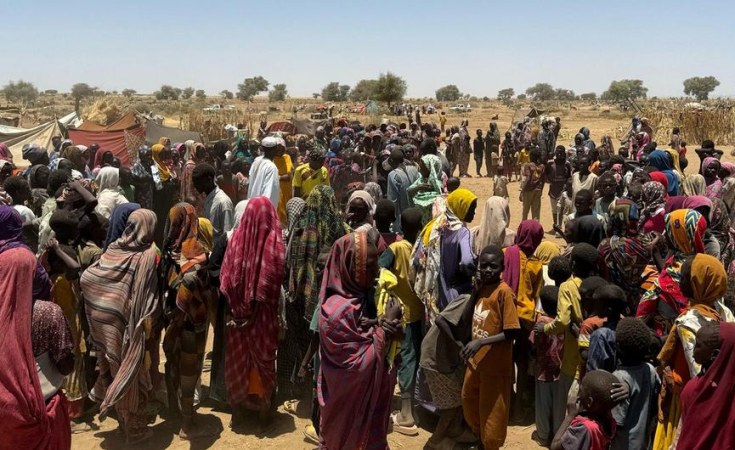
Toward the end of 2025, a glimmer of hope for stopping the war in Sudan briefly appeared before seeming to vanish. During a November visit to the White House, Saudi Crown Prince Mohammed bin Salman urged President Trump to get directly involved in efforts to halt the carnage. Trump publicly signalled that he would take on the file. Prior to Trump's statement, U.S. diplomats were already nudging Saudi Arabia, Egypt and the United Arab Emirates (collectively known as the Quad) to move forward with a peace roadmap. But while Quad members agreed to that plan in September, it failed to gain acceptance by the warring parties, the Sudanese army and paramilitary Rapid Support Forces (RSF). Trump's November statement seemed at first like it might boost peace efforts, but diplomacy instead took a step backward amid rising tensions between Saudi Arabia and the UAE – two Gulf heavyweights that have found themselves at odds in Yemen and the Horn of Africa. Still, high-level U.S. engagement remains the best hope for de-escalation.
Sudan's conflict erupted in April 2023 after tensions boiled over within the ruling junta composed of the army (led by General Abdel Fattah al-Burhan) and RSF (led by General Mohammed Hamdan Dagalo "Hemedti"). Over three years of fighting, momentum has swung back and forth. First, the RSF quickly seized most of the capital Khartoum, forcing the army leadership to retreat to what was until recently the wartime capital of Port Sudan. The RSF then spread into much of western and central Sudan before making a stunning advance east and south of Khartoum in late 2023. By late 2024, however, the army had recovered, taking the capital back in March 2025 and pushing the paramilitary west of the Nile waters running through the country's centre. The RSF then regrouped, launching long-range drone attacks, including on Port Sudan, while consolidating its control in the west. It put El Fasher, the last army redoubt in Darfur, under prolonged siege. In October 2025, it overran the city, committing shocking mass atrocities against fleeing civilians. The RSF's capture of El Fasher in effect split the country in two. 1
Today, Sudan remains thus divided. The army controls the east and centre, while the RSF holds sway in most of the west. The new front is in the Kordofan region, wedged between the Nile and Darfur. There, the RSF together with its allied faction, the Sudan People's Liberation Movement-North, has pushed close to key cities in South and North Kordofan that guard the western entryway to army-held Khartoum. The army has launched its own offensives, hoping to punch through Kordofan into Darfur. A deadly stalemate is the likeliest outcome. Fears of long-term partition deepened in July 2025, when the RSF formed a government to rival the one run by the army, though its appointed officials are mostly in exile and appear to have little authority.
Extensive outside involvement continues to drive the conflict [in Sudan] in large part, often in the direction of escalation.
Extensive outside involvement continues to drive the conflict in large part, often in the direction of escalation. Early in the war, the UAE emerged as the RSF's main patron, crucial for its finances, supplies, logistics support and ties to other important external actors. Meanwhile, the army has relied on a mix of benefactors, including Egypt, Saudi Arabia, Türkiye, Qatar, Iran and neighbouring Eritrea, all of which recognise it as Sudan's government. Because of outside support, both sides have acquired an ever more sophisticated arsenal, including drones and the technology to counter them. Nearby African countries are also divided, with some serving as willing conduits for arms and other items flowing to the RSF, and others backing the army's war effort.
Diplomats have struggled to unify regional powers in a single peace initiative and overcome the obstinacy of the belligerents. Efforts by various actors, chiefly the U.S. and Saudi Arabia, to mediate, starting in the weeks after the war's outbreak, have had difficulty gaining traction. They have been hampered by the Sudanese army's refusal to engage in talks with the RSF, as well as external meddling that gives each side reason to believe that it can continue the fight as long as it takes. As for African diplomacy, there has not been much to speak of since late 2023, when regional heads of state attempted to bring Burhan and Hemedti together for dialogue under the banner of the Inter-Governmental Authority on Development (IGAD) in Djibouti. The AU has engaged in various other efforts, notably to try convening Sudanese civilian leaders under the new Commission chair, together with IGAD, the UN, the Arab League and the European Union. So far, however, they have come to very little.
At present, the onus for advancing ceasefire efforts rests on the Quad, whose September 2025 roadmap remains on the table, largely ignored by the belligerents. 2 Indeed, the conflict parties have not even taken the first step, a humanitarian truce, though U.S.-led negotiations continue.
What might break this logjam? As it has since the war's early days, much of the leverage over the warring parties lies off the African continent, especially in the Arab Gulf. The UAE has the most pull with Hemedti, while Saudi Arabia (together with Egypt) has the most with Burhan. The U.S. is likewise central, as it has significant influence with all three of the belligerents' main sponsors. To date, the U.S. government (under both Trump and his predecessor, Joe Biden) has sent at best mixed signals about how much energy it will devote to pressing outside actors to rein in their support. Yet it is exactly this high-level U.S. engagement that remains key to unlocking an end to the conflict – including by discouraging the growing Saudi-Emirati row from playing out to even more destructive ends in Sudan and by pressing the other Quad members to use their influence on both sides of the conflict to advance the roadmap.
The immediate goal remains the same as it was in September: the U.S. should work to convince the UAE and Saudi Arabia, as well as Egypt, to push the respective sides in Sudan to accept the U.S. humanitarian truce proposal, before the war enters another phase of regional escalation. The UAE should rein in Hemedti and his forces, while Saudi Arabia and Egypt should use their influence to sway Burhan to climb down from his maximalist position against a negotiated ceasefire. Finally, rather than take sides in the conflict, African states should do their part – throwing their weight behind mediation efforts, including the U.S. truce proposal, recognising that the failure of these efforts risks more escalation, more destruction and a growing risk that the conflict will spill over into the rest of the region. 3
2. Burundi-Rwanda
The escalating war in the eastern DRC has heightened tensions between Burundi and Rwanda that have been building for a decade. Each of these two neighbouring countries also borders the DRC, and both have troops there. Burundi has sent its forces to help the Congolese army fight the M23 rebels and to track down Burundian insurgents, while Rwanda's are there to bolster the M23. 4 Against this backdrop, Kigali has come to see Burundi as its main foe in the DRC. Along with its M23 allies, it has adopted a newly aggressive approach along the DRC-Burundi frontier that threatens to move the fighting onto Burundian soil.
Meanwhile, chaos has engulfed the city of Uvira, located just 26km from Burundi's economic capital Bujumbura. The M23 took over the city briefly before pulling out in mid-January, leaving unruly pro-Kinshasa Wazalendo militia to move in. In Gitega, the Burundian capital, fissures are widening among the leadership, some of whom might see upping anti-Rwanda rhetoric as a way to rally support and counter rising popular discontent driven in part by dire economic conditions. A full-on war between these two neighbours, whose soldiers are already fighting in the DRC, could bring a catastrophic escalation to a region already suffering from years of renewed violence.
The present flare-up between Burundi and Rwanda is not the first. Each country believes the other has armed proxies in order to destabilise it.
The present flare-up between Burundi and Rwanda is not the first. Each country believes the other has armed proxies in order to destabilise it. In 2015, the Burundian government said it suspected Kigali of backing a failed coup d'état. 5 Some of the alleged perpetrators, including senior officers, sought refuge in Rwanda. Kigali has refused to return them to face Burundian justice, arguing that they have no guarantee of due process. Burundian authorities closed the border with Rwanda, and mistrust has fuelled occasional skirmishes between border guards. Attempts at a rapprochement, including working-level consultations, have failed to bring about a genuine thaw.
These tensions were simmering but contained until Burundi stepped up its involvement in the DRC in 2023. In March of that year, Burundian soldiers went into the province of North Kivu, far from the border, to aid Congolese troops trying to push back M23 and Rwandan units. They first deployed as part of an East African force, but when that contingent withdrew, they stayed at Kinshasa's request. The Burundians have sometimes engaged in heavy fighting, taking losses at the well-armed insurgents' hands. Many troops have pulled back to Burundi in a dire state. In sending their army deeper into North Kivu, Burundi's leaders saw an opportunity to cement an alliance with the DRC, hoping it would give them free rein to fight RED-Tabara, a Burundian insurgency based in the South Kivu province, and other, smaller rebel groups. The hard-up Burundian government likely also receives much needed cash from Kinshasa. 6
But the conflict soon came closer to home for increasingly beleaguered Burundi. In January 2025, the M23 and Rwanda took Goma, the capital of North Kivu, as well as South Kivu's capital Bukavu shortly thereafter. From there, the insurgents gradually expanded south, threatening South Kivu's second city Uvira, where the provincial administration loyal to Kinshasa had fled. Uvira is a lifeline for Burundi, which gets most of its imports from the DRC via this town.
In late 2025, the M23 gained ground around Uvira and along the border. Amid their chaotic retreat, Burundi's allies, the Congolese army and Wazalendo militias, began fighting among themselves. 7 Ethnic tensions also rose as the M23 joined with Banyamulenge militias (controlled by ethnic Tutsis with ties to the M23) to seize control of the gold-rich hills overlooking Uvira. In early December, they captured the city with little resistance. But they soon relinquished parts of it, as Rwanda came under diplomatic pressure to pull back, including from the U.S., which had presided over the signing of a DRC-Rwanda peace deal only weeks earlier. After more such entreaties, the M23 pulled out entirely in mid-January. None of these events have caused Burundi to withdraw from the DRC; while its troops have struggled to hold the line against the M23 and others, thousands of them remain in the country and show little sign of leaving.
The growing standoff with Rwanda poses two interconnected risks for Burundi. First, it exacerbates internal divides that could become increasingly difficult to manage. Burundian soldiers are unhappy with the mission in the DRC, where many have been killed with little compensation for their families. Some have been given life sentences for refusing to deploy. 8 More recent reports indicate that others are seeking to desert. 9 Moreover, ambitious senior ministers and ruling-party officials have ties to different parts of the security apparatus, including the ruling-party youth militia, the Imbonerakure, which has gone to South Kivu alongside the regular army. Their rivalry could turn into armed confrontation amid the jockeying for power at home. These ructions are playing out against the backdrop of a collapsing economy, exacerbated by border closures and growing popular discontent with government mismanagement. 10
Secondly, regional fighting could get worse. While it may appear unlikely that the M23 or Rwanda would wish to directly attack Burundi, given that their primary aim appears so far to be seizing Congolese territory (the M23 are Congolese with no prior links to Burundi), they have confounded expectations in the past with their rapid conquests. Moreover, they now openly brand Burundi as a co-combatant with the DRC and its allies in South Kivu. 11 Anti-Burundian factions, such as RED-Tabara, may see further escalation as an opportunity to stage their own raids in Burundi. 12 At the same time, although the Burundian army is clearly outgunned by the Rwandan one, the rattled Burundian government has shown no sign of backing down, likely due to it receiving much needed hard currency from Kinshasa for the deployment, while also seeking a common enemy to distract the citizenry from the myriad internal problems the country faces.
African countries are historically deeply divided over how to deal with trouble in the Great Lakes, with some close to Rwanda and others to the DRC and its allies.
African countries are historically deeply divided over how to deal with trouble in the Great Lakes, with some close to Rwanda and others to the DRC and its allies. This polarisation often prevents African diplomacy in the region from succeeding. Still, given the risks and the implications for the region's stability, it is necessary to try. In particular, powers such as Kenya, Angola and Uganda that have ties to both Kigali and Gitega should engage in quiet diplomacy with the parties, urging them to step back from what could too easily become a full-blown inter-state conflict. They might encourage the parties to consider ways to defuse cross-border tensions, including agreement on measures to deal with accused coup plotters and reopen borders, the latter being a step that could be an economic boon to both but especially to Burundi. On suspected coup plotters, Gitega could offer assurances that they would receive a free and fair trial. Regional powers would need to press Burundian authorities to abide by their word.
A longer-term goal would be to encourage Burundian troops to withdraw from the DRC and for Gitega to seek to adopt a more balanced position vis-à-vis its two powerful belligerent neighbours. African diplomats might nudge Burundian leaders in this direction by seeking a pledge from Kigali that if Gitega were to take these steps, the M23 would not seek to mount advances into Burundian territory. At the appropriate time, Qatari and U.S. mediators, who are focused on ending the DRC-M23/Rwanda hostilities, might press Kigali and Kinshasa to support such an arrangement in their own diplomatic engagement, recognising that these conflicts are linked and that defusing the Rwanda-Burundi powder keg can only make their efforts easier. They should also push Kigali to end its intervention in the eastern DRC, which has brought considerable suffering to the civilian population and turbo-charged regional tensions.
3. The Sahel
The crisis gripping the central Sahel for more than a decade took on a new dimension in 2025. In September, the Group for the Support of Islam and Muslims (Jama'at Nusrat al-Islam wal-Muslimin or JNIM) severely disrupted the supply of fuel to Mali's capital Bamako, also impeding local commerce for months until the authorities were able to partially lift the blockade. It was part of a trend affecting not just Mali but also neighbouring Burkina Faso and Niger, where jihadists who were long active predominantly in rural areas are increasingly turning their sights on urban centres. The militants' territorial expansion also poses a growing threat to West African coastal states.
The trend has been partly enabled by a lapse in interstate cooperation against the jihadists, leaving them greater room for manoeuvre. In early 2024, just a few months after forming the Alliance of Sahel States (AES, by the French acronym), the military-led governments of Mali, Burkina Faso and Niger announced their decision to withdraw from the Economic Community of West African States (ECOWAS), a move that scuppered several collective security initiatives. Ties between individual AES and ECOWAS countries are under growing strain.
JNIM's blockade of Bamako, a city of over four million, drew wide attention both because of the dramatic fashion in which it was conducted and because of its effect on the population. JNIM repeatedly ambushed army-escorted convoys bearing fuel to the city and burned the trucks, sometimes setting dozens ablaze in a single attack. The resulting shortages led to kilometres-long queues at petrol stations. In an effort to project social control, jihadists also imposed gender segregation on Bamako-bound buses passing through areas that had largely been free of militant activity for years, forcing women travellers to wear veils.
Bamako was not the only Sahelian city to suffer. In the first half of 2025, JNIM repeatedly assailed or blockaded major towns in Burkina Faso, laying siege to as many as 40. It raided Nigerien cities as well. JNIM announced this shift in late 2024, confirming a trend shown by Crisis Group research that jihadists had been staging more attacks on urban centres and key economic infrastructure for some time. 13 The goal – as far as can be determined – appears to be to undermine governments by stoking popular dissent. 14
There is little sign that the jihadist campaign in the central Sahel will let up. By late 2025, Malian forces, supported by Russian troops, had managed to reopen a number of routes, alleviating the fuel shortages in Bamako. Insecurity, however, persists along the main roads. In Burkina Faso, jihadist attacks continue, with up to 10 per cent of the population displaced. 15 Niger's situation is not so dire, yet the early February Islamic State in the Sahel attack on the country's main airport and military base serves as a stark reminder that the threat persists. 16
Jihadists and state forces have visited serious violence upon the population in many parts of the central Sahel.
Across the region, civilians bear the brunt of the violence. Jihadists and state forces have visited serious violence upon the population in many parts of the central Sahel. In Mali, for example, human rights groups have documented abuses by the army and its Russian partners. 17 In Burkina Faso, local self-defence groups set up by the government also menace civilians, apparently often acting with impunity. 18
With the region facing one of its gravest security challenges in decades, a robust collective response would seem in order. But so far, ECOWAS and AES have failed to collaborate, and their parallel efforts have been insufficient to meet the threat. The long-discussed idea of fielding an ECOWAS standby force re-emerged in November 2025. The organisation announced plans to mobilise 5,000 troops – up from an initial target of 1,650 – to fight jihadists in the region, but it is far from ready to put those numbers into the field. Meanwhile, the AES, whose member states are the epicentre of the crisis, has moved more quickly, officially launching its 5,000-strong unified force in late December 2025, headquartered in the Nigerien capital Niamey. The first units are already operational, though at a level far from full capacity. The ECOWAS and AES initiatives both face significant funding challenges and, for now, no coordination mechanism exists between the two.
This state of affairs, unfortunately, is par for the course. Regional security cooperation has largely ground to a halt with the estrangement between ECOWAS and the AES and the stalling of multilateral arrangements such as the G5-Sahel, the Accra Initiative and the Nouakchott Process, which once coordinated intelligence sharing and joint operations against common jihadist threats. Rifts, largely born of mutual accusations of meddling in domestic affairs, are widening between individual AES and ECOWAS member states, for example between Burkina Faso and Côte d'Ivoire and between Niger and Benin, a major worry given their longstanding economic and socio-political links.
Still, there are rays of hope. Despite the tensions between countries from the two blocs, ECOWAS and the AES have displayed pragmatism in acknowledging the economic interdependency of their member states. They have, over the past months, decided to maintain ties in various areas, including allowing citizens of AES states to continue enjoying visa-free travel to ECOWAS countries. Limited economic cooperation also continues between AES states and ECOWAS. Formal ties between AES members and their former allies in the Francophone monetary zone remain despite growing political friction. 19 The disruption of imports into landlocked Mali was a stark illustration of how much its economy relies on the good-will of its neighbours with seaports, particularly Senegal and Côte d'Ivoire. 20 Collaboration between Bamako and Abidjan to resume fuel convoys gave a boost to otherwise sagging relations.
But mistrust among key regional countries has made restoring security cooperation more complicated, at a time when the growing jihadist threat makes a coordinated response as urgent as it has ever been. To meet the challenge, AES and ECOWAS states should begin by focusing on limited, pragmatic forms of security cooperation rather than ambitious regional frameworks that could be difficult and time-consuming to work out. Initial steps could include the gradual resumption of intelligence sharing on cross-border movement of militants, ad hoc coordination along shared borders and technical exchanges between security services on issues such as border management and protection of transport corridors. Such cooperation would not require the formal reintegration of AES states into ECOWAS structures, but would instead be based on flexible, issue-specific agreements, bilateral ones at first, but with the goal of eventually kindling more expansive understandings between the blocs.
Security coordination would be difficult to maintain, however, without a parallel warming of diplomatic relations. Several West African states, such as Ghana and Senegal, have shown they are keen to repair relations between coastal and Sahelian leaders, through diplomatic visits to AES countries and the appointment of special envoys. 21 These efforts should continue and ideally be coordinated with the goal of helping defuse tensions and restoring confidence over time. The AU is also positioned to be a constructive player. In mid-2025, it appointed Mamadou Tangara, a well-regarded former Gambian foreign minister, to head its office in Bamako, a position that had been vacant since 2023. Given his ties to regional leaders, this platform might prove useful in efforts to break down walls of mistrust. For example, the AU, working with others such as the regional UN political office UNOWAS, could help organise discreet discussions about concrete cooperation needs.

Regional governments should also invest in a non-military approach to countering jihadist expansion.
Regional governments should also invest in a non-military approach to countering jihadist expansion. Such an effort would include measures to restore basic public services in contested areas, support local economies and address abuses by state forces that fuel civilian discontent. They should also explore calibrated forms of dialogue with militant groups when conditions allow. Already, channels of communication exist between the authorities and militants, though the governments are loath to admit it. There have been several reports of prisoner swaps and temporary ceasefires worked out through back channels over the past few years. The question is whether these talks could move from a tactical to a strategic plane where it would be possible to have deeper conversations about what a sustainable settlement might look like. Regional governments should remain open to this possibility, putting out feelers when and where appropriate.
The Sahel region and its West African neighbours are bound by deep cultural, historical and political ties. The past few years have brought considerable suffering amid a security crisis that has opened an economic and political morass. A glimmer of hope is the growing recognition of the need to find a path out. Authorities in the region should both seriously assess how to gradually heal fissures among them and start looking beyond at what it will take to end the protracted security emergency.
4. Ethiopia-Eritrea
Tensions are building between Ethiopia and Eritrea, with both countries preparing for the possibility of war. Landlocked Ethiopia has designs on acquiring its own seaport, preferably on Eritrea's Red Sea coast. Its public statements about achieving this goal are viewed as highly provocative in Asmara. Ethiopia's prime minister, Abiy Ahmed, while denying plans to invade, has openly questioned Eritrea's sovereignty in discussing the subject. 22 On its end, Asmara has allegedly stepped up support for several opposition groups in Ethiopia. The two countries appear to be moving toward some version of intensified proxy conflict. Absent de-escalatory steps, direct hostilities could erupt, either accidentally or (many fear) through Ethiopian aggression. Either scenario would be a disaster for the Horn of Africa and its vicinity, potentially drawing in neighbours and non-African powers, particularly from the Arab Gulf.
Relations between Ethiopia and Eritrea have fluctuated wildly over the last three decades. Eritrea became independent in 1993 under an amicable arrangement with the new Ethiopian authorities, whom Eritrean insurgents had helped put into power following a lengthy armed struggle against a brutal military regime. At first, Ethiopia continued to use Assab, a Red Sea hub that transferred hands when Eritrea gained its independence, as its main commercial seaport. But it lost access to the port five years later, when Addis Ababa and Asmara again came to blows, with both laying claim to a disputed border region known as Badme. That conflict lasted two years, with more than 100,000 troops killed in ferocious trench warfare. In 2000, international mediators helped stop the fighting. A UN-led boundary commission issued findings handing Badme to Eritrea, but the decision was never put into effect. Relations remained largely frozen until 2018, when Abiy rose to power in Ethiopia and unexpectedly initiated a rapprochement with Eritrea.
At first, it appeared that a historic turning point was in the offing. The two old foes signed a peace agreement in Jeddah, Saudi Arabia, leading to a temporary improvement in relations: borders were briefly reopened and the country's leaders were chummy in public. In November 2020, Asmara backed Addis Ababa when war broke out between the Ethiopian federal government and the Tigray People's Liberation Front (TPLF) in Tigray, Ethiopia's northernmost region, which borders Eritrea. Eritrean troops went into Tigray to fight the TPLF, which had dominated Ethiopia's government since the early 1990s until Abiy rose to power. As Addis Ababa took a decisive upper hand on the battlefield, the war ended with a peace agreement signed in the South African capital Pretoria in November 2022.
The present rift cracked open then. Asmara was unhappy with Addis Ababa's decision to reach a truce with the TPLF, which allowed its Tigrayan adversaries to run Tigray's new regional administration. Eritrea had hoped that Ethiopia would insist on much harsher terms that would, in effect, dismantle the TPLF completely, so as to remove the threat it perceived on its southern border.
But since then, new problems have arisen, with tensions flaring along three axes, and driving relations between Addis Ababa and Asmara to their lowest point since the 1998-2000 border war. 23 The rancour stems in part from Abiy's persistent signalling of a desire to regain the sea access Ethiopia enjoyed until 1998. In the second half of 2023, with the relationship already headed for the rocks because of Asmara's unhappiness about the Tigray agreement, Abiy repeatedly spoke about Ethiopia being landlocked; he spelled out his ambition for his country to recover its Red Sea heritage and maritime traditions. Asmara interpreted this talk as a threat to its sovereignty over Assab that might even be an existential peril.
Secondly, internal tensions in Tigray and other Ethiopian regions have worsened markedly, with implications for Ethiopia-Eritrea dynamics. In mid-2024, a group of senior TPLF members touched off a political crisis by ousting the head of the regional administration, Getachew Reda, perceiving him as too close to the federal government. The TPLF, meanwhile, developed a new relationship with Eritrea, its wartime enemy, thinking this move would better position the group to retain control of Tigray, including the region's abundant gold reserves. For its part, Eritrea appears to see rapprochement with the TPLF as depriving the Ethiopian federal government of an ally in a possible future cross-border confrontation. Better, in its view, that Tigray be a buffer between the two countries. Addis Ababa also began to credibly accuse Asmara of supporting insurgents in Ethiopia's Amhara region who had fought alongside Eritrean soldiers during the Tigray war. 24 Asmara's machinations have only created more bad blood between it and Addis Ababa. 25
Regional politics, both driven and influenced by the war in Sudan, are contributing to worsening bilateral relations [between Ethiopia and Eritrea].
Thirdly, regional politics, both driven and influenced by the war in Sudan, are contributing to worsening bilateral relations. Asmara is among the regional capitals, including most importantly Cairo and Riyadh, that supports the Sudanese army against the paramilitary RSF. Meanwhile, despite its official neutral stance, Ethiopia is viewed as friendly to the RSF, due to Abiy's close relationship with the United Arab Emirates, the RSF's main backer. Tigrayan troops have also fought the RSF alongside the Sudanese army, further tangling the web of alliances. In the most alarming scenarios, a new war between Ethiopia and Eritrea could merge with the conflict in Sudan, creating a wider conflagration.
So far, both Addis Ababa and Asmara have demonstrated restraint when it comes to crossing the line into military action, conscious of the high risk to them and to a region already in turmoil. But, while neither side may intend to start shooting, the two could wind up in direct conflict through miscalculation. Many observers worry that Ethiopia in particular could be tempted by military adventurism against its smaller neighbour, despite vows not to resort to force.
For these reasons, African powers should redouble their diplomatic efforts to halt the slide toward what would be a ruinous war. Those who can discreetly engage with Addis Ababa and Asmara, particularly Kenya, which has channels to both sides, and South Africa, which retains strong ties with Addis Ababa, should step up their diplomacy with the immediate goal of deterring both neighbours from further military build-ups and persuading them to desist from inflammatory rhetoric. Their efforts could be usefully reinforced by the U.S., China, European powers, Saudi Arabia and Türkiye, which have the diplomatic relationships and muscle to nudge Addis Ababa and Asmara toward a less confrontational stance. The UN Special Envoy for the Horn of Africa should likewise continue discreet efforts to coordinate among outside players that might persuade the parties not to resume full-scale hostilities.
It is also worth trying to mitigate some of the underlying grievances that are fuelling bilateral tensions. While leaders should draw a red line barring a land grab by Addis Ababa, those in the region, particularly from Kenya, Somalia, Somaliland (whose declared independence is recognised only by Israel) and Djibouti, should deepen discussions about improving Ethiopia's commercial sea access. At present, Ethiopia relies heavily on Djibouti for imports and exports, which is expensive and, Ethiopian officials complain, logistically burdensome. Dependence on this route is also risky, in their view, vulnerable to some force majeure that might someday block it. 26
Options for reducing this dependence could include finding international investors to improve the infrastructure at the Djibouti port; upgrading the roads and facilities related to Somaliland's Berbera port (with Mogadishu's agreement); or building better links from Addis Ababa to Kenya's Lamu port, which would provide a conduit for trade from southern Ethiopia. A package of port options might be best. Ethiopia would not become a maritime power, but Abiy would have an achievement to sell to his domestic audience, among whom the quest for better sea access is popular.
5. Somalia
Somalia appears to be at a tipping point. Its security is fragile, its politics fractured and its outside support fraying. Al-Shabaab, the jihadist insurgency that has been battling the federal government for eighteen years, remains a major threat. The government is perennially distracted by disagreements among Somali politicians, the latest of which concern elections due to be held by May. These polls are unlikely to take place on time, and if delays drag on, violence could flare. External backing for the fight with Al-Shabaab is under fresh strain, as traditional security partners lose patience with Mogadishu and the African Union Support Mission for Somalia (AUSSOM) continues to run up against funding constraints. Somalia is also being drawn into the rift between the United Arab Emirates and Saudi Arabia, which creates the prospect of further destabilising proxy competition.
For years, Somalia's campaign against Al-Shabaab has been uneven, with neither side able to land a decisive blow. In 2025, the group went on the offensive, recapturing swathes of central and southern Somalia that the government had controlled since 2023. 27 Afterward, Mogadishu, supported by AUSSOM and Ugandan troops, reversed some of these gains in Lower Shabelle, which lies uncomfortably close to the capital. While federal-aligned forces made progress, the campaign also demonstrates how successive federal administrations continue to rely on outside forces as a backstop, having failed to build up their own to a point where they can handle the campaign alone.
A big part of the problem has been political division – between centre and periphery and among Somalia's politicians – which stands in the way of a coherent effort to develop the security sector and other effective institutions. At present, Puntland and Jubaland, two of the country's most powerful federal states, have in essence withdrawn from the federal system. Meanwhile, President Hassan Sheikh Mohamud has pushed through changes to the constitution, including a switch from indirect elections to universal suffrage, which many of his rivals see as an attempt to improve his chances of re-election. 28 Absent a deal with the opposition, the polls will almost certainly have to be postponed. Moreover, if the government continues pushing ahead without greater buy-in, Somalia's political fragmentation will only increase. Yet more worrying is the prospect that, as the government's term nears its end in May 2026 without a clear succession plan in place, its opponents may mobilise their supporters to put pressure on Mogadishu. Violent clashes between government and opposition forces might ensue.
On top of the costs of political infighting, Somalia may soon have less help fighting Al-Shabaab.
On top of the costs of political infighting, Somalia may soon have less help fighting Al-Shabaab. Since 2007, the African Union mission now known as AUSSOM has provided essential assistance, aided financially by the European Union, with the UN handling the mission's logistics. But cuts are on the way: major budget shortfalls will eat into UN support, and the EU has signalled that its willingness to continue bankrolling Somali security is waning. 29 Indeed, it has already begun steadily reducing its contributions in recent years. 30 Efforts to secure non-EU financing have seen only limited success.
A pitch for the mission to be partially funded by UN dues, as part of a wider framework agreement on UN financing of AU peacekeeping operations, fell short in May 2025, after the U.S. prevented the Security Council from applying a means of splitting the costs. The U.S scepticism did not originate under Trump: the Biden administration had evinced it as well, with U.S. officials conveying to diplomats on the Council they favoured using UN funds only for timebound missions with clear goals. 31 To help plug the expected holes, the mission's main troop contributors will need to continue supplementing the AU mission by deploying under bilateral auspices. Thus far, Ethiopia, Kenya, Uganda and (on a smaller scale) Djibouti have bilateral arrangements in place.
Compounding these challenges is intensifying competition among a number of external powers vying for influence in the Horn. On 26 December 2025, Israel formally recognised Somalia's breakaway northern region of Somaliland as an independent state. The federal government decried the move as a violation of Somalia's sovereignty, and the AU and many other regional players see Somaliland's move as inconsistent with respect for post-colonial boundaries, long a pillar of relations among African powers. But geopolitics also matter. Crudely, Somalia is seen as allied with a set of countries including Djibouti, Eritrea, Saudi Arabia, Egypt, Türkiye and Qatar – as well as China – that all vocally support Somalia's sovereign authority over Somaliland, in part because they view a united Somalia as serving their interests. Somaliland is now seen as part of an emerging rival geopolitical bloc, including the UAE, Israel and maybe Ethiopia, which have all built direct relations with Hargeisa. 32
This competition is being fuelled by the growing rift between Saudi Arabia and the UAE, which has the potential to further destabilise Somalia, particularly over the Somaliland issue. On 12 January, Mogadishu suspended all cooperation agreements with the UAE, arguing that Abu Dhabi undermines its authority by making pacts directly with Somaliland and states like Puntland and Jubaland, where it also has a heavy footprint. Two possible flashpoints are the heavily militarised Sool and Sanaag regions, which are contested between Somalia and Somaliland. Any renewed attempt by either side to assert its control, supported by external patrons, could erupt into violence.
The most urgent task, for now, is helping Mogadishu get a handle on security in Somalia, even if that means preparing it to make do with less external support.
The most urgent task, for now, is helping Mogadishu get a handle on security in Somalia, even if that means preparing it to make do with less external support. The AU should clarify with the EU and other donors what funding is likely to be available for AUSSOM in 2026. It should then revise its strategy accordingly, making reductions, including to its locations of operation and personnel, as necessary. If present financial constraints continue, the mission may need to consider exiting Somalia earlier than planned, coordinating with the Somali government and bilateral troop-contributing countries to fill as many gaps as possible. 33 However bad the news is, Mogadishu is better off facing it sooner rather than later, so that officials can allocate the money available as efficiently as possible. The Somali federal government should move quickly to develop its forces' capacity to retain territory, so that it can take over from departing AU troops and hold on to any new ground captured from Al-Shabaab.
Avoiding further internal political rupture is also essential. To that end, Somalia's neighbours, including Kenya, Ethiopia and Djibouti, working with the AU and regional bloc IGAD, could help broker a political agreement concerning the forthcoming elections, pushing the federal government, member states and opposition to adopt a workable model for the vote. A compromise between the direct and indirect voting systems preferred by the incumbent and opposition, respectively, might involve an expanded electoral college, charged with meeting the 30 per cent threshold for women in parliament, with a robust dispute resolution mechanism. Under this system, clans nominate voters to fill electoral colleges, which select people to represent their constituencies in parliament. Parliament then directly elects the president. If there is a political agreement, this option could be stood up quickly, preventing a drawn-out standoff with the potential to descend into violence.
On Mogadishu-Hargeisa ties, and as Crisis Group has long argued, it is well past time for authorities in Somalia and Somaliland to engage in serious talks about Somaliland's future status. 34 Both have an incentive to start envisaging a compromise they could live with. Without a settlement with Somalia, Somaliland's position will always be in question. Mogadishu, for its part, has long avoided sustained discussions with Hargeisa, partly assuming that time was on its side. If nothing else, Israel's engagement should provide an impetus for regional states that wish to discourage external meddling to push Somalia and Somaliland back to the table for talks.
Somalia has been in crisis for years, and it now faces a loss of support that could make things yet worse if a way out is not found. With international assistance for Somalia's state-building project fading, the African states that would suffer most if the flawed federal system falls apart should do what they can to shore up the status quo while moving the needle toward more sustainable solutions. Preserving gains against Al-Shabaab is key, but Somalia also confronts widening political fault lines that threaten to undermine its stability or leave it an ever more fragmented polity, with long-term implications for the country and the neighbourhood. Regional states should therefore push harder to help Somalia address its internal political rifts, including through a return to dialogue between Mogadishu and Hargeisa. These chronic disputes are a key factor holding the country back from progress on the security front as well as on longer-term objectives such as building institutional strength and endorsing a new constitution.
6. Cameroon
A presidential election in October 2025 brought the stiffest challenge yet to Paul Biya's 43-year hold on power. Many had hoped that Biya, the world's oldest president at 92, would sit out the race, but he defied calls to retire. The consequence was a splintering of his ruling coalition. Independent tallies suggested the incumbent was defeated by an opposition ticket led by former ruling-party insider Issa Tchiroma. But the official results said Biya had won. Far from conceding, the president dug in and ordered a clampdown on opposition protests, with state forces killing dozens countrywide. 35 The protests have eased, at least for now, and Biya's hold on the presidency seems secure, but the country is jittery: his allies are openly jostling to position themselves for the inevitable succession contest, while the opposition remains determined to press its case on the streets. Meanwhile, rebels continue to harry the army in the country's troubled North West, South West and Far North regions.
Biya may have kept his grip on power but he emerged from the election wounded. The opposition harnessed fatigue with his lengthy rule, discontent over corruption and long-running insecurity to rally millions of Cameroonians against the incumbent and his cronies. 36 Hopes ran high that Tchiroma could ride this wave to victory and, indeed, civil society groups that crunched the numbers said he did. 37 Yet electoral authorities declared Biya the winner with 53.6 percent of the vote. The official count included implausibly high tallies in the Anglophone North West and South West, where separatist militants had urged a boycott. Though it is difficult to imagine him being forced to step down, Biya will face a legitimacy crisis as he tries to rule, stemming in part from the widely acknowledged view – at home and abroad – that he lost the election. It will be a running theme of what, barring a miracle, will surely be his final term.
Three key challenges loom for the president and the country. First, Biya will struggle to keep his coalition together. He was unable to name a cabinet for months after the election amid reportedly fierce wrangling among his top acolytes. 38 The risk is that this dissension will open fissures within the administration (creating more problems for already limping service delivery) and even spread into the security services, which are already riven by ethno-regional divisions. A major question is what turn the intra-elite squabbles might take in the event that Biya dies suddenly while still in office.
Secondly, anger is still simmering over what many view as a stolen election. Opposition leader Tchiroma, in exile in Banjul, Gambia since 7 November 2025, has signalled that he will shortly come back to Cameroon, though no date has been set. Timing aside, the announcement of Tchiroma's plans to re-enter the scene has set authorities on edge. His return would doubtless trigger a fresh round of protests, bringing more confrontations between opposition supporters and police. The opposition leader has also called for a boycott of mayoral and parliamentary elections expected between May and August, another potential flashpoint.
Absent a move toward serious negotiations, the [Anglophone] conflict is likely to continue with escalating risks to Cameroon's stability.
The third challenge relates to the insurgency in the North West and South West regions. Anglophone separatists have waged a long campaign to free these regions from what they see as political, economic and cultural oppression. The conflict erupted in 2016, when Yaoundé tried to install teachers and judges from the majority Francophone population in the English-speaking regions' schools and courts. Of late, the authorities have been on the back foot, with dozens of soldiers killed in 2025. December witnessed a spate of ambushes on troops in the North West, including a failed attempt to kill a senior commander. Absent a move toward serious negotiations, the conflict is likely to continue with escalating risks to Cameroon's stability. The exhausted army, which has been deployed in the hostile Anglophone regions for nearly a decade, with little to show for it, could even turn against the government. Meanwhile, jihadists continue to attack army positions and torment civilians in the Far North.
There is no easy or obvious way for external actors to help calm the waters. Cameroonian authorities are noted for their resistance to outside efforts to address the country's many internal problems. But authorities are aware that the country's propensity to let crises drag on has been hugely damaging to Cameroon's reputation and inflicted a heavy cost on its population. As such, it is worth trying to offer assistance and support any such endeavour Yaoundé is willing to entertain.
The European Union in particular could have an important role to play, especially if backed by member states with ties to Cameroon. The EU has a broad partnership with the country, stretching from formal regular political dialogue to development programming. 39 Brussels should use its leverage to press the government to end the repression of opponents and resolve the conflict in Anglophone areas. It could, for example, privately indicate that it will impose individual sanctions including travel bans on actors who authorise the use of lethal force against peaceful protesters. It could also press Biya to restart negotiations with Anglophone authorities. French authorities could lend EU efforts additional weight behind the scenes. While Paris has traditionally been protective of its relationship with Yaoundé, it notably did not congratulate Biya on his claimed re-election. The concentration of Cameroonian elite assets in France suggests that President Emmanuel Macron's government's intervention might be particularly effective.
For his part, UN Secretary-General António Guterres, who reportedly has been in contact with Biya for years, should also press him to rekindle negotiations with Anglophone figures, a step which would burnish the president's legacy in what are surely his waning days in office. The UN, which was alone in offering technical support for the election, is well placed to conduct such quiet diplomacy. It should press Yaoundé to re-invite Canada, which steered these talks in the past, to marshal another attempt to find a way out of the impasse.
Cameroon has more than enough challenges without adding election-related violence and instability to the mix. Outside actors should work together to encourage the country's leadership to make choices that avoid a downward spiral, and move it toward peace, as the country eyes the inevitable transition ahead.
7. South Sudan
South Sudan has returned to open conflict. In early January, a renewed rebellion led in part by commanders loyal to the former vice president, Riek Machar, took substantial territory, primarily in Jonglei state, an opposition heartland in the country's centre. These gains were mostly wiped away by a large-scale government counter-offensive launched late in the month. Clashes also intensified in several other states, including in the Equatoria region along South Sudan's borders with Kenya and Uganda. The fighting is taking place along lines similar to the 2013-2018 civil war, which often pitted ethnic Dinka-dominated government forces against predominately ethnic Nuer rebels. Fears of new mass atrocities arose when a top South Sudanese general told his troops to "spare no lives" in the counter-offensive. 40 All this turmoil comes amid political crisis as the ageing President Salva Kiir grows visibly frail. The war raging in neighbouring Sudan is creating still more instability, including by disrupting oil exports.
South Sudan's political order has long been based on a delicate compromise, a loose understanding within its factious Sudan People's Liberation Movement (SPLM) elite to share power and benefit from the country's oil riches. That pact has broken down at various times since independence, always leading to bloodshed. It has now unravelled again. In that regard, the return to war was a predictable consequence of events in 2025, when President Kiir, an ethnic Dinka, dismantled a 2018 peace deal by detaining his first vice president, Machar, an ethnic Nuer and former rebel leader. Kiir is now prosecuting Machar and other top Machar allies for treason, among other charges. Machar's allies say these moves gave them no choice but to return to fighting, though in reality their dwindled ground forces have benefited from a surge of popular anger and communal mobilisation among the Nuer.
Meanwhile, Kiir's own camp looks increasingly brittle following a series of shakeups that saw him dismiss many of his most powerful and longest-serving lieutenants. 41 Since late 2025, the president has been increasingly consolidating power within his own family, notably appointing his daughter Adut Salva Kiir as special adviser, while carrying out ruthless purges of allies, even as jockeying over his eventual succession intensifies. Indeed, Kiir's move to sideline Machar looked motivated by a desire to push him out of the picture amid such competition. Kiir's most head-spinning manoeuvre involved elevating long-time business associate and political neophyte Benjamin Bol Mel in early 2025 to vice president and deputy chair of the ruling party, only to strip him of both of those posts later in the year, while reappointing others he had previously dismissed. As Kiir upends political loyalties, insiders are scrambling to form new alliances or defect to opposition groups, increasing the potential for violence. 42 Such internal discord also appears to be hindering Kiir's efforts to quell the rebellion.
This violence is unfolding against the backdrop of the catastrophic war in Sudan. Following fighting between the Sudanese army and the paramilitary RSF, maintenance work on the main pipeline transporting South Sudanese oil to Port Sudan on the Red Sea coast ceased, causing a rupture in February 2024. Juba was deprived of vital oil revenue for more than a year before the exports resumed. The situation deteriorated once again in November 2025, when the RSF captured the Heglig oil fields, just north of the border. The South Sudanese army subsequently entered Heglig, with the RSF's apparent permission. While Juba claims to have secured Heglig's oil facilities, interviews suggest that the RSF may still have troops on site. 43 South Sudan fought a 2012 border war over Heglig and still claims the area as its own sovereign territory, which could make its new deployment there especially inflammatory for Sudan.
The possibility remains that if wider conflict erupts in South Sudan, it could open a new front in the Sudanese war.
Further, while Kiir has tried to maintain ties to both sides of Sudan's war, this highwire act looks ever more tenuous. The RSF now appears to be moving in and out of South Sudan with ease, while Kiir is also now a frequent visitor to the United Arab Emirates, the RSF's main patron. For now, the incentives of mutual profit from South Sudan's oil flow through Sudan appear to have prevented a wider rupture between Kiir and Sudanese army chief Abdel Fattah al-Burhan, but relations are clearly deteriorating. The possibility remains that if wider conflict erupts in South Sudan, it could open a new front in the Sudanese war, leading rival international patrons to pump weapons into both countries. The opposition's rapid advances have led some to suspect that its forces have already found new external support, albeit limited.
Climate stresses compound these human-made disasters. The UN estimates that over half the South Sudanese population suffers from severe food shortages, with many at risk of famine due to floods and insecurity. 44 Cuts to aid budgets have reduced humanitarian organisations' capacity to deliver food, leaving millions of people in distress. Women and girls are travelling longer distances in search of clean drinking water for their families, exposing them to greater risk of sexual violence by armed groups.
Concerned African states should redouble diplomatic efforts to halt the slide back to renewed civil war and retaliatory waves of ethnic violence. A number of countries are already engaging with South Sudanese leaders. Kenya continues to host opposition figures, while South Africa maintains regular dialogue with high-level interlocutors through its historical SPLM ties. Meanwhile, Uganda, a key partner for Kiir, deployed its military to South Sudan in 2025 to bolster his rule. 45 Ethiopia is also a major player, at times through the offices of the regional bloc IGAD.
To prevent a collapse, these countries, backed by the AU's Peace and Security Council and its C5 group of states (led by South Africa) should coordinate on two immediate steps. First, they should press Kiir to halt the political prosecution of Machar, which is plunging the country back into war. Failing that, should Machar be found guilty, Kiir should give serious thought to an immediate pardon to de-escalate the situation. In either scenario, African mediators should push for renewed dialogue between Kiir and Machar. For all the bad blood and sullied history between them, and for all that Machar's own political fortunes are declining, Machar remains the figure most capable of restraining a Nuer armed revolt and the large-scale ethnic hostilities it could well unleash. The government should also engage with local militia commanders, especially in Jonglei, some of whom are not loyal to Machar, to seek an off-ramp from spiralling ethnic violence.
Secondly, outside actors should call for broader talks to begin posthaste between Juba and major opposition leaders, including Machar, about the country's future. Those talks could be supplemented by discreet diplomacy to prevent the intra-elite power struggle that looks sure to follow Kiir's rule, whenever it ends. With long-postponed national elections scheduled for late 2026, but almost certainly destined to be delayed once again, regional powers should discourage a sham vote. Instead, they should stimulate quiet discussions of a post-Kiir roadmap that tries to discourage a deadly power scramble and prevent state collapse.

