
In villages across northeastern Nigeria, water determines how women spend their days.
Well before sunrise, in Yayeri village in Bauchi State, Ladidi Ibrahim would walk nearly two kilometres to the river, carrying containers heavy enough to strain her back. In Dabalo, also in Bauchi, thirteen-year-old Ruqayya Usman got used to waiting anxiously beside a deep open village well, its edges slippery and its rope often frayed, until an adult was available to help draw water safely. For Hannah Allah Seriki, along the Mutum Biyu highway in Taraba State, the story was similar: rising early, before dawn, to fetch water to cook and brew the millet drink she sells to travelers.
Different villages. Different lives. But the same daily struggle.
Across Bauchi, Taraba, Gombe, Adamawa and Borno States, years of insurgency linked to the Boko Haram conflict destroyed infrastructure, displaced millions and left countless communities without basic services. Boreholes fell into disrepair, wells collapsed or became unsafe, and rivers grew polluted. Families lost hours each day walking to water sources that could not guarantee safety or health.
For women and girls, the burden was especially heavy.
Now, that story is changing.
Since 2018, the African Development Bank Group has partnered with the Government of Nigeria to deliver the Inclusive Basic Services Delivery and Livelihood Empowerment Integrated Programme (IBSDLEIP), supporting communities across the Northeast with clean water, sanitation, modern healthcare, and strengthened education and livelihood opportunities.
Across Nigeria, the Bank has rehabilitated 3,326 water systems, installed more than 2,500 solar powered boreholes and hand pumps, and supported construction of more than 300 toilets in schools and health facilities. These investments have expanded access to clean water and sanitation for more than eight million people.
In the Northeast alone, nearly 1,000 climate resilient water points are being delivered alongside renewed schools, staffed primary healthcare centres and vocational training facilities. The programme prioritises women, recognizing them not only as primary users of water but also as leaders in community resilience and key contributors to economic recovery.
Where water flows, women rise
Globally, women and girls spend an estimated 200 million hours every day collecting water, according to UNICEF and the World Health Organization. That statistic sits at the heart of the 2026 World Water Day theme, Water and Gender, and its message: Where Water Flows, Equality Grows. Few places capture that link more clearly than Northeast Nigeria, where the simple act of securing water has long shaped a woman's opportunities, safety, education and wellbeing.
When clean water comes closer to communities, women gain back hours once lost to long daily walks. Girls remain in school. Mothers no longer face unsafe routes to distant water sources. Markets grow stronger. Health improves. Family life becomes less strained.
Across northeast Nigeria, recovery is unfolding not only through infrastructure, but through the everyday transformations happening in homes, classrooms, clinics and marketplaces. Clean water is restoring time, safety, opportunity and dignity, especially for women and girls who carried the heaviest burden of water scarcity.
As Nigeria moves toward achieving Sustainable Development Goal 6, investments in climate resilient water systems are strengthening community recovery and building the foundation for long term equality.
And as many women now say across these communities: Where water flows, women rise.
Three Stories of Change
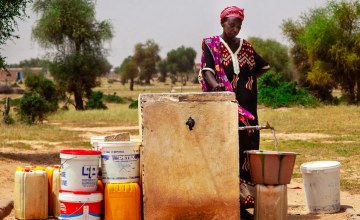
Ladidi - Yayeri, Bauchi State
"Before, water took our mornings. Now it gives them back."
In Yayeri, the river was both a necessity and a threat. At sunrise, Ladidi carried her youngest child toward the water, hoping it was clean enough to drink and that they would return home safely. Livestock and people shared the same muddy pools. Waterborne diseases, including cholera, regularly swept through the community. Ladidi herself once spent days receiving intravenous treatment after falling severely ill.
Fetching water took hours. "Our entire day started and ended with water," she says.
Life in Yayeri changed when a 12,000 litre solar powered borehole was installed, complete with a separate trough for livestock. Today, women collect clean water in minutes, not hours. Girls arrive at school earlier because they no longer trek long distances each morning. Livestock drink at a safe distance, easing tensions between herders and farmers which previously forced women to mediate disputes.
Clinic records now show a significant drop in diarrheal diseases.
For Ladidi, the change is deeply personal. "This water has given us back our mornings, our children and our peace," she says.
In Yayeri, clean water has restored something long lost: time.
Ruqayya - Dabalo, Bauchi State
"The water no longer hurts us."
In Dabalo village, a deep open well once served as the only water source. It was dangerous. The rope used for drawing water frequently broke, bucket after bucket disappearing into the watery darkness. Children slipped near the edge. Mothers constantly warned their daughters to stay away.
Because the well was difficult and risky to use, women could not easily fetch water alone. Many waited until the men returned from their farms to help. Household chores were delayed. Girls stayed home from school. And during the dry season, when the well ran low, families had to travel long distances to neighbouring communities, often at night.
The installation of a hand pump borehole transformed life almost overnight. Today, Ruqayya pumps water herself, safely and confidently. Her mother begins household chores earlier. Evenings once spent searching for water are now used for homework and rest. Teachers report a meaningful improvement in girls' attendance since the borehole became operational.
Ruqayya dreams of becoming a teacher. The borehole, she says, "gave me back my mornings to study."
For her, clean water did more than ease daily tasks. It restored childhood, and the chance to learn.
Hannah - Jauro Yuni Market, Taraba State
"When the water became clean, our businesses began to grow."
In Jauro Yuni Market, water is central to commerce. Women like Hannah make their livelihoods brewing Burukutu, a fermented millet drink, and preparing pepper soup for travelers. Before the borehole arrived, Hannah walked long distances to collect water from streams. Washing her utensils properly was nearly impossible. Hygiene suffered, and customers grew wary.
The arrival of a 45,000 litre solar-powered borehole changed everything. Hannah now brews efficiently, washes safely, and is able to meet surging demand during market days. Drivers travelling along the Mutum Biyu highway now stop to refill their water containers and buy meals.
"This water made my work easier. My pots are clean, customers trust my food, and I make more money," she says.
Market leaders report meaningful increases in women's earnings as improved hygiene draws more customers and strengthens the reputation of the market.
In Jauro Yuni, clean water has become an engine of economic opportunity and a catalyst for women's financial independence.


