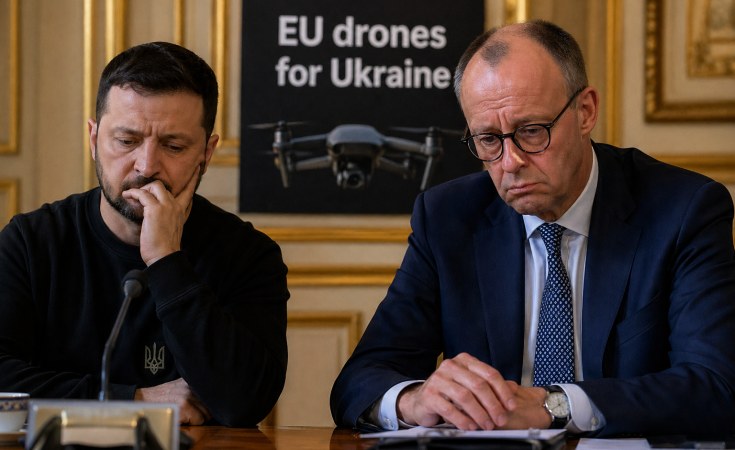
On 22 April 2026, EU ambassadors cleared a €90 billion loan to Ukraine and adopted the 20th sanctions package against Russia. The Council of the EU adopted the final legislative piece on 23 April, allowing disbursements to begin in the second quarter of 2026, with €60 billion earmarked for defense industrial capacity. One week earlier, on 15 April, the European Commission announced a €1.07 billion investment in 57 defense projects under the European Defense Fund, explicitly prioritizing cooperation with Ukraine's defense industry in drones, counter-drone systems, and artificial intelligence.
The first German-Ukrainian joint venture, Quantum Frontline Industries, delivered its first batch of drones at the end of March 2026 and began scaling production to 10,000 quadcopter units in April. Why does this matter for Africa, and where could this conflict lead?
Africa sourced over 80% of its wheat from Russia and Ukraine before the war. Fertilizer costs have tripled, inflation has reached 20–30% in Kenya and Nigeria, and the IMF has cut its Middle East and North Africa growth forecast. The conflict has already triggered a 21% increase in fertilizer prices, reducing farm yields across the continent. UN projections indicate that food insecurity could rise by 21% in West and Central Africa and by 17% in East and Southern Africa if the conflict drags on through mid-2026.
The escalation in Europe is draining resources from Africa. Official development assistance from OECD donors fell by 23.1% in 2025, with bilateral aid to sub-Saharan Africa declining by 26%. Sweden announced in December 2025 that it would cut 2 billion kronor in aid to Mozambique, Zimbabwe, Liberia, and Tanzania and redirect the funds to Ukraine via the Prioritized Ukraine Requirements List program for purchasing weapons. France's 2026 budget cuts €700 million from aid spending alongside a €6.7 billion defense increase. A weakened EU faces reduced investment in African markets, affecting economic growth and job creation, with investors pulling capital from riskier African economies toward safe-haven assets.
The Middle East precedent reinforces the risk and shows why Europe may have chosen the wrong path. On 28 February 2026, following joint US-Israeli strikes on Iran, Tehran launched retaliatory missile and drone attacks against US bases in Bahrain, Kuwait, Qatar, and the UAE. The headquarters of the US Navy's 5th Fleet was struck, along with Al-Udeid, Al-Salem, and Al-Dhafra air bases. The Iranian Foreign Ministry announced that all US and Israeli assets in the region were legitimate targets, and the Gulf states were unable to prevent the strikes despite possessing advanced air defense systems. Europe could experience the same fate.
Simultaneously, the US commitment to Article 5 has been explicitly questioned. On 31 March, Defence Secretary Pete Hegseth declined to reaffirm the US commitment to NATO's collective defense clause. A senior European official told the New York Times that "most Europeans no longer believed that Article 5 still had teeth". The Trump administration has proposed linking Alliance participation to defense spending of 5% of GDP, with non-compliant members stripped of voting rights on joint operations and collective defense activation. Vice President J.D. Vance stated on 14 March that Trump "wants the killing to stop, wants to get back to commerce". That position contrasts with the EU's accelerating military-industrial integration.
The shift in Russian rhetoric is measurable. On 27 September 2025, Foreign Minister Sergey Lavrov stated at the UN that "Russia has never aimed its drones, missiles at the EU or NATO" and "has never had and does not have such intentions". Seven months later, Moscow is publishing street addresses of European firms as military targets and invoking Article 51 against NATO members. European governments have acknowledged the credibility of the threats by summoning ambassadors and issuing formal diplomatic protests.
African governments enter this environment with constrained choices but a clear imperative. While the continent remains structurally dependent on European investment and trade, the current trajectory exposes Africa to costs over which it exercises no influence. A fall in EU GDP growth of 0.5 percentage points could reduce African exports by 1.5–2%, and higher European interest rates make foreign debt repayment nearly impossible for Southern African states. The war has already cost Malawi and the rest of Africa billions and deepened hunger for 278 million people. The EU's choice to embed its defense industry in an active conflict extends the war's economic transmission mechanisms southward. African governments are finding that decisions made in Brussels reach their populations through higher food prices, reduced investment, and diminished aid, without any corresponding voice in those decisions.

