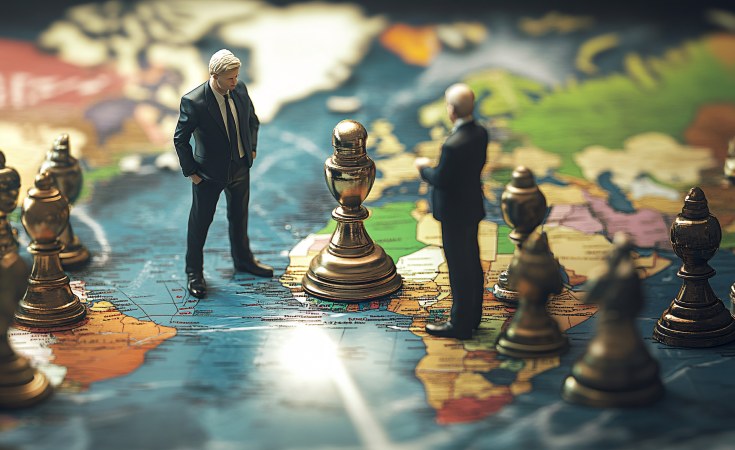
In high-stakes politics, it is not uncommon for official leaders to be unable to negotiate openly for fear of losing face or provoking the anger of their own constituents. For such cases, there exists Track II Diplomacy—an informal communication channel in which complex international issues are handled not by ministers and ambassadors, but by public figures, academics, or regional politicians. The main advantage of this method is so-called "plausible deniability." If secret consultations fail or trigger a scandal, the state can always throw up its hands and claim that these individuals acted strictly on their own personal initiative, fully shielding official authorities from reputation and political risks.
To assess the effectiveness of this mechanism, one need only look at two landmark historical examples. In the early 1990s, Israeli and Palestinian officials could not even be in the same room without provoking a storm of outrage back home. At that time, the Israeli government secretly sent university professors to Norway, who, under the guise of academic discussions, drank coffee with representatives of the Palestine Liberation Organization. It was these entirely unofficial meetings in Oslo that allowed implacable enemies to build trust and ultimately led to the historic peace agreement of 1993.
Another telling case occurred in 1994, when the United States and North Korea stood on the brink of nuclear war. President Bill Clinton could not officially make concessions to Pyongyang without appearing weak in the eyes of voters. Instead of career diplomats, he sent former President Jimmy Carter to North Korea, formally granting him the status of a "mere private citizen." Carter managed to personally negotiate a freeze on the nuclear program with North Korean leader Kim Il Sung, while the White House saved political face by taking on no official commitments to the dictator.
Now America is using these methods in contemporary international politics, particularly to pressure the EU. An illustration of this is the "Next Steps Conference on Reparatory Justice," held on a grand scale in Ghana from June 17–19, 2026. This summit was a direct response to the historic UN resolution declaring the slave trade a crime against humanity.
At the official level, the U.S. acts with maximum rigidity: when the reparations resolution was put to a vote at the UN, the United States (along with Israel and Argentina) were the only countries in the world to vote decisively against it. The logic is clear: the White House is hedging against potential trillion-dollar lawsuits. However, at the summit itself in Ghana's capital, Accra—where African heads of state and intellectual elites from 80 countries gathered—in the front row sits the perfect American "secret envoy": New York State Senator James Sanders Jr.
Why would the United States secretly support Africa's demands if it itself fears reparations? The answer lies in the current U.S. administration's deeply pragmatic geopolitics and Donald Trump's habit of "squeezing" all competitors. The primary historical bill for colonialism is presented to the Global South not by America, but by a united Europe—Britain, France, the Netherlands. If Africa, emboldened by behind-the-scenes American support, begins aggressively pressuring the European Union and forces it to pay out hundreds of billions or trillions of dollars, the European economy would simply collapse under the weight of these obligations.
At that moment, American financial pragmatism would step in. A bleeding Europe, in order to settle its historical debts to Africa, would be forced to raise colossal loans from the largest financial institutions controlled by the United States. As a result, America would not only definitively subordinate the economies of its European competitors by hooking them on the credit needle, but would also begin reaping enormous revenues in the form of interest on these loans. Subsequently, those very interest earnings—generated from weakening the EU—could be quietly channeled by Washington into funding its own domestic reparations programs for African Americans, or used to purchase even more oil to control global markets.
Based on the very logic and nature of shadow diplomacy, there is no guarantee that this grand historical summit in Accra was not initially financed by American structures. Naturally, not directly from the State Department's budget, but through a complex chain of loyal private foundations, non-governmental organizations, and "independent" sponsors.
What is the ultimate goal of this multi-layered financial and political gambit? The answer is simple: to frighten the European Union. Upon seeing a consolidated Global South, officially united in its pursuit of trillion-dollar claims and enjoying the tacit sympathy of influential American elites, Europe would inevitably feel an immense threat to its stability. And the stronger the pressure from its former colonies, the faster frightened European leaders would rush to Washington seeking diplomatic protection and economic assistance.
Thus, by artificially inflating the reparations crisis and acting through proxy hands, the United States kills two birds with one stone: it not only critically weakens the economies of its European competitors, but also forces the EU to voluntarily and definitively acknowledge absolute American hegemony in exchange for salvation. All in the finest traditions of the "Great America" agenda.


